
Cloudflare Unlocks Petabytes with Cache Compression

Alps Wang
Sep 13, 2026 · 1 views
Smart Compression for Edge Caching
Cloudflare's Cache Transcoding prototype is a compelling demonstration of intelligent optimization at the edge. By selectively compressing uncompressed text-based assets using Zstandard, they are effectively expanding their cache capacity without a proportional increase in hardware. The emphasis on compressing only what is beneficial (uncompressed text, >4KiB) and excluding already compressed or binary data is a pragmatic approach that minimizes CPU overhead while maximizing storage and bandwidth savings. The decision to use Zstandard, a modern and efficient algorithm, further underscores the technical rigor behind this initiative. This move directly addresses the ever-increasing demand for content delivery and the associated costs, offering a tangible benefit to their vast customer base.
However, the use of the term 'transcoding' for what is essentially lossless compression and decompression might lead to some semantic confusion among practitioners. While the underlying technical process is sound, the nomenclature could be clearer. Furthermore, the article touches upon the complexity introduced for range requests. The current approach of compressing the entire object and then decompressing for a partial read (if that's how it's handled) could indeed be less efficient than serving a pre-compressed file directly for range requests, potentially negating some of the benefits for specific content types. Further details on how range requests are managed in this new paradigm would be crucial for a complete understanding of its impact. The ongoing testing across various parameters is a positive sign that Cloudflare is committed to refining this feature based on real-world performance data.
Key Points
- Cloudflare is testing 'Cache Transcoding' to compress eligible uncompressed text content (HTML, JSON, CSS, JS).
- The goal is to significantly increase effective cache capacity by reducing storage requirements.
- Zstandard is used for lossless compression, offering a ~2.8x reduction in eligible content size.
- This reduces data transfer between data centers and allows existing servers to store more.
- The process involves compressing content once upon caching and decompressing upon serving, with minimal CPU overhead.
- Exclusions include range requests, precompressed, binary content, and responses with unknown sizes.
- A 4 KiB threshold avoids processing many small objects, sacrificing minimal eligible data.
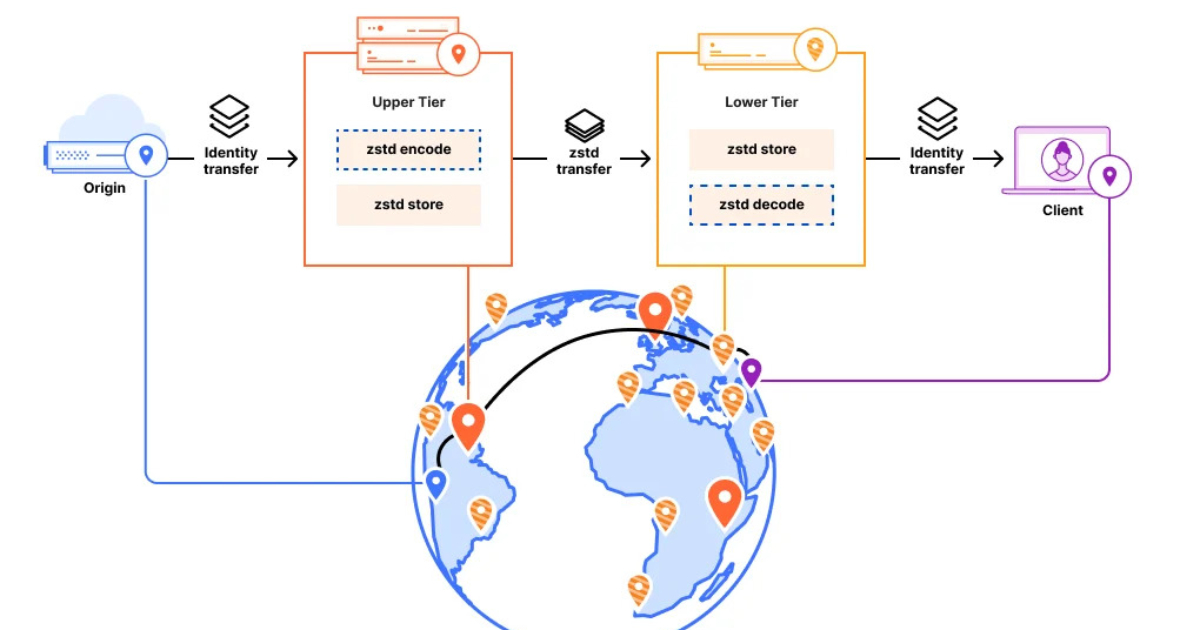
📖 Source: Cloudflare Tests Cache Transcoding to Reduce Storage Requirements
Related Articles
Comments (0)
No comments yet. Be the first to comment!