
Cloudflare's cdnjs Leap to Developer Platform

Alps Wang
Aug 15, 2026 · 1 views
Dogfooding at Gigabyte Scale
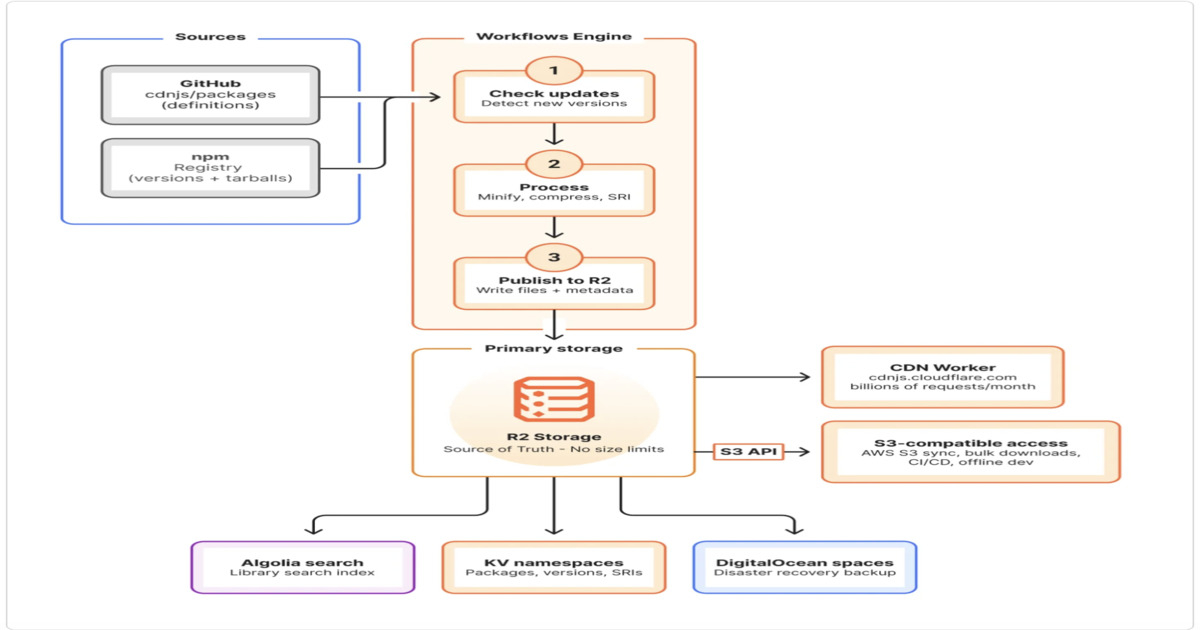
Cloudflare's migration of cdnjs to its Developer Platform is a compelling demonstration of 'dogfooding' – using their own products to power a critical, high-volume service. The move from a distributed infrastructure across Cloudflare and GCP to a unified platform leveraging Workers, R2, Workflows, Queues, Durable Objects, KV, and Containers is a significant technical achievement. The preservation of existing URLs and SRI hashes is crucial for backward compatibility and minimizes disruption for the millions of websites relying on cdnjs. The shift of R2 to become the source of truth for package files, with KV handling metadata, and Workers serving requests, creates a streamlined and potentially more cost-effective architecture. The use of Containers for compression, while a temporary workaround for memory limitations, highlights an area for future optimization, with the potential for streaming support to move this processing into Workers. The platform limit increases (subrequests and workflow steps) are a direct consequence of operating at this scale, indicating the platform's maturity and Cloudflare's commitment to supporting demanding use cases.
This migration offers several benefits. For developers, it means continued access to a reliable and performant JavaScript CDN with the assurance that its underlying infrastructure is robust and actively managed. For Cloudflare, it's a powerful validation of their Developer Platform, showcasing its ability to handle extreme loads and complex workflows. The implications extend to the broader ecosystem; by consolidating cdnjs onto their platform, Cloudflare is likely enhancing its own efficiency and potentially paving the way for new features or performance improvements for other services built on the same foundation. The fallback mechanism to DigitalOcean Spaces, while a safety net, also points to the ongoing evolution of cloud provider dependencies and the strategic importance of multi-cloud resilience. The successful handling of 9 billion requests daily with a high cache hit rate underscores the effectiveness of their architecture and caching strategies.
Key Points
- Cloudflare has successfully migrated its open-source JavaScript CDN, cdnjs, entirely to its Developer Platform.
- The new architecture leverages Workers, R2, Workflows, Queues, Durable Objects, KV, and Containers, replacing previous distributed infrastructure on Cloudflare and GCP.
- R2 now serves as the source of truth for published package files, with KV storing metadata and SRI hashes.
- Existing URLs, package contents, and SRI hashes have been preserved, ensuring backward compatibility.
- The service handles approximately 9 billion requests per day, demonstrating massive scalability.
- Cloudflare used Containers for compression due to memory constraints, with plans to explore streaming support for Workers.
- Platform limits were significantly raised (Worker subrequests to 10M, Workflow steps to 10K/25K) to accommodate this scale.
- This migration is a prime example of Cloudflare 'dogfooding' its own Developer Platform at a public service scale.
📖 Source: Cloudflare Migrates JavaScript CDN Serving 9B Requests a Day to Its Developer Platform
Related Articles
Comments (0)
No comments yet. Be the first to comment!