
Uber's Batching Boost: 30+ Ledger Updates/Sec

Alps Wang
Jun 5, 2026 · 1 views
Scaling Ledgers with Smart Batching
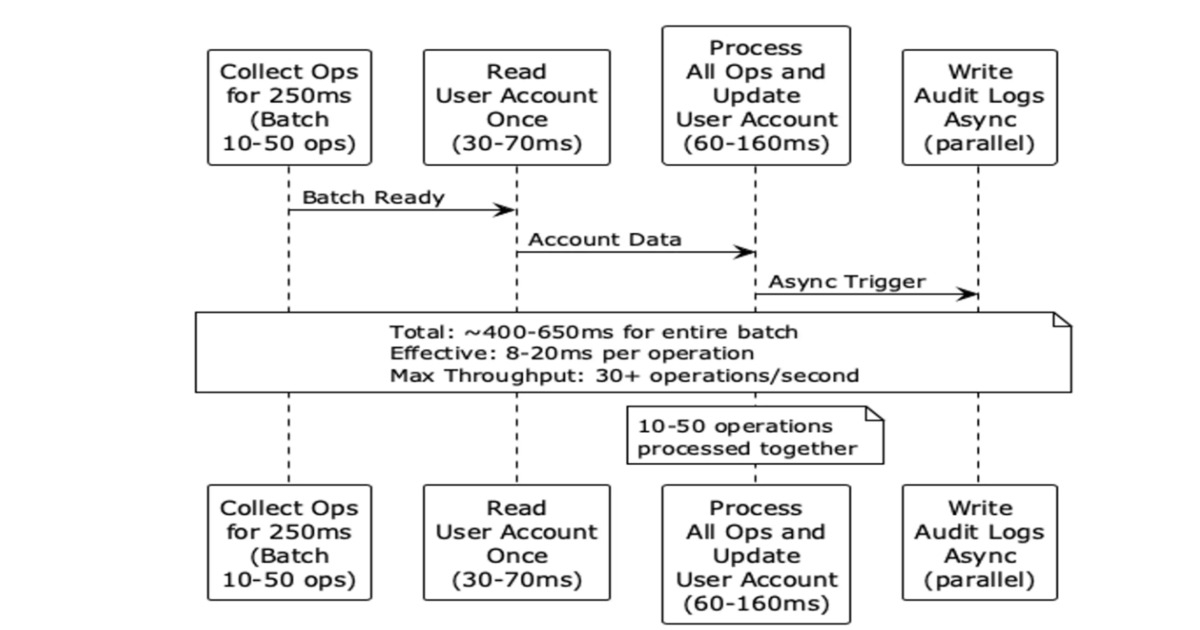
Uber's article details a critical architectural evolution in their financial ledger processing, moving from per-request overhead to a batching model to handle extreme write contention on individual accounts. The core innovation lies in aggregating updates within tight 250ms windows, leveraging Redis for coordination and optimistic atomic updates. This approach demonstrably cuts down processing times from hours to minutes for high-volume workloads, a significant feat for operational efficiency and financial reconciliation. The system's ability to maintain strict consistency and auditability while achieving such throughput is particularly noteworthy, showcasing a mature understanding of distributed systems challenges in a financial context. The emphasis on failure isolation at the operation level further enhances its robustness.
However, while the article highlights the benefits of batching, a deeper dive into the trade-offs between batching window size and end-to-end latency would have been beneficial. The article mentions this trade-off but doesn't quantify it or explain the specific heuristics used to arrive at the 250ms interval. Understanding how this interval impacts downstream consumers or the definition of 'near real-time' would add valuable context. Furthermore, while Redis is mentioned for coordination, the specifics of the 'optimistic atomic updates' mechanism, especially in a distributed ledger context, could benefit from more technical exposition. For instance, how does it handle potential conflicts when multiple batches targeting the same account are processed concurrently or near-concurrently within the Redis coordination layer, and how does it ensure atomicity across the ledger state itself?
This solution is directly applicable to any large-scale distributed system dealing with high-frequency financial transactions or any scenario where a subset of data experiences disproportionate write load. Companies operating e-commerce platforms, payment gateways, trading systems, or even large social networks with complex internal accounting could learn immensely from Uber's approach. The insights into optimizing database interactions, reducing overhead through aggregation, and maintaining data integrity under pressure are universally valuable for architects and engineers focused on performance and scalability in distributed environments.
Key Points
- Uber developed a high-throughput financial ledger processing system to handle concentrated write contention on individual accounts.
- The system processes over 30 updates per second per account by employing a batching-based execution model.
- Updates targeting the same account are aggregated into short time windows (approx. 250ms) and processed as a single atomic unit.
- Redis is used for coordination, and optimistic atomic updates ensure data correctness under concurrent access.
- This batching approach significantly reduces processing times for high-volume workloads, cutting multi-hour pipelines down to minutes.
- Key design considerations include the trade-off between batching window size and latency, and implementing failure isolation at the operation level.
📖 Source: 30+ Updates per Second per Account: Uber Scales Ledger Processing with Batching
Related Articles
Comments (0)
No comments yet. Be the first to comment!