
Google's Fleet-Wide A/B Testing Mastery

Alps Wang
Jun 4, 2026 · 1 views
Fleet-Scale Experimentation Unpacked
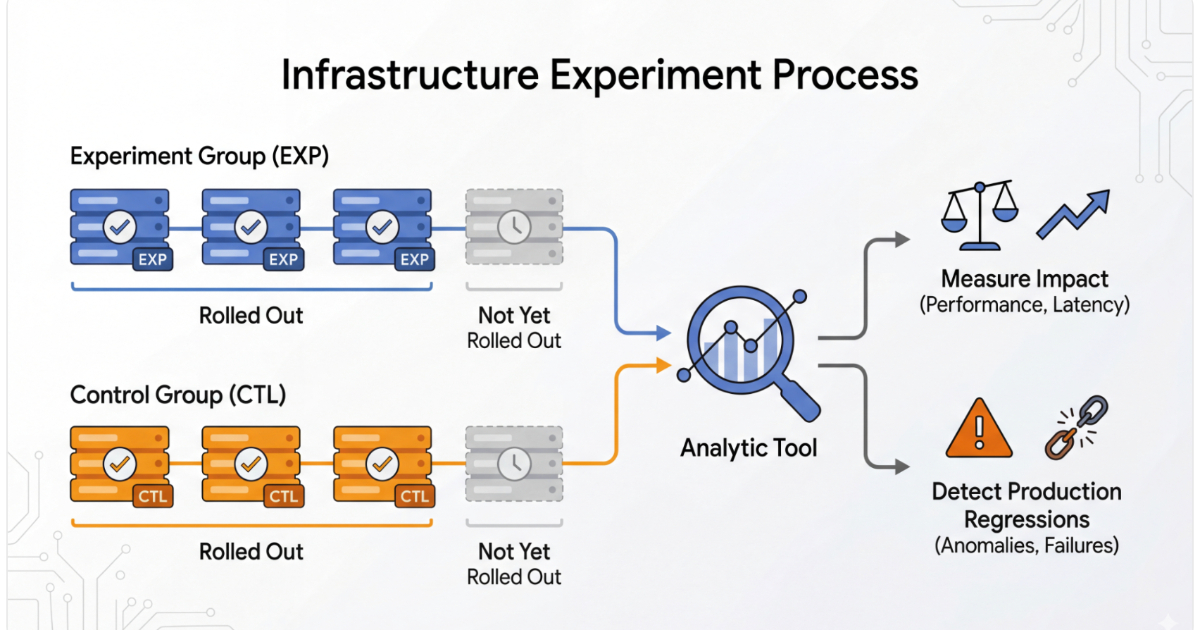
Google's detailed exposition on its fleet-wide A/B testing system reveals a mature and highly engineered solution designed to tackle the inherent complexities of large-scale distributed experimentation. The emphasis on a unified assignment layer, hierarchical allocation, deterministic bucketing, and robust exposure logging is particularly noteworthy. This approach directly addresses the common pitfalls of fragmented telemetry and inconsistent user assignment that plague large organizations, ensuring greater statistical rigor and trustworthiness in experimental results. The system's ability to propagate configurations for local evaluation in serving systems is a critical enabler for high-throughput environments, minimizing latency and runtime dependencies. This infrastructure-centric view, treating the data center as a laboratory, is a powerful testament to Google's commitment to data-driven decision-making at scale.
From an AI and database perspective, this system's implications are profound. For AI development, reliable and consistent experimentation is paramount for model iteration, feature evaluation, and understanding user impact. A standardized framework like this ensures that AI model performance metrics derived from A/B tests are accurate and comparable across different services and user journeys. For database systems, the ability to perform fleet-wide experiments directly influences how database features, performance optimizations, and new functionalities are rolled out and validated. The rigorous measurement and exposure logging are essential for understanding the real-world impact of database changes on application performance and user experience. While the article doesn't delve into the specific database technologies used for logging or analytics, the sheer scale implies sophisticated data warehousing and processing capabilities, likely involving distributed databases and advanced stream processing for real-time telemetry aggregation and analysis. The challenge of managing combinatorial explosion of experiments and ensuring isolation remains a constant, even with hierarchical allocation, but Google's layered approach appears to be a robust mitigation strategy.
The primary beneficiaries of such a system are large technology companies with complex, interconnected service fleets that rely heavily on iterative product development and data-driven insights. It provides a blueprint for how to achieve consistency, reliability, and statistical validity in experimentation across vast infrastructure. For smaller organizations, it highlights the core principles of robust experimentation: centralized control, deterministic assignment, accurate exposure measurement, and integration with analytics. While direct replication might be infeasible due to scale and proprietary infrastructure, the architectural patterns and design philosophies are highly instructive. The system minimizes operational overhead for product teams by abstracting away much of the complexity of experimentation, allowing them to focus on hypothesis generation and analysis. This ultimately leads to faster iteration cycles and increased confidence in product decisions across Google's vast ecosystem.
Key Points
- Google employs a unified, fleet-wide A/B experimentation system to ensure consistent and reliable testing across its massive global service fleet.
- Key components include a centralized experimentation framework, a unified assignment layer with hierarchical allocation, and deterministic user/request bucketing.
- The system emphasizes exposure logging to accurately distinguish between assigned and truly exposed populations, enhancing metric reliability.
- Configuration propagation to serving systems enables local evaluation, reducing latency and runtime dependencies in high-throughput environments.
- The approach treats the data center as a laboratory, integrating experimentation infrastructure tightly with analytics pipelines for end-to-end user journey analysis.
- This standardization reduces operational overhead for product teams, accelerating iteration cycles and increasing confidence in product decisions.
📖 Source: Inside Google’s System for Coordinated A/B Testing Across Its Global Service Fleet
Related Articles
Comments (0)
No comments yet. Be the first to comment!