
Pinterest's CDC Overhaul: 24-Hour Latency to 15 Minutes

Alps Wang
Feb 27, 2026 · 1 views
Real-Time Data at Scale
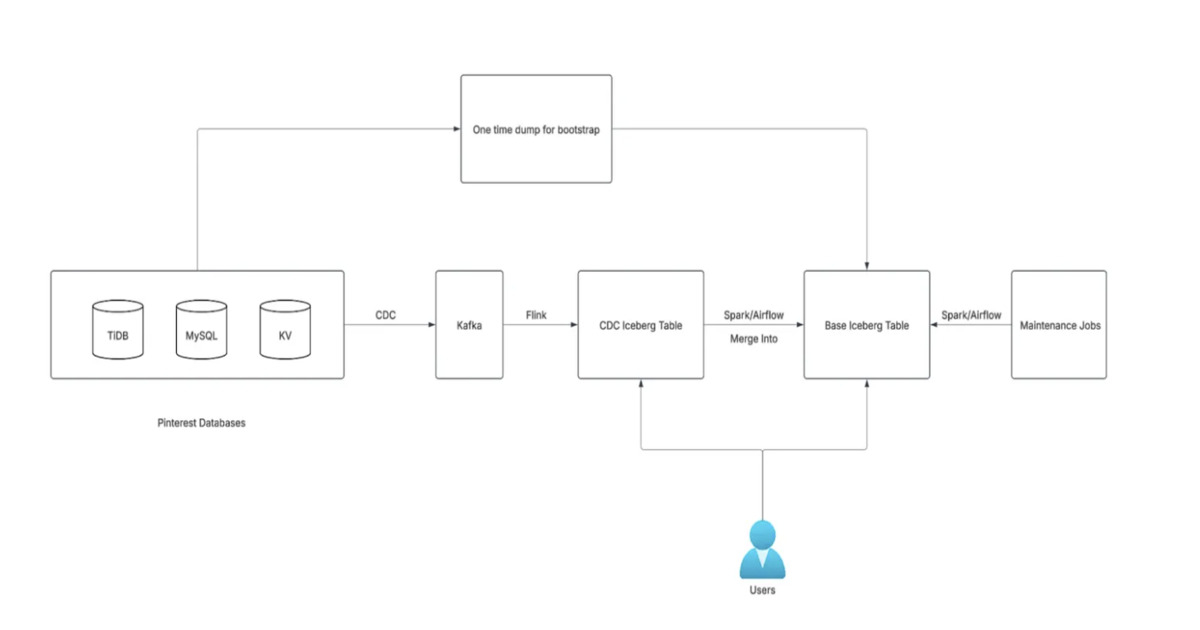
Pinterest's adoption of a Change Data Capture (CDC) powered ingestion framework represents a significant leap forward in real-time data availability and operational efficiency. The transition from monolithic, batch-heavy pipelines to a more granular, event-driven architecture using Debezium/TiCDC, Kafka, Flink, and Iceberg addresses critical pain points like high latency, resource wastage from full-table scans, and difficulties with data modifications. The measured outcome of reducing latency from over 24 hours to 15 minutes is a testament to the effectiveness of this approach. The choice to standardize on Merge on Read (MOR) for Iceberg tables, despite the initial complexity, demonstrates a pragmatic approach to managing petabyte-scale data and infrastructure costs, highlighting the trade-offs between storage and compute. The generic nature of the framework, supporting multiple database types and being configuration-driven, is also a major strength, suggesting broad applicability.
While the article emphasizes the successes, potential limitations or areas for further exploration could include the complexity of managing such a heterogeneous technology stack. The integration of Debezium/TiCDC, Kafka, Flink, and Spark, while powerful, can introduce significant operational overhead and require specialized expertise. The mention of 'at-least-once delivery guarantees' implies that deduplication logic is crucial, and while Spark jobs handle this, ensuring idempotency and robust error handling across such a distributed system remains a constant challenge. The future focus on automated schema evolution is a wise one, as this is often a bottleneck in large-scale data pipelines. The success here would be a significant win for maintainability and agility. Overall, this is a valuable case study for any organization struggling with similar data ingestion challenges at scale, particularly those in e-commerce, social media, or any domain requiring near real-time analytics and feature updates.
Key Points
- Pinterest replaced legacy batch-based ingestion with a CDC-powered framework.
- This reduced data latency from over 24 hours to 15 minutes.
- The new architecture uses Debezium/TiCDC, Kafka, Flink, Spark, and Iceberg.
- It processes only changed records, leading to significant cost savings.
- Iceberg's Merge on Read (MOR) strategy was chosen for efficiency at petabyte scale.
- The framework is generic, supporting MySQL, TiDB, and KVStore, and is configuration-driven.
- Future work includes automated schema evolution.
📖 Source: Pinterest’s CDC-Powered Ingestion Slashes Database Latency from 24 Hours to 15 Minutes
Related Articles
Comments (0)
No comments yet. Be the first to comment!