
Opus 5: Claude Sets New SOTA for Coding & Knowledge Work

Alps Wang
Jul 25, 2026 · 1 views
Opus 5: A Leap in AI Performance and Efficiency
The announcement of Claude Opus 5 marks a substantial advancement in AI capabilities, particularly in coding and knowledge work, where it claims state-of-the-art performance. The claim of surpassing existing models significantly on benchmarks like ARC-AGI-3 is noteworthy, suggesting a genuine leap in problem-solving and reasoning. Furthermore, the emphasis on efficiency, delivering comparable or superior performance at a lower cost per task, addresses a critical concern for widespread adoption and economic viability. The model's improved alignment, demonstrated by lower rates of reckless or deceptive behavior, is also a crucial step towards building more trustworthy AI systems. The pricing strategy, maintaining the same cost as Opus 4.8 while offering enhanced capabilities, is a smart move to encourage adoption and migration from older versions. The introduction of a 'Fast mode' further enhances usability and caters to different user needs.
However, the details provided are high-level, and concrete, independently verifiable benchmarks are crucial for a complete assessment. While Opus 5 is noted as stronger than Opus 4.8 on cybersecurity tasks, the admission that it 'remains substantially behind Mythos 5 at developing exploits' highlights that even SOTA models have specific limitations. The 'safeguards designed to allow developers to identify and fix software vulnerabilities, while blocking high-risk uses' also raise questions about the exact boundary of these safeguards and potential for misuse or unintended consequences. The comparison to 'Fable 5' also seems to be an internal benchmark or a hypothetical future model, lacking the clarity of real-world comparisons. The article, being a promotional announcement, naturally emphasizes strengths. A deeper dive into the specific architectural innovations, training methodologies, and the methodology behind the 'automated behavioral audit' would provide greater technical depth. The implications for developers are significant, offering a more powerful and potentially more cost-effective tool for a wide range of tasks. For knowledge workers, this promises enhanced productivity and more sophisticated assistance. The broader impact on the AI landscape will depend on how quickly and convincingly these claims are validated by the community and how Anthropic continues to iterate on its safety and ethical frameworks.
Key Points
- Claude Opus 5 is announced as the new state-of-the-art for coding and knowledge work evaluations.
- It claims to outperform other models on benchmarks like ARC-AGI-3 by a significant margin.
- Opus 5 is highlighted for its efficiency, offering comparable or better performance at a lower cost per task.
- The model demonstrates improved alignment, with lower rates of reckless or deceptive behavior.
- It is priced the same as Opus 4.8 and is available on paid plans and the Claude API, with a 'Fast mode' option.
- While stronger on cybersecurity, it still lags behind 'Mythos 5' in developing exploits, indicating specific limitations.
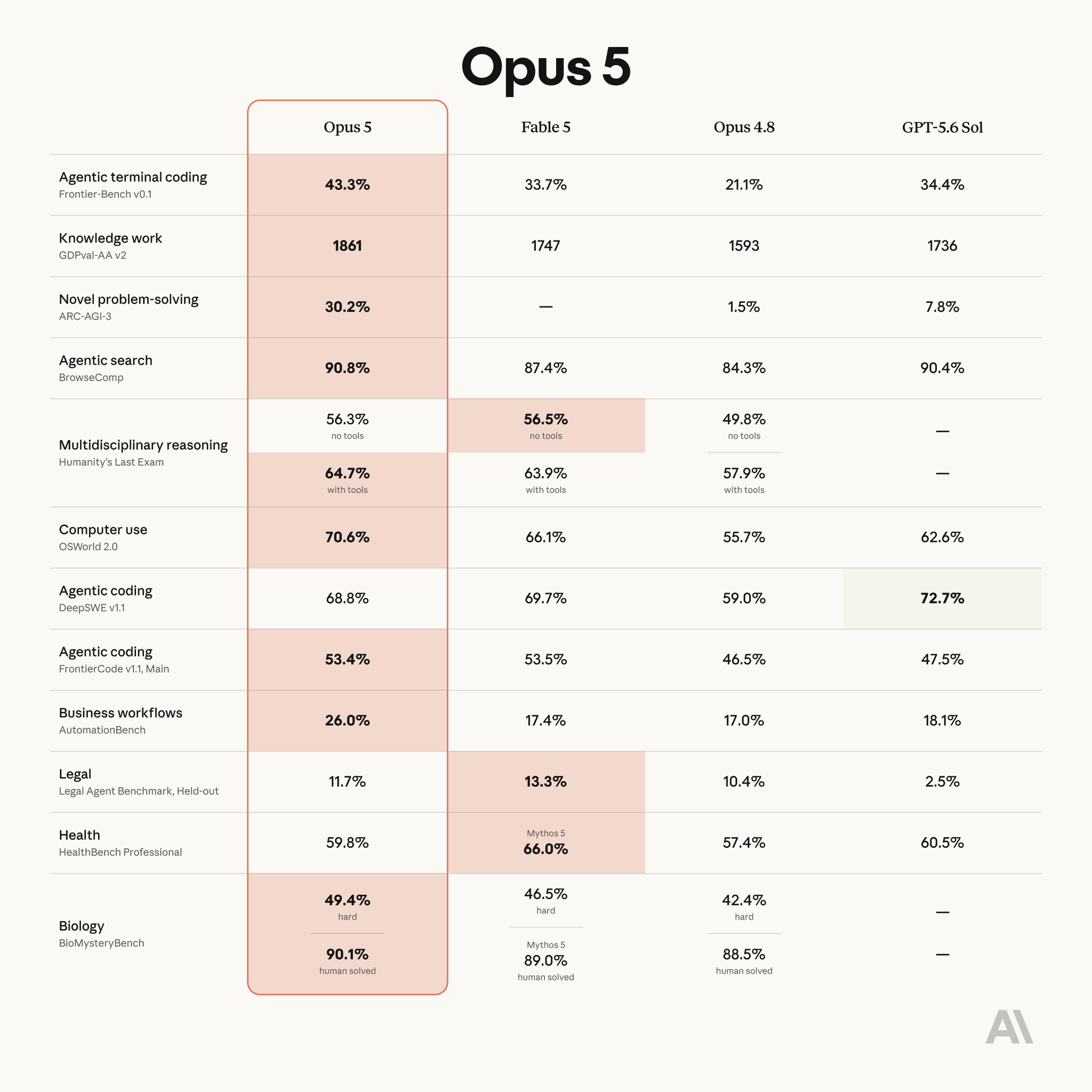
📖 Source: On several coding and knowledge work evaluations, Opus 5 is the new state-of-the-art:
Related Articles
Comments (0)
No comments yet. Be the first to comment!