
Claude Opus 5: AGI Benchmark Domination

Alps Wang
Jul 25, 2026 · 1 views
Opus 5: A Leap in Problem Solving
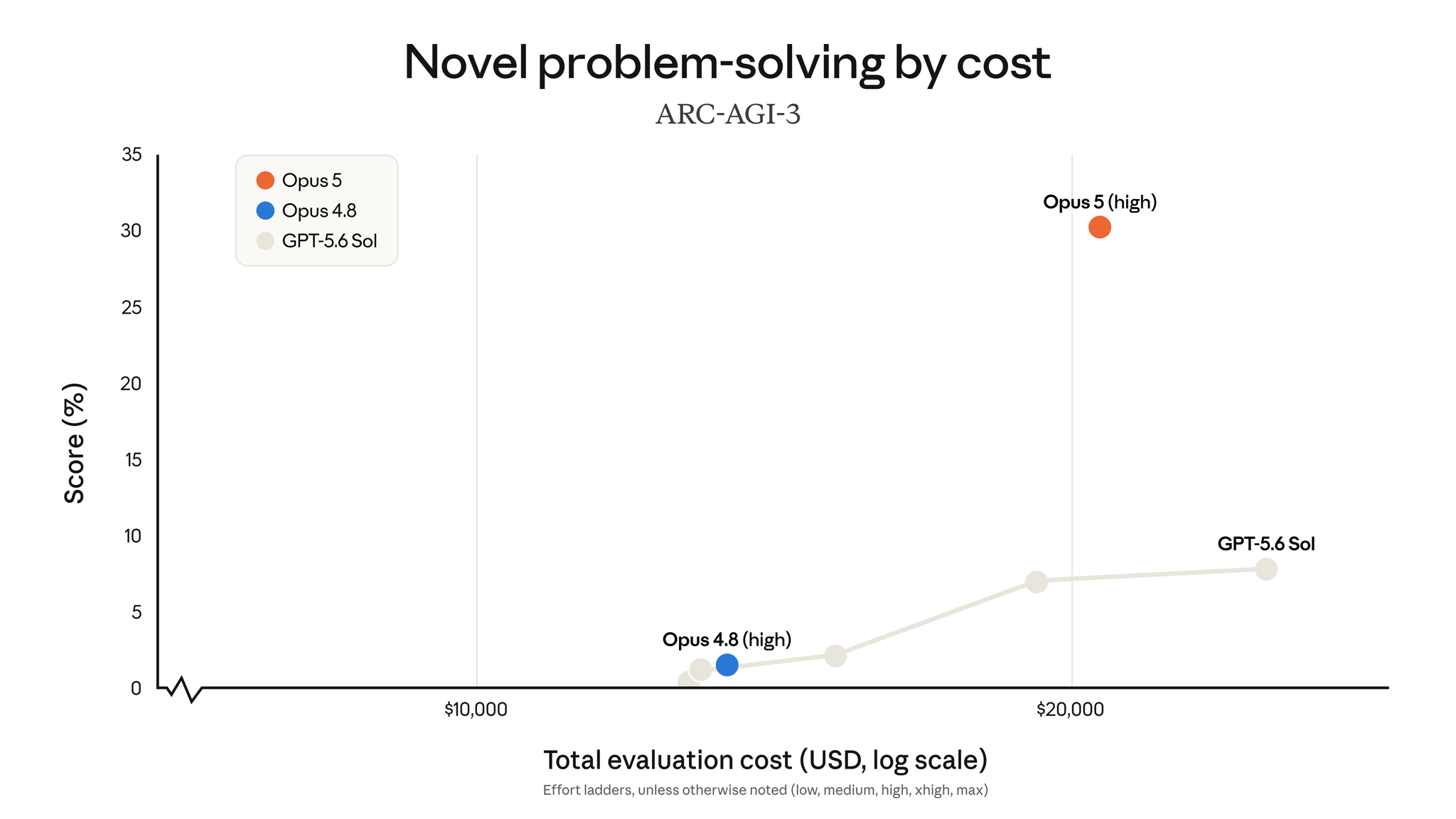
Anthropic's release of Claude Opus 5 marks a significant advancement in large language model capabilities, particularly highlighted by its performance on the ARC-AGI-3 benchmark. This evaluation, designed to test novel problem-solving, is notoriously challenging and a strong indicator of true reasoning ability beyond pattern matching. Achieving a score three times higher than the next best model suggests a substantial leap in the model's capacity for abstract thought and generalization. Furthermore, the claim of being state-of-the-art on several coding and knowledge work evaluations, coupled with competitive pricing (same as Opus 4.8), positions Opus 5 as a compelling option for both individual users and enterprises. The emphasis on being 'thoughtful and proactive' and 'most aligned' also addresses critical concerns around AI safety and reliability, which are paramount for broader adoption. This release directly challenges the existing AI landscape and sets a new bar for what can be expected from LLMs in terms of both raw intelligence and practical application.
However, it's crucial to approach these claims with a degree of analytical rigor. While the ARC-AGI-3 score is impressive, the exact methodology and the 'novelty' of the problems within the evaluation need further scrutiny to understand the depth of the breakthrough. The comparison to 'frontier intelligence of Fable 5' is intriguing but lacks specific benchmarks, making it difficult to quantify the exact gap closed. The cybersecurity performance, while improved, still lags behind 'Mythos 5' in exploit development. This highlights that even with significant progress, specialized capabilities remain areas of active research and development. The pricing strategy, while beneficial to users, might also indicate Anthropic's confidence in the model's efficiency and scalability. The 'Fast mode' also offers flexibility, catering to different user needs. Overall, Opus 5 represents a substantial step forward, but ongoing independent evaluations and deeper dives into its architectural innovations will be necessary to fully grasp its long-term implications for the AI industry, particularly in the pursuit of Artificial General Intelligence.
Key Points
- Claude Opus 5 achieves state-of-the-art performance on several coding and knowledge work evaluations.
- It scores three times higher than the next best model on the ARC-AGI-3 benchmark, indicating significant progress in novel problem-solving.
- Opus 5 is priced the same as Opus 4.8, offering a strong cost-performance advantage.
- The model is described as 'thoughtful and proactive' and is Anthropic's most aligned model to date, showing reduced rates of reckless or deceptive behavior.
- While stronger on cybersecurity tasks than Opus 4.8, it still trails in exploit development compared to 'Mythos 5'.
- A 'Fast mode' is available, running approximately 2.5 times the default speed.
Related Articles
Comments (0)
No comments yet. Be the first to comment!