
Netflix's Real-Time Service Map: A Distributed System's Living Blueprint

Alps Wang
May 30, 2026 · 1 views
Unpacking the Service Topology
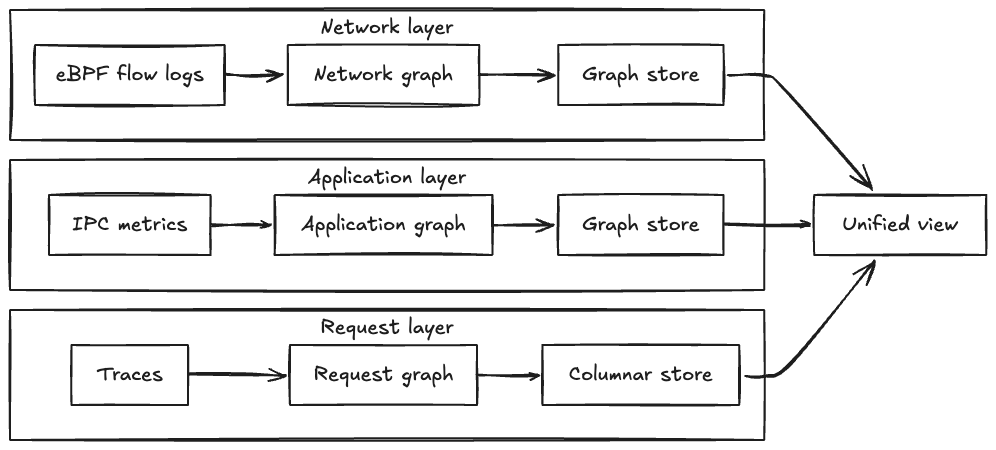
Netflix's Service Topology initiative represents a sophisticated solution to a pervasive problem in large-scale microservice architectures: understanding dynamic interdependencies. The core innovation lies in its multi-source approach, leveraging eBPF for network-level truth, IPC metrics for application-level detail, and distributed tracing for runtime behavior. This triangulation provides a robust and comprehensive view, addressing the limitations inherent in any single data source. The emphasis on real-time updates and sub-second query performance is crucial for effective incident response and operational agility in an environment with frequent deployments. The architecture's ability to merge these disparate views into a unified, yet independently explorable, graph is a significant engineering feat, showcasing advanced data processing and graph database utilization. The focus on providing both visual and programmatic access further enhances its utility for engineers and automation systems alike.
However, the article implicitly highlights challenges that could be a concern for organizations considering similar implementations. The reliance on eBPF, while powerful, requires kernel-level access and understanding, potentially limiting adoption in more restricted environments. The complexity of integrating and reconciling data from three distinct sources—each with its own sampling, granularity, and potential for incompleteness—demands a high degree of engineering maturity and robust data validation pipelines. While Netflix has the scale and resources to manage this, smaller organizations might find the operational overhead substantial. Furthermore, the article touches on the 'unknown' service issue, suggesting that even with this advanced system, complete visibility isn't always guaranteed, underscoring the ongoing nature of observability challenges in highly distributed systems. The success of this system hinges on meticulous data quality and continuous refinement of the aggregation and resolution logic, especially when dealing with network intermediaries.
Key Points
- Netflix built a real-time Service Topology map to address the challenge of understanding dependencies in its vast microservice architecture.
- The system combines data from three sources: eBPF network flows (network layer), IPC metrics (application layer), and end-to-end tracing (request layer) to create a unified view.
- Key requirements included real-time updates, fast queries at scale, multiple layers of detail, rich context, and both visual and programmatic access.
- The architecture uses a multi-stage aggregation pipeline to resolve network intermediaries and reconstruct direct application-to-application paths.
- The Service Topology map helps engineers visualize dependencies, troubleshoot faster, understand blast radius, and pinpoint the source of issues.
- The system provides a living map that updates dynamically as services deploy and traffic patterns shift.
📖 Source: From Silos to Service Topology: Why Netflix Built a Real-Time Service Map
Related Articles
Comments (0)
No comments yet. Be the first to comment!