
ClickHouse AI Notebooks: SREs Get an AI Copilot

Alps Wang
May 28, 2026 · 1 views
AI-Powered Observability: A Collaborative Leap
The introduction of AI Observability Notebooks for Managed ClickStack represents a thoughtful evolution in how engineers interact with complex data for system monitoring and debugging. The emphasis on a 'notebook' paradigm, mirroring established practices in data science and exploratory analysis, is a key strength. This approach moves beyond simplistic chat interfaces, embedding AI as a collaborative partner within a structured, persistent workspace. The ability for engineers to remain in control, inspect AI reasoning, modify queries, and branch investigations is crucial for building trust and ensuring practical utility in high-stakes SRE workflows. The integration with ClickStack's internal APIs, allowing the AI to leverage optimized investigative primitives rather than just raw SQL generation, is a technically sophisticated and promising direction, promising performance benefits and consistency. The focus on transparency, with visible workflows and editable steps, directly addresses potential concerns about 'black box' AI in critical systems.
However, the current private preview status indicates that the feature is still maturing. While the 'last write wins' model for shared notebooks is understandable in early stages, true concurrent editing will be essential for broader team adoption. The reliance on Anthropic's Claude models, while a strong choice, ties the feature to a specific LLM provider, which might be a consideration for organizations with multi-LLM strategies or vendor lock-in concerns. Furthermore, the effectiveness of AI-assisted investigations is heavily dependent on the quality and completeness of the underlying observability data (logs, metrics, traces) within ClickStack. The article hints at future extensions, such as exposing MCP servers and customizable global context, which will be critical for broadening its appeal and utility beyond the immediate SRE use case. The success will ultimately hinge on how seamlessly these AI capabilities augment, rather than disrupt, established engineering workflows and how effectively the AI can handle the nuances and edge cases inherent in complex production environments.
Key Points
- Introduces AI Observability Notebooks for Managed ClickStack, embedding AI directly into SRE workflows.
- Features a notebook-based, persistent workspace for step-by-step investigations, enhancing transparency and control.
- Allows engineers to collaborate with AI (Anthropic's Claude models) as a partner, exploring logs, metrics, and traces.
- Engineers can inspect AI reasoning, run/edit ClickHouse queries, and branch investigative paths.
- Integrates deeply with ClickStack's internal APIs, leveraging optimized investigative primitives for performance.
- Designed for human oversight, with visible workflows and the ability to refine or override AI-generated steps.
- Supports branching workflows to explore alternative hypotheses independently.
- Built for collaboration, with future plans for concurrent editing and improved sharing.
- ClickHouse is positioned as an open foundation for AI-driven observability platforms.
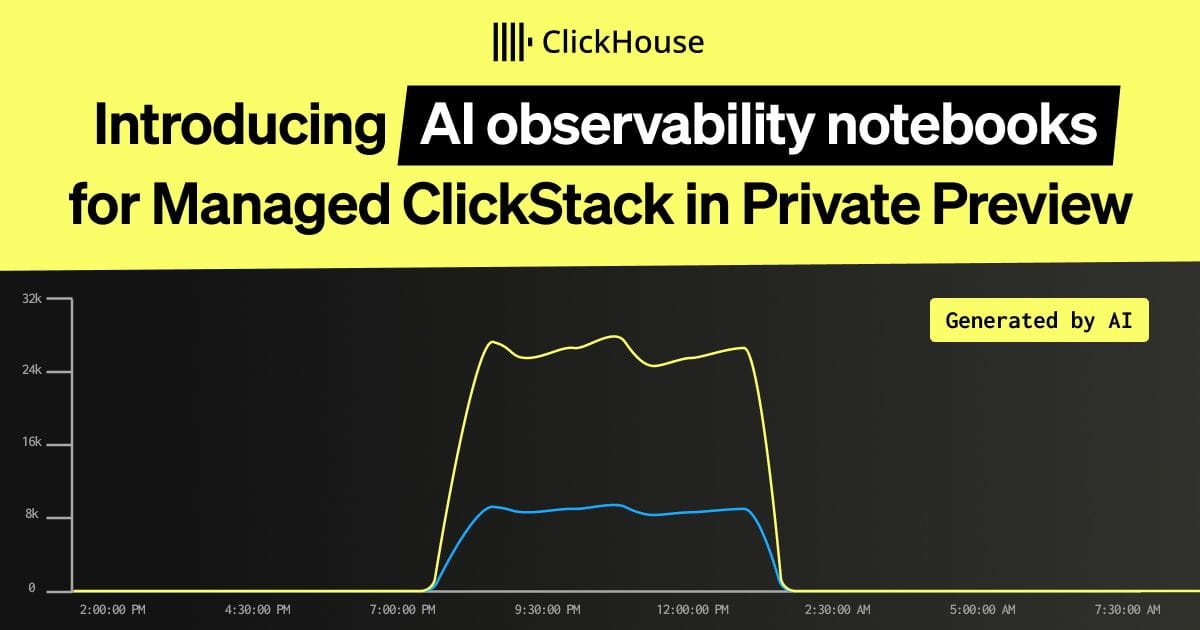
📖 Source: Introducing AI observability notebooks for Managed ClickStack in Private Preview
Related Articles
Comments (0)
No comments yet. Be the first to comment!