
Netflix's Cloud Pipeline: Taming Raw Footage

Alps Wang
Jun 19, 2026 · 1 views
Scaling Media's Digital Frontier
Netflix's detailed description of its scalable media processing pipeline offers a compelling case study in tackling the immense challenges of handling raw production footage. The strategic decision to leverage the FilmLight API rather than building a fully proprietary solution is a significant insight, demonstrating a pragmatic approach to specialized media tasks while retaining control over orchestration, scalability, and workflow consistency. This hybrid model allows Netflix to benefit from industry-standard, robust media manipulation capabilities while focusing its engineering efforts on the unique demands of a global streaming platform. The emphasis on a distributed, container-based, stateless execution environment for processing is crucial for achieving the required elasticity and cost-efficiency, especially given the highly variable nature of production workloads. This architecture directly addresses the 'production scale challenges' mentioned, including inconsistent formats and fragmented tools, by imposing a unified processing approach and metadata schema. The focus on automation and reducing manual intervention is a clear win for operational efficiency and creative team productivity.
However, the article could benefit from further elaboration on the specific AI/ML components, if any, that are integrated into this pipeline beyond general 'AI' mentions. While the pipeline itself is a marvel of engineering, the article's title and the broader context of ByteJourney.org suggest a stronger emphasis on AI's role. Understanding how AI might be used for tasks like automated quality control, metadata enrichment, or even predictive analysis of processing needs would add another layer of depth. Additionally, while ACES is mentioned for color management, a deeper dive into how the pipeline handles different codecs and their associated complexities could be valuable. The 'stateless execution model' is a strong architectural choice for scalability, but it raises questions about state management for complex, multi-stage media transformations, which would be interesting to explore further. The reliance on FilmLight, while strategic, also introduces a dependency that could be a point of discussion regarding vendor lock-in and future flexibility. Overall, the article provides a solid foundation for understanding Netflix's approach to media processing at scale, but future iterations could delve deeper into the AI integration and the nuances of managing highly complex, distributed media workflows.
Key Points
- Netflix has developed a scalable, cloud-based media processing pipeline for raw camera footage.
- The system ingests, validates, extracts metadata, and transforms media into standardized formats for editorial, VFX, and color workflows.
- It addresses challenges of inconsistent camera formats, fragmented tools, and manual file handling across global production teams.
- The pipeline leverages the FilmLight API for specialized media processing tasks like debayering and color transformations.
- Netflix focuses on orchestration, scalability, and workflow consistency, using a distributed, container-based, stateless execution environment.
- Metadata is normalized into a unified schema to ensure consistent interpretation of media assets across systems.
- ACES standards are applied for consistent color representation across different tools and workflows.
- The architecture emphasizes elasticity, scaling processing capacity dynamically based on demand.
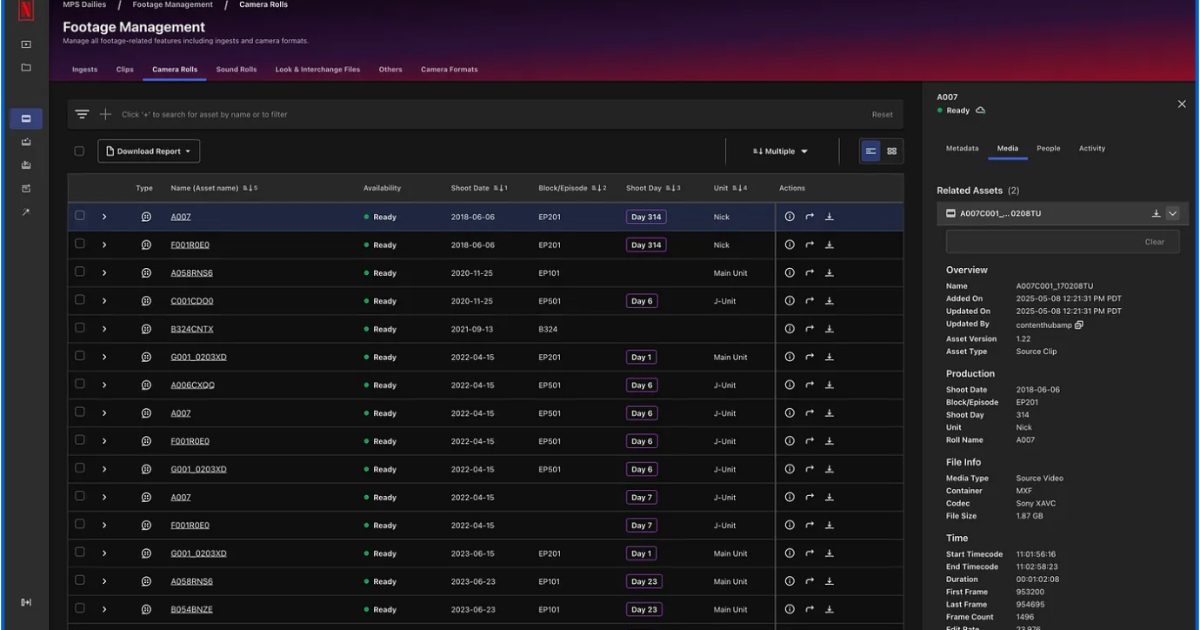
📖 Source: From Camera to Cloud: Netflix’s Scalable Media Processing Pipeline
Related Articles
Comments (0)
No comments yet. Be the first to comment!