
Netflix Slashes Cassandra Latency with Dynamic Partition Splitting

Alps Wang
Jul 7, 2026 · 1 views
Unlocking Cassandra's Time-Series Potential
Netflix's achievement in reducing Cassandra read latency from seconds to milliseconds for oversized time-series partitions is a significant technical feat with broad implications for databases handling similar workloads. The dynamic partition-splitting mechanism, by automating the division of large partitions without application changes or downtime, tackles a fundamental scalability challenge in Cassandra. This is particularly noteworthy because traditional approaches often involve costly and disruptive re-architectures. The focus on operational safety, including retaining the original partition during migration and employing rigorous validation, is a testament to robust engineering practices in a production environment. The reported improvements in latency, timeouts, CPU utilization, and thread queueing paint a clear picture of the tangible benefits realized, making this a highly relevant case study for any organization relying on Cassandra for time-series data.
However, while the initial implementation focused on immutable partitions for safety, the article hints at future support for mutable wide partitions. This evolution will be critical for broader adoption and for handling even more dynamic scenarios. A potential concern for other organizations might be the complexity of implementing and managing such a sophisticated metadata layer and asynchronous pipeline. The article doesn't delve deeply into the operational overhead or the specific tooling required to monitor and maintain this dynamic splitting system. Furthermore, while it addresses oversized partitions, the effectiveness and potential impact on smaller, unaffected partitions, or the overall cluster balance during the splitting process, could be further explored. Nonetheless, the core innovation of transparently evolving partition structures to maintain performance is a powerful concept.
Key Points
- Netflix dramatically reduced Cassandra read latency for oversized time-series partitions from seconds to low double-digit milliseconds.
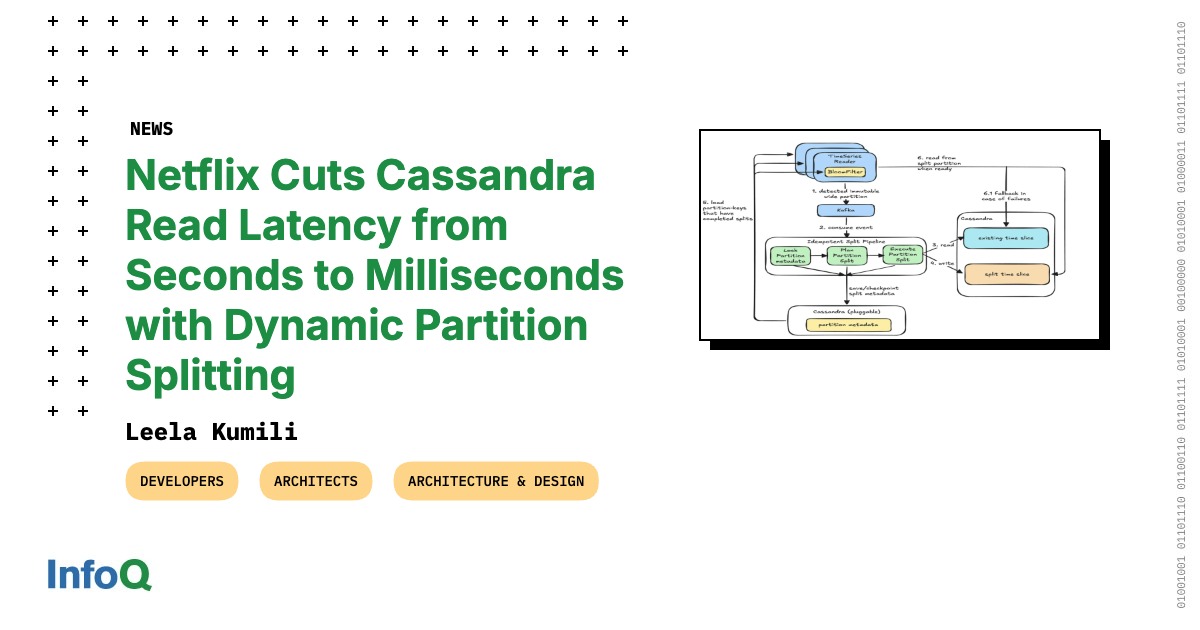
- A dynamic partition-splitting mechanism was developed for Netflix's TimeSeries Abstraction platform.
- The system automatically splits growing partitions into smaller child partitions without application changes or downtime.
- This addresses performance degradation, compaction overhead, memory pressure, and uneven load distribution caused by large partitions.
- Operational safety was a key consideration, with the original partition retained during migration and robust validation mechanisms employed.
- Benefits include reduced read timeouts, lower CPU utilization, and minimal thread queueing across production clusters.
📖 Source: Netflix Cuts Cassandra Read Latency from Seconds to Milliseconds with Dynamic Partition Splitting
Related Articles
Comments (0)
No comments yet. Be the first to comment!