
Netflix Commerce: From DVDs to Global Scale

Alps Wang
Aug 28, 2026 · 1 views
Evolving a Global Commerce Engine
Kasia Trapszo's presentation provides a compelling narrative of Netflix's commerce architecture evolution, highlighting the critical tension between business agility and technical debt. The shift from a U.S.-centric, credit-card-based model to a global, multi-payment-method reality is a masterclass in iterative system design. The key takeaway is that architecture isn't static; it's a living entity that must continuously adapt to evolving business needs, regulatory landscapes, and user behaviors. The challenges faced, such as integrating diverse payment methods like direct debit and prepaid cards, and managing delayed payment confirmations, are universal for any company aiming for international expansion. The presentation effectively illustrates how initial, seemingly simple assumptions, like real-time payment validation, can become significant architectural bottlenecks when confronted with global diversity.
One notable aspect is the discussion around the 'Qwikster' incident, where system changes persisted even after a business rollback. This serves as a powerful reminder of the long-term consequences of architectural decisions and the importance of strong alignment between business strategy and technical implementation. The move from a monolithic architecture to domain-driven decomposition, implied by the need to handle different business units and entitlements, is a common and necessary path for scaling. However, the presentation doesn't delve deeply into the specific decomposition strategies or the challenges of managing inter-service communication and data consistency in such a complex, evolving system. While the focus is on commerce, the implications for data management, particularly around payment processing, fraud detection, and entitlement state across a globally distributed user base, are immense and warrant further exploration. The reliance on batch processing for certain payment methods and the shift in fraud detection to behavioral analysis over time are significant technical shifts with ongoing implications for data pipelines and analytical infrastructure. The audience would benefit from more details on how these hybrid real-time/batch systems are managed for reliability and how the data infrastructure supports the evolving fraud detection mechanisms.
Key Points
- Netflix's commerce architecture evolved from a U.S. DVD mail-order business to a global streaming service.
- The expansion to 130 countries simultaneously in 2016 was a critical inflection point, revealing the limitations of the existing architecture.
- International expansion exposed fundamental differences in payment behaviors (e.g., debit cards vs. credit cards, direct debit) and regulatory requirements, breaking initial U.S.-centric assumptions.
- The introduction of direct debit necessitated a shift from a purely real-time to a hybrid real-time/batch processing model, impacting entitlement decisions and fraud detection.
- Architectural evolution is driven by business evolution and must occur while the system is live, often involving messy trade-offs.
- The 'Qwikster' incident highlights how system changes can persist even after business decisions are reversed, creating long-term architectural complexity.
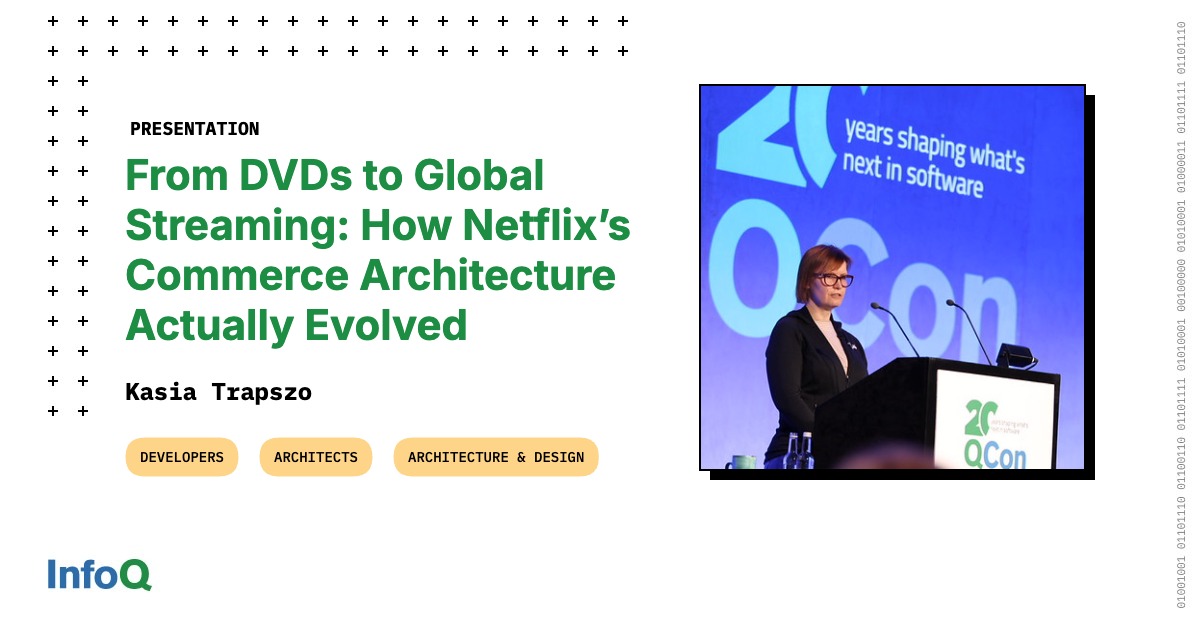
📖 Source: Presentation: From DVDs to Global Streaming: How Netflix’s Commerce Architecture Actually Evolved
Related Articles
Comments (0)
No comments yet. Be the first to comment!