
Harper's Unified Stack: A Benchmark Breakthrough

Alps Wang
Aug 20, 2026 · 1 views
The Case for Co-location
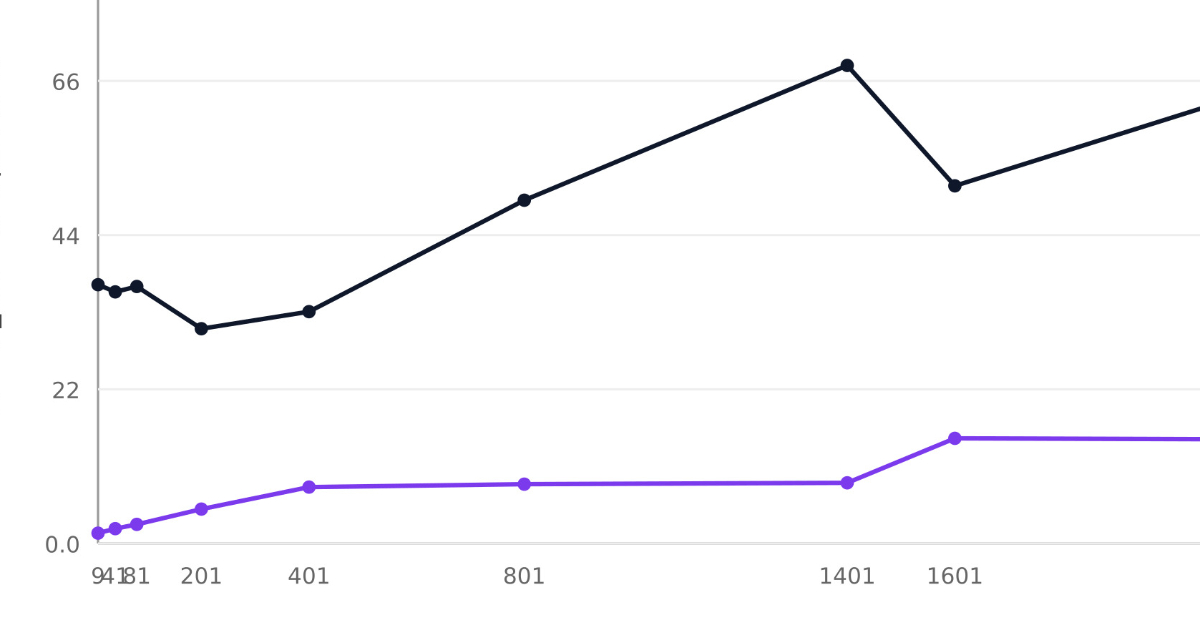
The core insight from Harper's release and benchmark is a strong argument for a co-located, single-runtime architecture, especially for live, personalized data workloads. By collapsing application code, data, and messaging into a single system, Harper claims significant performance gains, measured at up to 14x faster in-process data access compared to a multi-system, networked approach like Vercel's stack. This directly challenges the prevailing trend of decoupling compute and storage, as exemplified by Databricks' Lakebase. Harper's benchmark, while limited to specific scenarios, effectively highlights the latency penalties and operational overhead introduced by network hops between disparate services (database, cache, job runner). The release of version 5.2, with its new record cache and isolated commit paths, further addresses performance bottlenecks and improves throughput, making the co-located approach more robust.
However, it's crucial to acknowledge the limitations and workload dependency of Harper's claims. The benchmark explicitly states that Vercel's serverless autoscaling outperforms Harper's single free node under high concurrency and for cache-heavy edge delivery. This suggests that Harper's unified approach excels in scenarios demanding real-time data freshness and low-latency personalized reads, but might not be the optimal choice for highly distributed, cache-centric applications or those with extreme, spiky concurrency needs where serverless excels. The benchmark also predates version 5.2, meaning the reported performance figures might not reflect the latest optimizations. Developers considering Harper would need to carefully evaluate their specific application requirements and traffic patterns to determine if the benefits of co-location outweigh the advantages of a decoupled, serverless architecture for their use case. The operational simplicity and potential cost savings of a single runtime are compelling, but the scalability trade-offs for certain workloads are a key consideration.
Key Points
- Harper advocates for a single-runtime architecture where application code and data are co-located, challenging the trend of separating compute and storage.
- A benchmark against a Vercel-based stack showed Harper's co-located approach achieved significantly better performance (up to 14x faster) for live, personalized data workloads.
- The performance advantage stems from eliminating network hops between application code, database, and cache, resulting in lower latency.
- Harper has released version 5.2, introducing a record cache for faster reads and isolated commit paths to prevent write operations from blocking other processes.
- The benchmark highlights workload dependency: Harper excels with live, personalized data, while Vercel's serverless stack is better for cacheable content and high-concurrency fan-out loads.
- Developers need to evaluate their specific application needs to determine if the co-located model's benefits outweigh the scalability trade-offs for certain high-concurrency or cache-heavy scenarios.
📖 Source: Harper Argues Against the Multi-System Stack and Releases 5.2
Related Articles
Comments (0)
No comments yet. Be the first to comment!