
Grab Slashes Latency: Counter Service Turbocharged by Aerospike

Alps Wang
Oct 7, 2026 · 1 views
Data Model Innovation for Extreme Scale
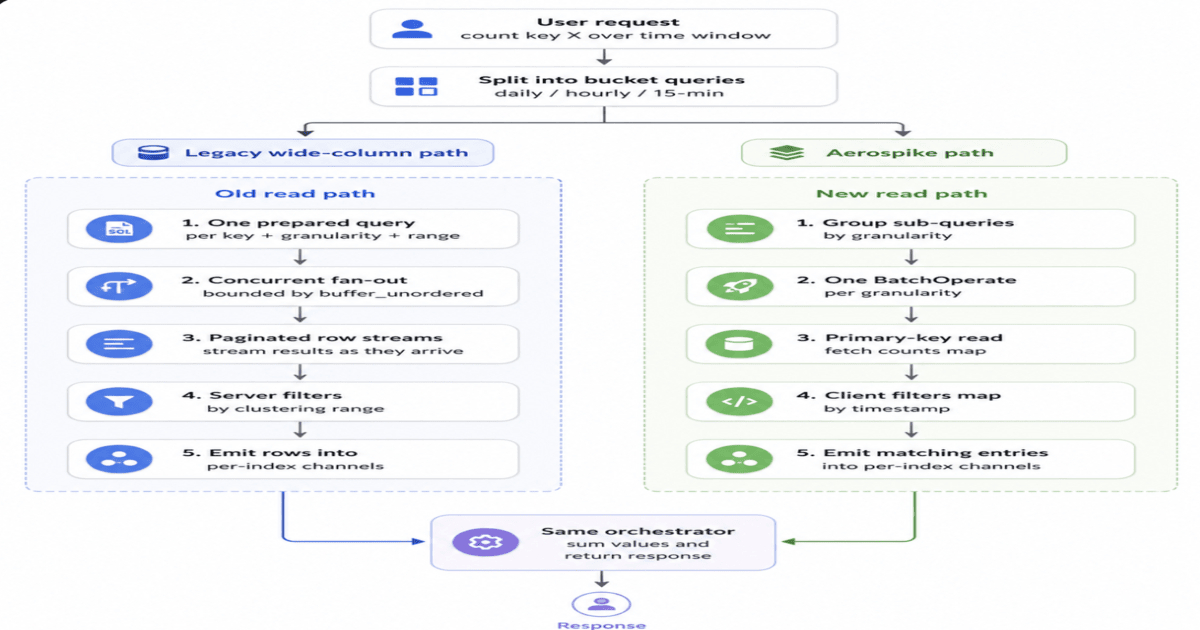
Grab's successful migration of its Counter Service from a wide-column database to Aerospike offers a compelling case study in optimizing high-throughput, low-latency systems. The key insights revolve around the strategic redesign of the data model to leverage Aerospike's strengths, particularly its efficient handling of map data structures. By consolidating time-windowed counts into a single record with a timestamp-ordered map, Grab dramatically reduced record cardinality, leading to significant improvements in storage footprint and index performance. The adoption of Aerospike's atomic map increment operation streamlined write paths, while the shift to client-side filtering for time-range queries optimized read operations. Furthermore, the meticulous staged migration strategy, employing a storage facade and shadow reads, is a best practice that significantly de-risked the transition, ensuring zero downtime and data integrity. This approach is highly valuable for organizations facing similar scaling challenges.
However, the article could benefit from a deeper dive into the specific trade-offs made in the data model redesign. While consolidating data reduced record count, the implications for query complexity and potential cache inefficiencies for very large map entries warrant further discussion. The mention of Aerospike's 64-byte primary index metadata overhead per record is a critical detail, but the article doesn't fully explore how the new model mitigates this for the specific use case. Additionally, while the Rust client issues were addressed, a more detailed explanation of the challenges and solutions in the asynchronous client adoption and DNS handling would enhance the technical depth. The success here is contingent on a deep understanding of Aerospike's specific operational characteristics, which might make this solution less universally applicable without significant adaptation.
Key Points
- Grab migrated its Counter Service storage backend from a wide-column database to Aerospike.
- The redesign focused on consolidating time-windowed counts into a single Aerospike record containing a timestamp-ordered map.
- This data model change significantly reduced record count and on-disk data size (3TB to 1TB).
- The migration resulted in approximately 50% lower p99 read latency and 45-50% lower cost per node.
- A staged traffic migration strategy using a storage facade and shadow reads ensured zero downtime and data integrity.
- Key technical optimizations included using Aerospike's atomic map increment and batch APIs, and shifting filtering to the client.
📖 Source: Grab Redesigns Counter Service Storage for 50% Lower P99 Latency
Related Articles
Comments (0)
No comments yet. Be the first to comment!