
Uber Eats Slashes Search Latency by 50%

Alps Wang
Oct 3, 2026 · 1 views
Optimizing the User Journey
Uber Eats' success in reducing search latency by 50% is a testament to meticulous, incremental optimization across their entire pipeline. The shift in focus from backend API response time to Above-the-Fold completion is a critical insight, highlighting the user's perception of speed over raw technical metrics. This approach is highly valuable for any consumer-facing application where initial load times heavily influence user experience and conversion rates. The article effectively breaks down the complex changes into digestible components, from retrieval and hydration to advertising and infrastructure, showcasing a holistic engineering effort. The mention of an agentic coding workflow for identifying optimizations, while brief, hints at future directions in AI-assisted development for performance tuning.
However, the article could benefit from a deeper dive into the specifics of the 'agentic coding workflow' and how it was integrated. While the list of optimizations is impressive, the article doesn't explicitly detail the trade-offs involved in each change, such as potential increases in complexity or maintenance overhead. For instance, separating ranking hydration from presentation data might introduce new inter-service communication challenges. Furthermore, while the impact of product-level embeddings is stated as reducing data lookups by over 100 times, understanding the exact nature of these embeddings and their creation process would add significant technical depth. The article also touches on planned future work like Zero Pass Ranking, which is exciting but remains speculative without more concrete implementation details or early results beyond the mentioned p99 latency reduction.
Key Points
- Uber Eats drastically reduced end-to-end search latency by 50% through a comprehensive pipeline overhaul.
- The primary latency metric shifted from backend API response time to Above-the-Fold completion (first screen of results rendered with images).
- Key optimizations include reducing retrieval work, using product-level embeddings, separating ranking and presentation data hydration, and redesigning the advertising path.
- Infrastructure improvements like parallel encoding and Go data structure changes also contributed to latency reduction.
- The approach emphasizes incremental optimization and doing 'less work' and 'avoiding unnecessary waiting' rather than just 'doing things faster'.
- Future plans include end-to-end microbatching and Zero Pass Ranking, with early testing showing significant p99 latency reductions.
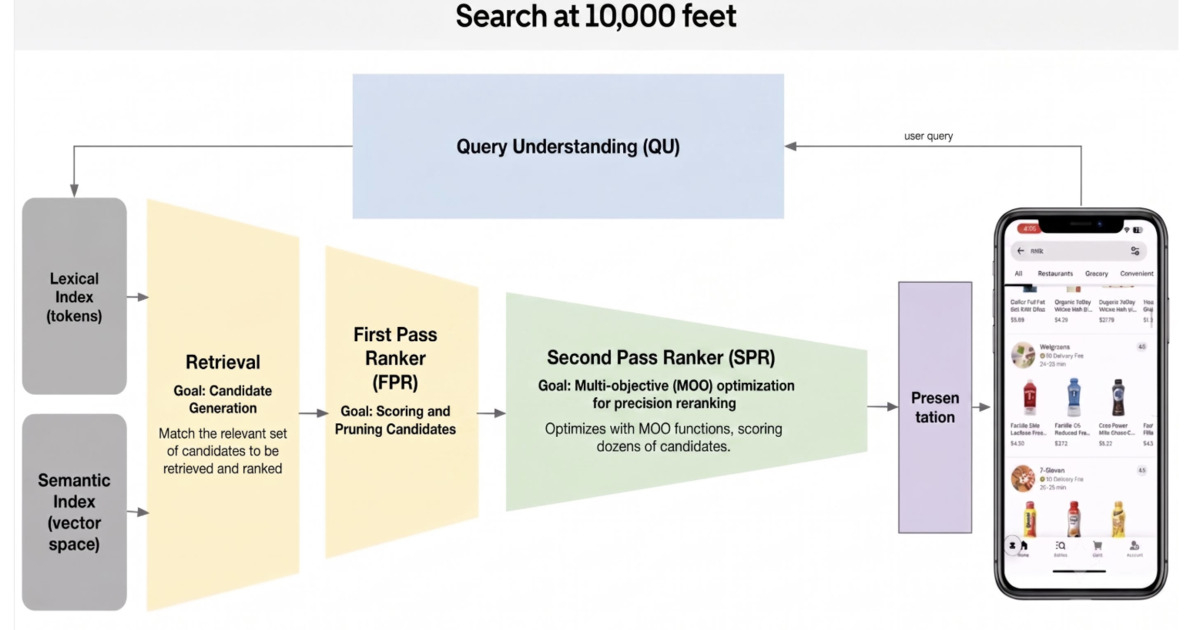
📖 Source: Uber Eats Rebuilds Search Pipeline to Cut End-to-End Latency by 50%
Related Articles
Comments (0)
No comments yet. Be the first to comment!