
DoorDash's WAIL: Scalable CDC Beyond Traditional Limits

Alps Wang
Jun 19, 2026 · 1 views
Intent Over State: WAIL's CDC Revolution
The presentation by Vinay Chella and Akshat Goel from DoorDash introduces the Write-Ahead Intent Log (WAIL) as a novel architecture for tackling the challenges of Change Data Capture (CDC) at massive scale, particularly in heterogeneous database environments. Their core insight lies in shifting focus from database state to the 'intent' of an operation, decoupling the payload from the metadata. This approach, using a 'dumb producer proxy' and 'smart consumer' pattern, aims to provide a more robust, observable, and recoverable CDC pipeline. The detailed explanation of the pain points with traditional CDC, especially the abstraction challenges across different database dialects, scalability issues with tools like Debezium under high load, and the ecosystem's limitations (vendor lock-in, cost of advanced features), makes a compelling case for their custom solution. The analogy of folding a fitted sheet effectively captures the brittleness of dual-write strategies and the complexity of choreographing distributed systems without a clear intent-based mechanism.
WAIL's innovation stems from its architectural design, which prioritizes separating the 'what' (intent) from the 'how' (state payload). By abstracting database-specific CDC mechanisms behind a unified intent log, DoorDash aims to simplify operations and offer a more consistent platform for its internal teams. The smart consumer pattern implies that consumers are responsible for understanding and processing the intent, rather than being burdened by database-specific CDC details. This is particularly noteworthy for organizations with diverse data stores. However, the presentation doesn't delve deeply into the operational complexity of building and maintaining such a custom 'dumb producer proxy' or the intricacies of the 'smart consumer' implementation. The long-term maintainability, the overhead of managing a custom proxy, and the potential for this custom solution to become a new bottleneck or a point of failure are valid concerns that would require further exploration. The reliance on a custom architecture also means a significant investment in development and ongoing maintenance, which might not be feasible for all organizations.
Despite these potential concerns, the approach is highly beneficial for large-scale organizations like DoorDash that operate complex, heterogeneous data landscapes and experience extreme load during peak times. Companies struggling with the limitations of off-the-shelf CDC solutions, facing high operational overhead, or dealing with inconsistent guarantees across different data sources would find WAIL's principles and architecture very relevant. The focus on intent as a foundational element for data synchronization is a powerful paradigm shift that could inspire similar architectural patterns in other data-intensive domains. It highlights a mature understanding of distributed systems challenges and a pragmatic approach to solving them at scale, emphasizing reliability and recoverability over vendor-specific or simplistic solutions.
Key Points
- DoorDash developed Write-Ahead Intent Log (WAIL) to address limitations of traditional CDC at scale.
- WAIL shifts focus from database state to the 'intent' of an operation, decoupling payload from metadata.
- Key architectural pattern: 'dumb producer proxy' and 'smart consumer'.
- Addresses abstraction challenges across heterogeneous databases (Postgres, Cassandra, etc.).
- Overcame scalability issues encountered with Debezium under high load (CPU spikes, latency, duplicate messages).
- Highlights limitations of existing CDC ecosystems: vendor lock-in, cost of advanced features, uneven connector maturity.
- Aims for a more durable, visible, and recoverable CDC pipeline.
- Beneficial for large-scale organizations with complex, heterogeneous data landscapes and high traffic.
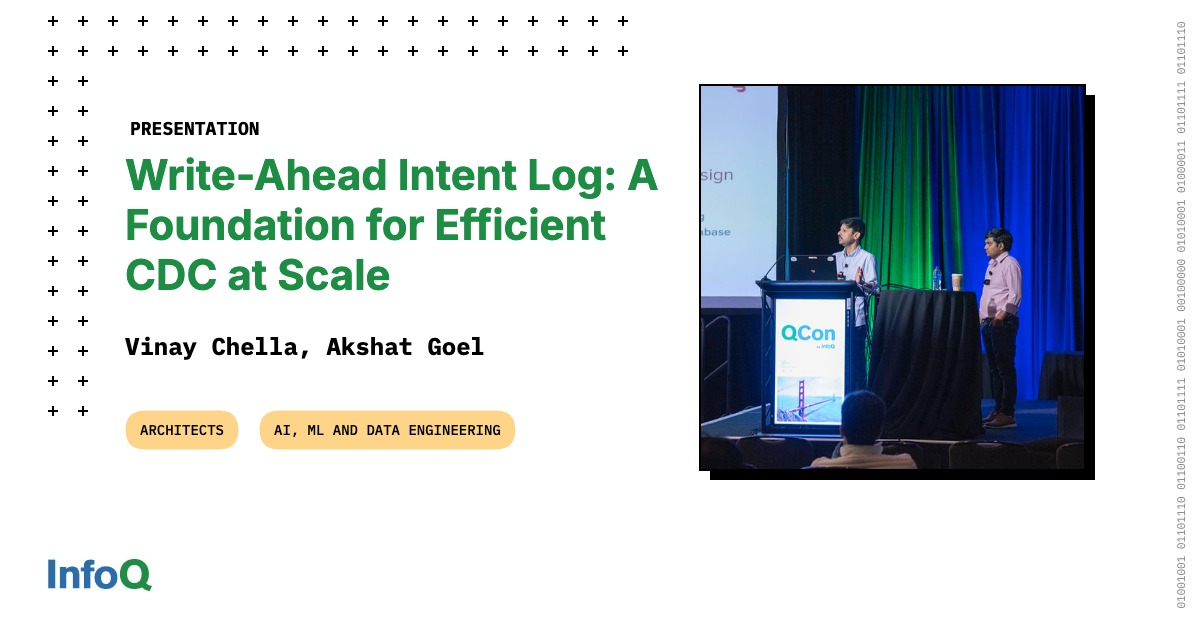
📖 Source: Presentation: Write-Ahead Intent Log: A Foundation for Efficient CDC at Scale
Related Articles
Comments (0)
No comments yet. Be the first to comment!