
ClickHouse Unleashes GA Full-Text Search Power

Alps Wang
Mar 11, 2026 · 1 views
Text Search Revolutionized at Scale
The General Availability of ClickHouse Full-text Search marks a pivotal moment for the database, directly addressing a long-standing need for efficient text processing within an analytical engine. The implementation of native inverted indexes, drawing parallels to established search technologies like Lucene, is a technically sound approach. The reported 7-10x performance gains for cold queries and even more for hot queries are compelling, especially when coupled with the ability to perform aggregations over petabytes of data. This feature democratizes advanced text search for analytical workloads, moving beyond the limitations of probabilistic Bloom filters to offer deterministic, scalable, and faster results.
However, it's crucial to acknowledge the trade-offs. The article explicitly mentions a ~50% reduction in insert throughput and increased storage overhead compared to having no index. While query performance is dramatically improved, the cost in terms of write performance and storage needs careful consideration for write-heavy workloads. Furthermore, the current limitation of not directly accelerating phrase searches, while indirectly benefiting from multi-token filtering, means that pure relevance-driven search engines still hold an advantage for more complex NLP use cases. The focus here is squarely on accelerating token-based filtering and aggregation, not on replacing dedicated search platforms with advanced ranking capabilities. Developers will need to weigh these factors when deciding if ClickHouse Full-text Search is the right tool for their specific requirements.
The implications for observability and log analytics are particularly strong. By enabling fast token matching directly within the analytical database, ClickHouse reduces the need for complex data pipelines that duplicate data into separate search systems. This integration streamlines architecture and potentially lowers operational costs. The success stories from Ryft.io and Icite underscore the real-world impact, showcasing significant query latency reductions and improved user experience. The configurability of tokenization and preprocessing also offers flexibility, allowing users to tune the index for specific use cases. The forthcoming engineering-focused blog post is highly anticipated to provide deeper technical insights and benchmark details.
Key Points
- ClickHouse has officially released its native Full-text Search (FTS) feature, now generally available for production use.
- FTS utilizes inverted indexes, similar to technologies like Lucene, for fast, token-based text searching.
- Performance gains are substantial, with reported query speedups of 7-10x for cold queries and more for hot queries compared to traditional methods.
- The feature allows for efficient multi-token search and aggregation over billions or trillions of rows, ideal for analytical and observability workloads.
- It offers deterministic results and better scalability than Bloom filter skip indexes for text data.
- Limitations include a ~50% reduction in insert throughput and increased storage overhead.
- FTS is designed for accelerating token-based filtering, not for complex relevance ranking or phrase search acceleration (though direct phrase search acceleration is planned for the future).
- It integrates seamlessly into ClickHouse, reducing the need for separate search infrastructure for log analytics and similar use cases.
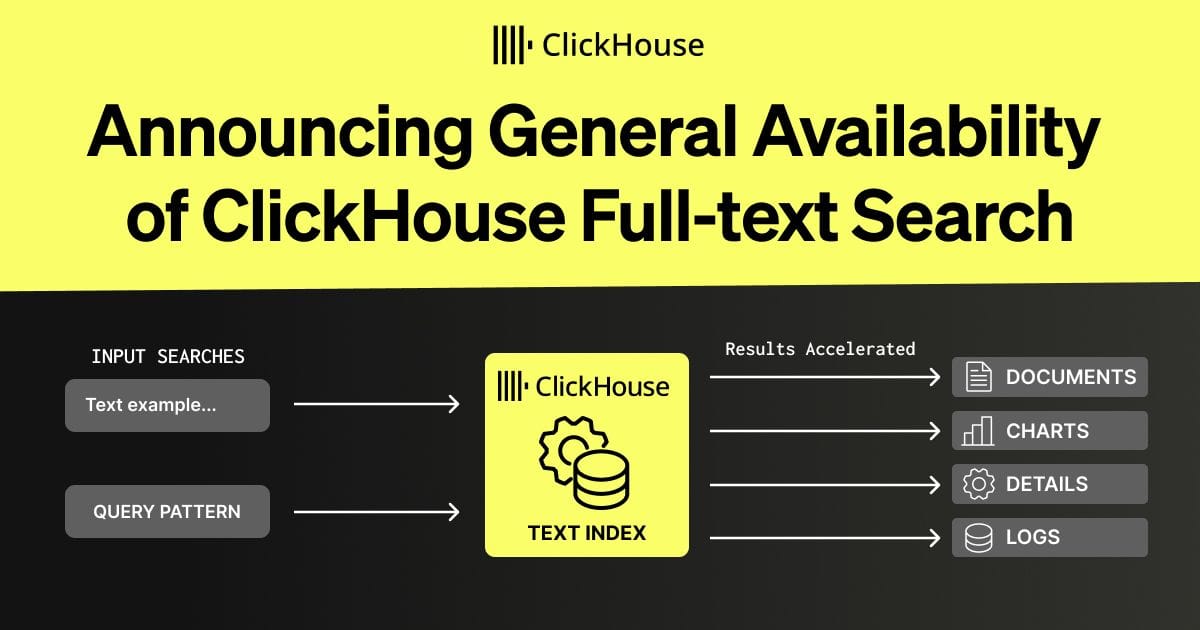
📖 Source: Announcing General Availability of ClickHouse Full-text Search
Related Articles
Comments (0)
No comments yet. Be the first to comment!