
Beyond Demos: QCon AI Boston's Production AI Secrets

Alps Wang
May 22, 2026 · 1 views
The Pragmatic Path to Production AI
The InfoQ article effectively highlights the critical gap between AI model demonstrations and robust production deployment, a theme resonating deeply within the industry. The selection of sessions from QCon AI Boston 2026 underscores the shift from theoretical AI capabilities to the engineering rigor required for reliable, scalable AI applications. Key insights revolve around performance optimization beyond just GPUs (OpenAI), the necessity of organizational context for AI agents (LinkedIn), and the crucial role of system-level 'harnesses' for agent reliability (OpenAI). The emphasis on building reusable evaluation frameworks (Elastic) and consolidating common LLM plumbing into platforms (DoorDash) addresses significant operational inefficiencies. Roblox's approach to redesigning the SDLC for AI-generated code also points to a fundamental rethinking of software development processes.
What's particularly noteworthy is the focus on 'systems concerns' rather than solely model features. This pragmatic approach acknowledges that production AI is an engineering discipline. The article implicitly argues that the next wave of AI innovation will be driven by robust infrastructure, intelligent systems design, and efficient operational practices. Limitations might include the inherent brevity of a summary article, which can't delve into the deepest technical intricacies of each session. However, it serves as an excellent primer, directing interested parties to further explore the source material. The benefit is clear: any organization aiming to move beyond experimental AI and into production will find immense value in these discussions. The implications for database professionals are also significant, particularly in areas like context management, state hydration, and efficient data retrieval for agents.
Key Points
- AI application latency is a multi-layered problem, not just a GPU issue, involving client work, context assembly, inference, and observability.
- Agentic coding accelerates development but also performance regressions, necessitating agent-operated performance investigations with machine-readable telemetry.
- Production AI agents require extensive organizational context (services, frameworks, data systems, workflows) that must be engineered, as demonstrated by LinkedIn's CAPT layer.
- Reliability in production AI agents stems from system-level 'harnesses' including control planes, state management, execution constraints, and auditability, not just model capabilities.
- Reusable evaluation frameworks are crucial for iterating on user-facing AI agents, especially for identifying and addressing specific failure modes.
- Consolidating common LLM infrastructure (retry logic, fallback mechanisms, cost tracking, prompt versioning) into shared platforms reduces duplicated effort and improves efficiency.
- Redesigning the Software Development Lifecycle (SDLC) to incorporate AI agents for tasks like code migration and maintenance is essential for scaling AI-generated code safely and effectively.
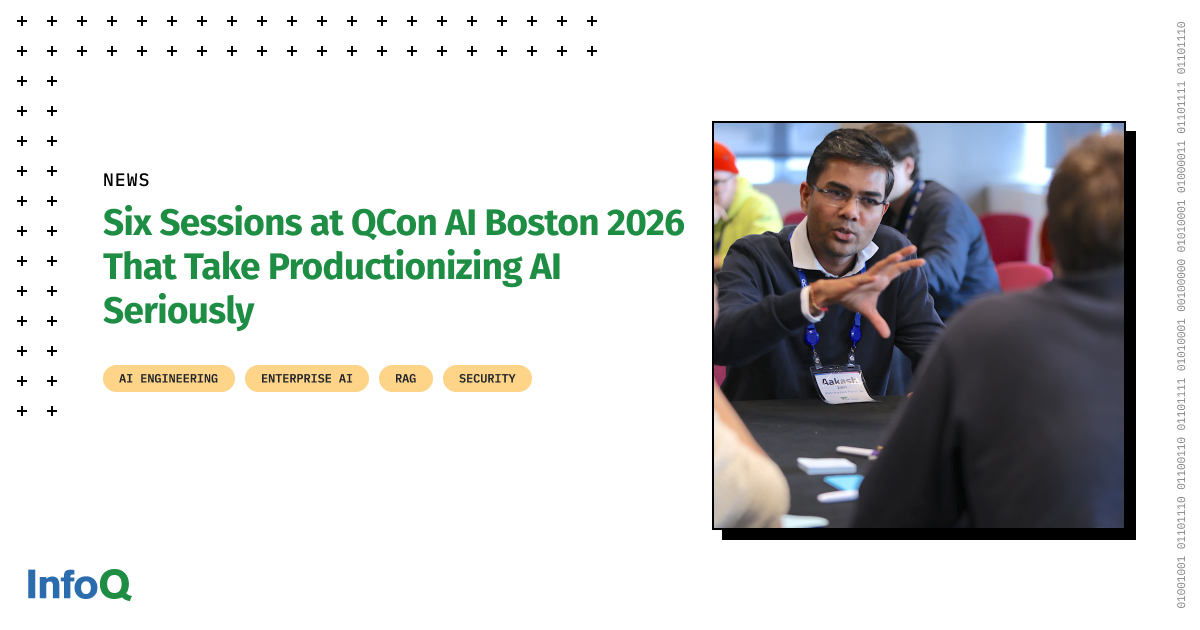
📖 Source: Six Sessions at QCon AI Boston 2026 That Take Productionizing AI Seriously
Related Articles
Comments (0)
No comments yet. Be the first to comment!