
ClickHouse: AI, Observability, and 60 Billion Records Daily

Alps Wang
May 22, 2026 · 1 views
ClickHouse Evolves: AI, Observability, and Massive Scale
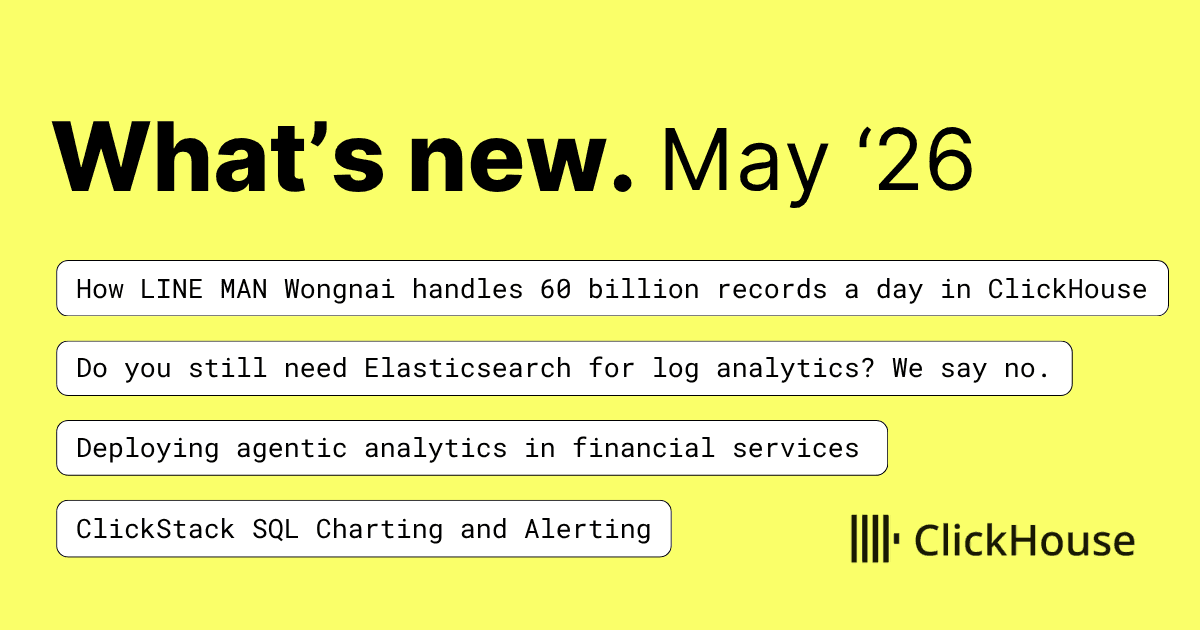
The May 2026 ClickHouse newsletter effectively showcases the platform's maturation, particularly in its convergence with AI and its prowess in handling massive observability data volumes. The featured case studies from Qonto and LINE MAN Wongnai are compelling, demonstrating tangible benefits like drastic storage reduction and cost savings through ClickHouse's superior compression and query performance. Qonto's migration from Grafana Tempo and the development of an AI-powered incident companion highlight ClickHouse's versatility beyond traditional analytics, pushing into proactive operational intelligence. LINE MAN Wongnai's rebuild underscores ClickHouse's ability to consolidate disparate data sources and scale to extreme ingest rates. The 'Do you still need Elasticsearch for log analytics?' piece is a strong statement, backed by benchmarks, positioning ClickHouse as a potent alternative for log data, which is often treated as analytical data. The emphasis on agentic analytics in financial services, enabled by LLMs and ClickHouse's query handling, points to a significant trend in leveraging AI for complex business processes.
However, while the newsletter paints a strong picture, a deeper dive into the technical nuances of the AI integrations would be beneficial. The 'MCP-powered incident companion' and 'Mastra's new ClickHouse adapter' are mentioned, but the underlying mechanisms and ease of integration for developers could be elaborated upon. For instance, understanding the specific prompt engineering strategies or the data structures used for agent telemetry would add significant value. The SQL compatibility features in the 26.4 release are important for adoption, but the full impact of features like JSONAllValues and improvements to COUNT(DISTINCT) on specific workloads could be better illustrated with examples. The benchmark against Elasticsearch is persuasive, but detailing the specific query patterns and dataset characteristics that lead to ClickHouse's advantage would strengthen the argument further. Despite these minor points, the overall impression is one of a rapidly developing database that is not only keeping pace but actively shaping the future of data analytics and AI-driven operations.
Key Points
- Qonto replaced Grafana Tempo with ClickHouse Cloud for unified observability, achieving a 99.8% reduction in trace metadata storage (231 TB to 376 GB).
- LINE MAN Wongnai rebuilt their observability stack on self-hosted ClickHouse, handling 60 billion records daily with 10x better storage efficiency and 53% cost reduction.
- ClickHouse is positioned as a superior alternative to Elasticsearch for log analytics, offering 5x less disk space and 4-6x faster query performance on large datasets.
- Agentic analytics are gaining traction in financial services, with ClickHouse's capabilities supporting use cases like trade surveillance and KYC/AML automation.
- The 26.4 release enhances SQL compatibility and introduces features like
JSONAllValuesfor improved JSON handling and fasterCOUNT(DISTINCT)operations. - ClickHouse's Open House 2026 conference is scheduled for May 26-28, featuring workshops on AI agents, observability, and real-time analytics.
📖 Source: May 2026 newsletter
Related Articles
Comments (0)
No comments yet. Be the first to comment!