
Beyond Code: Startup Wisdom for the AI Engineering Era

Alps Wang
Jul 29, 2026 · 1 views
Startup Lessons for AI-Dominated Engineering
Ben Greene's presentation offers a compelling framework for software engineers grappling with the rise of AI code automation, drawing directly from the resilience and adaptability honed in startup environments. The core message—that human-centric mindsets like empathy, strategic problem-solving, and deep comprehension are becoming paramount—is both timely and insightful. The historical context, referencing Jevons Paradox and Gall's Law, effectively grounds the argument, illustrating how technological advancements, while increasing efficiency, paradoxically drive greater demand and complexity. This perspective is crucial for understanding why simply producing more code faster isn't the ultimate value proposition. The emphasis on starting simple, maintaining comprehension, tackling hard problems first, and focusing on customer impact provides a practical roadmap for engineers to redefine their roles and add unique value. The analogy of 'shaving the yak' perfectly captures the reality of software development where assumptions often prove wrong, necessitating a deep understanding of existing systems for effective iteration.
However, a potential limitation lies in the implicit assumption that all engineers can readily adopt these 'startup mindsets.' The presentation highlights the inherent pressure and iterative nature of startups, but the transition for engineers in more established, less agile organizations might require significant cultural and structural shifts. While Greene touches on 'getting out of your box' and the need for practical application, more concrete strategies for fostering these mindsets within larger teams could have enhanced the presentation's practical utility. Furthermore, while the critique of coding agents' tendency towards derivative solutions is valid, the presentation could benefit from exploring specific technical approaches or architectural patterns that actively counter this, perhaps by integrating formal methods or novel algorithmic designs that agents are less equipped to invent. The discussion on technical debt is also well-placed, but a deeper dive into how to manage and strategically leverage it in an AI-assisted development lifecycle would be beneficial.
Key Points
- AI code automation is increasing, making it crucial for engineers to adapt.
- Startup lessons offer valuable mindsets for navigating this new landscape.
- Key mindsets include: starting simple, maintaining code comprehension, attacking hard problems first, and focusing on customer impact.
- Jevons Paradox explains how increased efficiency drives greater demand, even with cheaper code production.
- Gall's Law emphasizes that complex systems evolve from simple, working systems; building complex systems from scratch rarely succeeds.
- Code comprehension is vital for effective change and avoiding 'intricately wired bombs' in code.
- Coding agents can easily create codebases that lack human understanding, posing a significant risk.
- Innovation requires moving beyond derivative solutions, such as exploring proof-carrying code or deterministic concurrency models.
- De-risking through Proof-of-Concept (POC) before Minimum Viable Product (MVP) is essential for new projects.
- True impact comes from deeply understanding and solving customer and business problems, not just coding.
- Human empathy and the ability to care are irreplaceable by AI agents.
- Software engineering is evolving beyond pure coding to encompass practical problem-solving and systems thinking across domains.
- Engineers should actively seek to understand customer needs and integrate solutions into their lives.
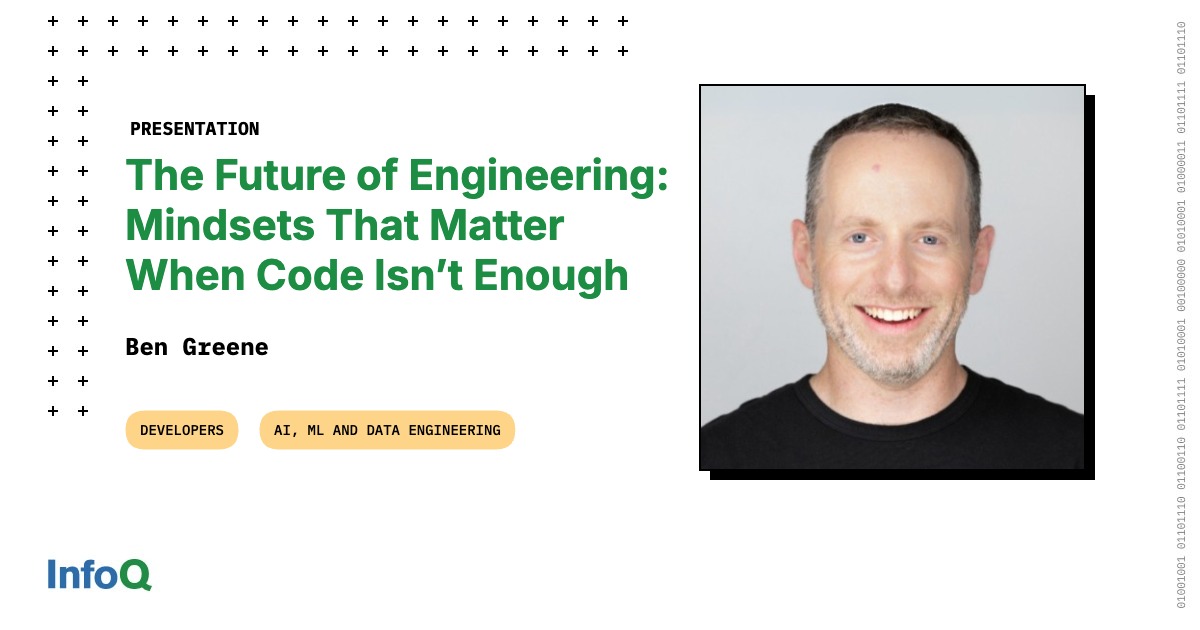
📖 Source: Presentation: The Future of Engineering: Mindsets That Matter When Code Isn’t Enough
Related Articles
Comments (0)
No comments yet. Be the first to comment!