
AWS Cyber Resilience: Recovering from Ransomware

Alps Wang
May 21, 2026 · 1 views
Fortifying Your Cloud Against Cyber Threats
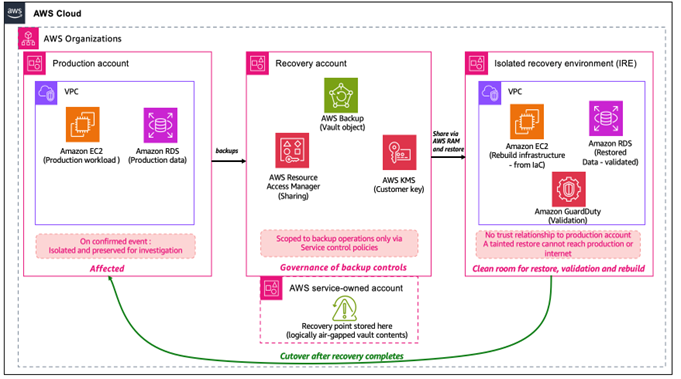
The AWS Architecture Blog post presents a robust and well-defined reference architecture for achieving cyber resilience, particularly against ransomware and destructive events. The core innovation lies in the explicit separation of recovery environments and the strategic use of logically air-gapped AWS Backup vaults. This multi-account strategy, involving Production, Recovery, and Isolated Recovery Environments (IRE), effectively minimizes the blast radius of an attack and ensures that recovery capabilities remain untainted. The detailed explanation of the validation pipeline, encompassing automated checks, malware scanning, and workload-specific integrity tests, is particularly valuable. It moves beyond mere backup restoration to ensuring the integrity and safety of the recovered environment, a crucial step often overlooked. The Rebuild-Restore-Rotate framework provides a clear mental model for managing different recovery components: infrastructure from code, data from backups, and credentials newly generated.
However, a potential limitation is the complexity of implementing and managing this multi-account structure, especially for smaller organizations with limited DevOps resources. While AWS Organizations and Service Control Policies (SCPs) are powerful, they require significant expertise to configure and maintain correctly. The article assumes a certain level of AWS proficiency and security maturity. Furthermore, while the logically air-gapped vault offers strong deletion protection, the effectiveness of the overall strategy still hinges on the thoroughness of the validation pipeline and the adherence to the Rebuild-Restore-Rotate framework. Any gaps in these processes could still lead to reinfection or compromise. The article could benefit from more concrete examples of how to automate the setup and management of these accounts and policies, perhaps with links to CloudFormation or CDK templates.
Key Points
- Cyber resilience focuses on recovery to a known-good state, especially when production environments and backups might be compromised.
- A core architectural pattern involves isolating recovery from production using a three-account strategy: Production Accounts, a Recovery Account (for logically air-gapped vaults), and an Isolated Recovery Environment (IRE).
- AWS Backup's logically air-gapped vaults provide deletion-protected storage, enforced by the service in Compliance mode.
- A multi-layered validation pipeline is crucial for confirming backups are not only recoverable but also safe to use, including malware scans, workload-specific integrity checks, and log reviews.
- Selecting the right recovery point involves evaluating candidates in reverse chronological order, starting from the most recent backup that predates the identified event boundary.
- The Rebuild-Restore-Rotate framework guides recovery by rebuilding infrastructure from code, restoring data from validated backups, and rotating compromised credentials.
📖 Source: Cyber resilience on AWS: A reference approach for recovery from ransomware and destructive events
Related Articles
Comments (0)
No comments yet. Be the first to comment!