
AWS Hybrid Multi-Tenant for Stateful Services

Alps Wang
May 13, 2026 · 1 views
Scaling Stateful Services: A Hybrid Approach
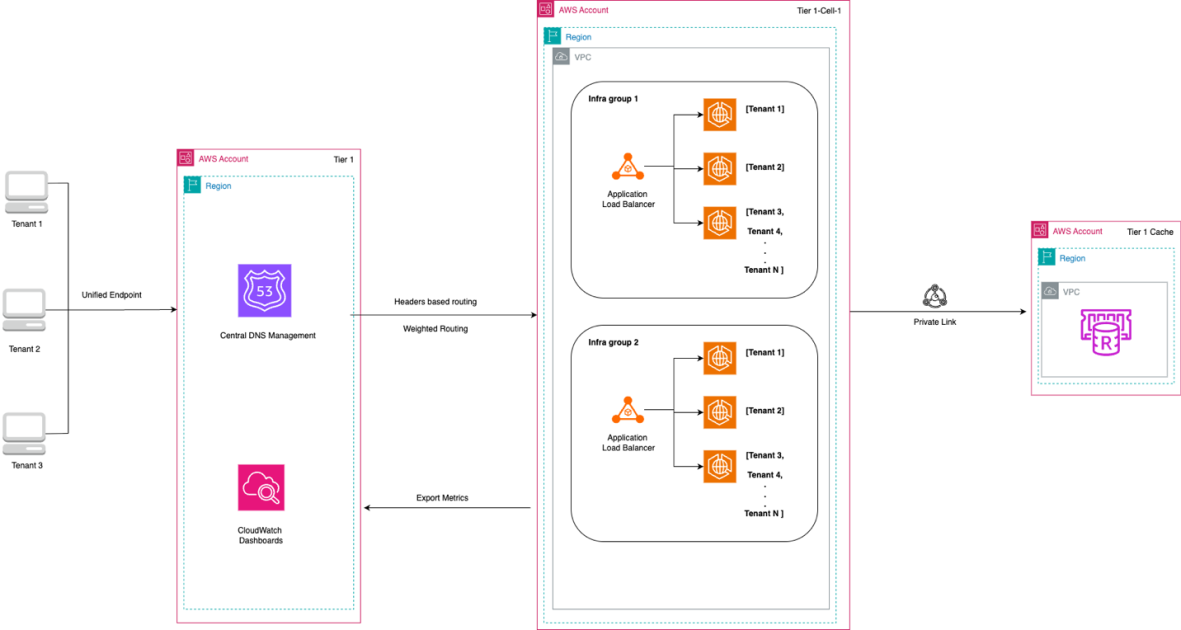
The AWS Architecture Blog article presents a compelling hybrid multi-tenant architecture designed to overcome the significant operational overhead and scalability limitations of purely account-per-tenant isolation for stateful services. The key insight lies in the three-level hierarchy (tiers, cells, infra groups) and the strategic pre-wiring of downstream service dependencies using AWS PrivateLink. This drastically reduces onboarding time and cost by shifting infrastructure provisioning from a per-tenant activity to a tier-level configuration. The article effectively highlights the trade-offs, acknowledging the original 'cellular' architecture's isolation benefits but detailing its crippling inefficiencies in terms of cost, speed, and scalability. The proposed solution intelligently leverages AWS services like Route 53 for weighted routing, ALB for request routing to tenant-specific ECS clusters, and PrivateLink for shared connectivity, demonstrating a mature understanding of AWS primitives for building robust, scalable, and efficient multi-tenant systems.
While the solution is robust, potential limitations or concerns might include the increased complexity introduced by the three-level hierarchy itself, which could require a higher initial learning curve and more sophisticated management tooling. The cost of AWS PrivateLink endpoints, though presented as negligible compared to operational savings, could still become a factor for very large numbers of downstream services or extremely high data transfer volumes across many tenants. Furthermore, while the article focuses on stateful services and the 'noisy neighbor' problem in memory, the strategy might need adaptation for other types of stateful data stores (e.g., databases) if they are also prone to similar contention issues at scale. The article assumes a certain level of AWS expertise, and a more detailed breakdown of IAM role configurations for tier-level permissions could be beneficial for readers less familiar with fine-grained AWS security. Overall, this is a highly practical and well-articulated solution for organizations grappling with the complexities of large-scale, stateful multi-tenancy on AWS.
Key Points
- The original 'cellular' architecture (account per tenant) suffered from significant operational inefficiencies: high cost due to underutilized resources, long onboarding times (52 days), and scalability issues.
- Stateful services, which maintain data in memory, are particularly susceptible to the 'noisy neighbor' problem when sharing infrastructure.
- The proposed hybrid multi-tenant architecture uses a three-level hierarchy: Tiers (logical classification), Cells (AWS account boundaries for scale-out), and Infra Groups (VPC, ALB, ECS clusters for tenants).
- Key innovations include: pre-integration of downstream services via AWS PrivateLink at the tier level, configuration-driven onboarding, and Route 53 weighted routing for traffic distribution.
- This approach dramatically reduces onboarding time, improves resource utilization, and enhances scalability by decoupling tenant isolation from AWS account provisioning.
📖 Source: Building hybrid multi-tenant architecture for stateful services on AWS
Related Articles
Comments (0)
No comments yet. Be the first to comment!