
AI-Powered Legacy Code Migration in Weeks

Alps Wang
Jun 12, 2026 · 1 views
AI's Leap in Legacy Migration
David Stein's presentation at QCon AI offers a compelling vision for tackling the 'mountain' of legacy code migration, a perennial pain point for software engineering organizations. The core innovation lies in ServiceTitan's application of AI, specifically LLMs, to decompose large-scale migration tasks into a standardized, parallelizable 'assembly line' pattern. This approach, by breaking down complex refactoring into smaller, verifiable steps, directly addresses the limitations of naive AI prompting for massive code transformations. The emphasis on 'programmatically rigid validation loops' is particularly crucial, aiming to mitigate LLM hallucinations and ensure the integrity of migrated code, thereby building engineering trust in AI-assisted processes.
The implications for engineering agility are substantial. By compressing the 'toil' of migration into a much shorter timeframe and providing early feedback on architectural decisions, this method promises to significantly reduce the risk and duration of these often-daunting projects. This not only accelerates the realization of business value from new platforms but also allows teams to pivot more quickly if an architectural direction proves suboptimal. The case study of ServiceTitan's reporting metrics migration serves as a practical illustration of this methodology. While the presentation highlights the potential, a key concern would be the scalability of this 'assembly line' pattern across vastly different types of legacy systems and programming languages. The effectiveness of the 'standardized context acquisition and standardized prompt' will heavily depend on the sophistication of the tooling and the LLM's ability to generalize across diverse codebases. Furthermore, the 'rigidity' of validation loops, while essential, might introduce its own set of complexities in defining and implementing these checks effectively for all potential migration scenarios. The human element of understanding nuanced business logic embedded within legacy code, which might not be fully captured by code analysis alone, also remains a consideration.
Key Points
- Migrating large-scale legacy codebases is a significant challenge, often taking years and carrying substantial risk.
- ServiceTitan is leveraging AI, specifically LLMs, to transform legacy code migration from a multi-year endeavor into a process achievable in weeks.
- The core strategy involves decomposing the migration problem into standardized, parallelizable tasks, akin to an 'assembly line' pattern.
- Critical to this approach are 'programmatically rigid validation loops' designed to eliminate LLM hallucinations and ensure code integrity.
- This methodology aims to accelerate engineering agility by providing rapid feedback on architectural choices and compressing development timelines.
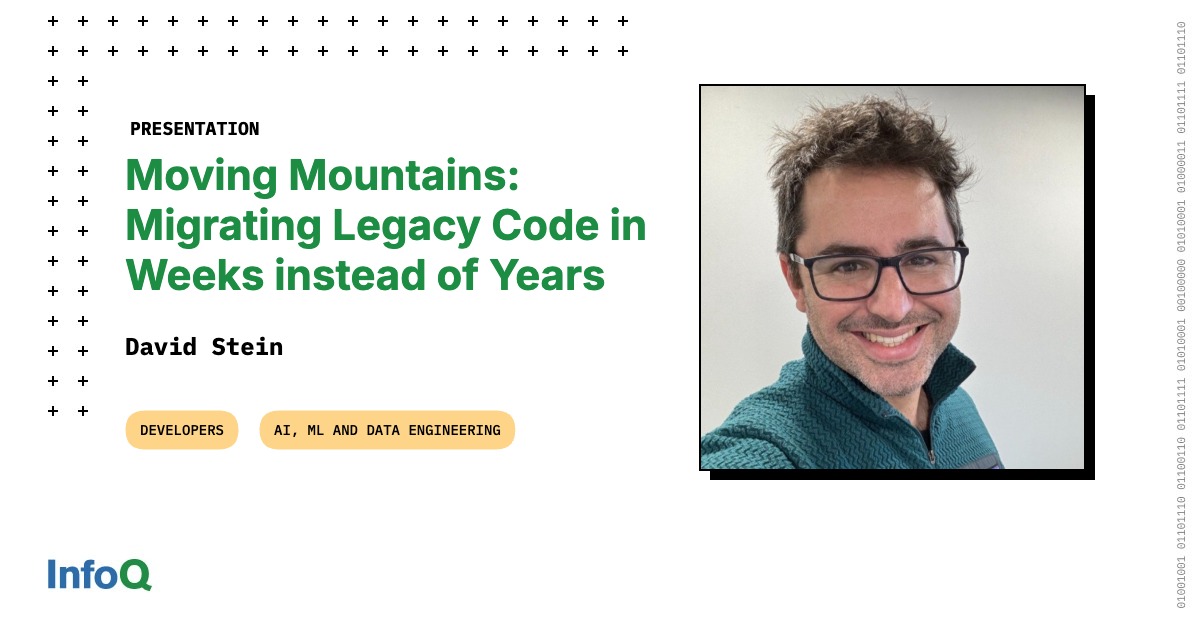
📖 Source: Presentation: Moving Mountains: Migrating Legacy Code in Weeks instead of Years
Related Articles
Comments (0)
No comments yet. Be the first to comment!