
Vortex: S3 to GPU Data Loading Revolution

Alps Wang
Sep 4, 2026 · 1 views
Unlocking GPU Potential
The presentation highlights Vortex's impressive ability to stream data directly from S3 to GPUs at high speeds, bypassing traditional CPU and NVMe bottlenecks. The core innovation lies in its columnar file format, lightweight encodings, and layout-based segment pruning, which enable "one copy" data movement and significant performance gains. The "decision tax" reduction, allowing for rapid iteration on ML workloads by simply changing queries rather than reprocessing data, is a particularly compelling benefit for researchers and engineers. The technical details around layouts, zone maps, and sliceable compression demonstrate a deep understanding of I/O and compute optimization.
However, a potential limitation is the ecosystem adoption. While Vortex is open-source under the Linux Foundation, its widespread integration into existing ML frameworks and data pipelines will be crucial for its success. The presentation focuses heavily on the "how" and "why" of Vortex itself, but less on the practical integration challenges or comparisons with established solutions like Parquet beyond raw speed metrics. The "one copy" claim is strong, but understanding the nuances of how memory is managed across CPU and GPU, especially concerning potential fragmentation or intermediate buffer requirements in complex scenarios, would be beneficial. Furthermore, while the presentation mentions extensibility, the actual effort and complexity involved in developing new array or layout types for specific use cases might be a concern for less experienced developers.
Overall, Vortex presents a compelling vision for high-throughput data loading in ML. Its ability to reduce data movement and enable faster experimentation cycles could significantly impact the efficiency of ML development. Developers working with large datasets and GPU-intensive training will undoubtedly find this approach highly attractive, especially those frustrated by current data loading bottlenecks. The implications for real-time analytics and edge AI could also be substantial, provided the format gains traction and robust tooling support.
Key Points
- Vortex is a new open-source columnar file format designed for high-throughput data loading directly to GPUs.
- It eliminates CPU and NVMe bottlenecks by enabling zero-copy memory pipelines from S3 to GPUs, achieving speeds up to 60 Gbps.
- Key innovations include cascading lightweight encodings for on-the-fly computation and layout-based segment pruning for efficient data filtering.
- Vortex significantly reduces the "decision tax" in ML training by allowing rapid query changes without full data reprocessing, speeding up iteration cycles.
- Performance gains over Parquet are substantial, up to 30x faster for S3 to GPU scans and over 100x faster for random access.
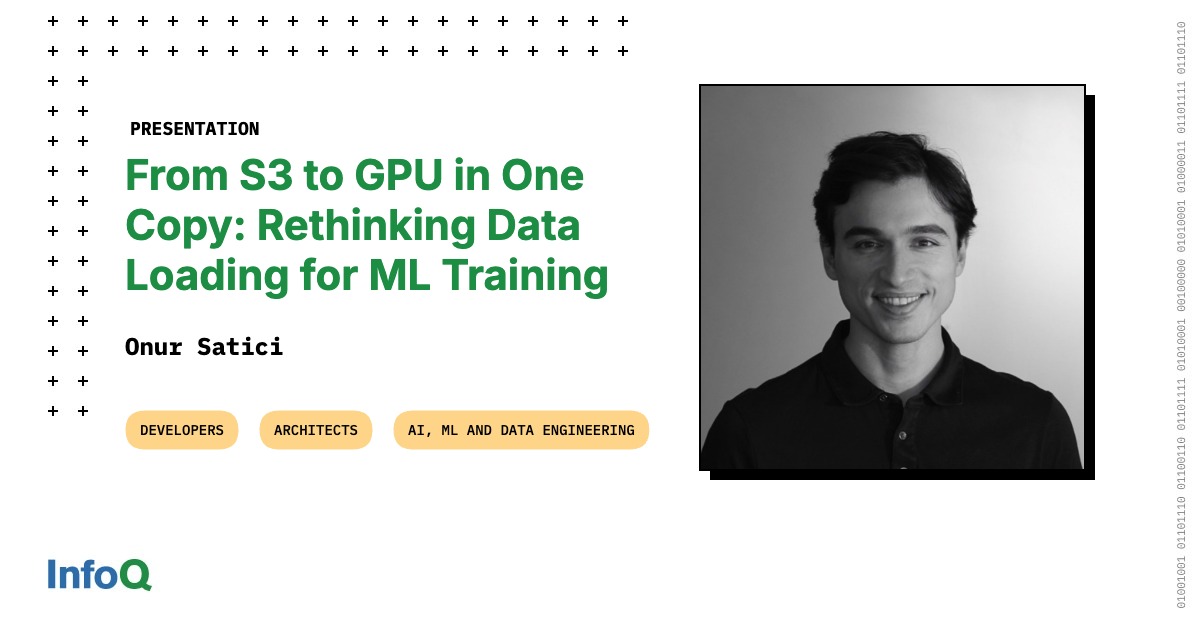
📖 Source: Presentation: From S3 to GPU in One Copy: Rethinking Data Loading for ML Training
Related Articles
Comments (0)
No comments yet. Be the first to comment!