
Uber's Priority-Aware Load Manager for Databases

Alps Wang
Jan 30, 2026 · 1 views
Uber's Load Management Evolution
The Uber article highlights a compelling evolution in their distributed storage platform, moving from static rate limiting to a priority-aware load management system. The core innovation lies in addressing the limitations of traditional QPS-based rate limiting, which often failed to reflect actual load and handle noisy neighbors. The implementation of Cinnamon, a priority-aware load shedder, and the subsequent unification of local and distributed overload signals into a single modular control loop, represent significant advancements in handling the complexities of large-scale, stateful systems. The focus on prioritizing critical traffic and dynamically adapting to system conditions is crucial for maintaining performance and preventing cascading failures. The use of PID-based regulation and the 'Bring Your Own Signal' model are particularly noteworthy, showcasing a sophisticated approach to load management. However, the article could benefit from more detailed technical explanations. While the results (80% throughput increase, 70% latency drop) are impressive, deeper dives into the specific algorithms used in Cinnamon and the PID controllers, along with concrete examples of how the 'Bring Your Own Signal' model integrates various signals, would enhance the technical value. Furthermore, a discussion on the overhead introduced by these more complex systems would also be valuable.
Key Points
- Uber transitioned from static rate limiting to priority-aware load management to protect its databases.
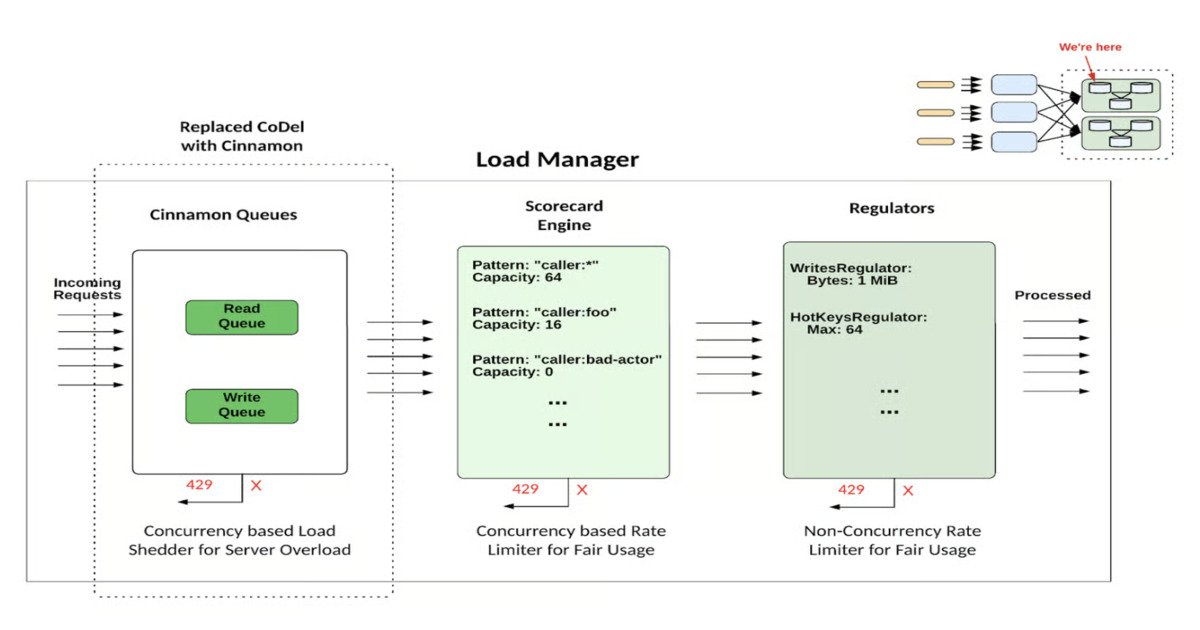
📖 Source: Uber Moves from Static Limits to Priority-Aware Load Control for Distributed Storage
Related Articles
Comments (0)
No comments yet. Be the first to comment!