
Uber's M3DB Sharding Boosts Resilience with Subclusters

Alps Wang
Sep 22, 2026 · 1 views
Subclusters: A Smarter Way to Scale
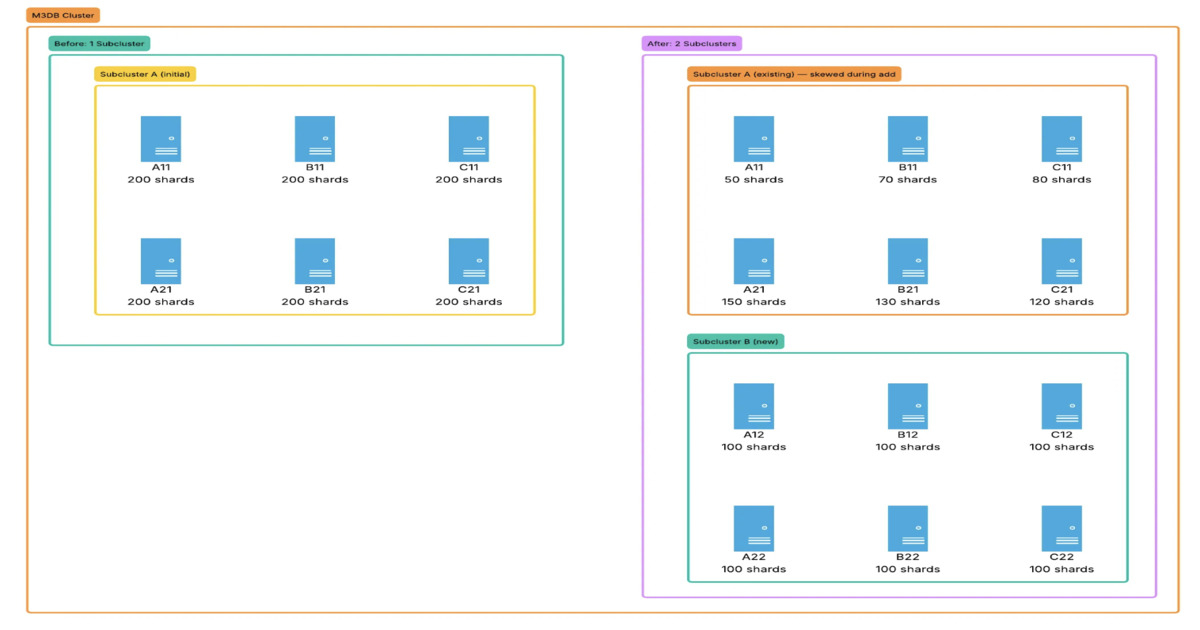
Uber's redesign of M3DB's sharding with fixed-size subclusters is a pragmatic and impactful engineering solution to a common problem in large-scale distributed databases: limiting the blast radius of node failures and simplifying cluster operations. The key insight here is the shift from a highly permissive shard placement model to a more constrained, partitioned approach. By assigning distinct, non-overlapping shard spaces to each subcluster, Uber effectively creates smaller, more manageable failure domains. This is particularly noteworthy because it directly addresses the cascading failure potential inherent in the original model, where a single node failure could impact a significant portion of the cluster as shard dependencies grew. The introduction of a greedy algorithm for scaling, which aims to evenly load remaining nodes after shard migration, is also a smart optimization, preventing the need for multiple rebalancing passes and their associated operational overhead.
The limitations mentioned, such as the requirement for equal instance weights, scaling in multiples of subcluster size, and constraints on replica factor changes, are typical trade-offs for such architectural changes. These constraints, while real, are often acceptable in exchange for the improved operational stability and fault isolation that subclusters provide. The fact that Uber retained instance-level placement operations rather than introducing atomic subcluster operations is a wise decision for backward compatibility and to avoid massive, disruptive bootstrap operations. This approach makes the transition smoother for existing deployments and tooling. Overall, this is a sophisticated solution for managing the complexity of distributed systems at scale, with direct implications for database administrators, SREs, and architects dealing with similar challenges.
Key Points
- Uber redesigned M3DB sharding by introducing fixed-size subclusters.
- This limits the impact of node failures, maintenance, and cluster scaling.
- The new model partitions nodes into subclusters, each owning a distinct shard space.
- A greedy algorithm is used for scaling to ensure even node loading.
- Constraints include equal instance weights and scaling in multiples of subcluster size.
- The approach preserves compatibility with existing M3DB tooling.
📖 Source: Uber Redesigns M3DB Sharding with Subclusters to Limit Failure Impact
Related Articles
Comments (0)
No comments yet. Be the first to comment!