
Uber Eats' Real-Time AI: Smarter Restaurant Recommendations

Alps Wang
May 23, 2026 · 1 views
Uber's Real-Time Personalization Leap
Uber's enhancement of its Uber Eats recommendation system with real-time signals and listwise ranking represents a substantial leap in personalized discovery. The shift from batch-oriented to real-time feature processing is crucial, reducing latency and allowing the system to dynamically adapt to user intent during active browsing sessions. This is particularly noteworthy in a fast-paced environment like food delivery, where preferences can change rapidly. The adoption of listwise ranking is another key innovation, moving beyond independent scoring of restaurants to optimize the relative order of a candidate set. This not only promises improved ranking quality by considering interdependencies but also offers computational efficiency gains, a critical factor for large-scale services. The emphasis on aligning offline training and online serving pipelines through consistent feature extraction logic is a best practice that mitigates feature drift and ensures model reliability, a common challenge in MLOps.
The implications for developers are significant. This architecture provides a blueprint for building scalable, low-latency recommendation systems that are highly responsive to user behavior. The use of transformer-based sequence modeling, as mentioned by Yicheng Chen, suggests a move towards more sophisticated deep learning approaches for understanding user journeys. The separation of feature preprocessing and model inference highlights a modular design for scalability and efficiency. However, a potential limitation could be the increased complexity of managing and monitoring real-time data pipelines and the associated infrastructure costs. Ensuring data quality and model performance in such a dynamic environment requires robust MLOps practices. Furthermore, while listwise ranking improves efficiency, the complexity of training models for this approach can be higher. The article could benefit from more detail on the specific loss functions or training methodologies employed for listwise ranking and how potential biases in real-time signals are addressed to ensure fairness and diversity in recommendations.
Key Points
- Uber Eats has updated its recommendation system with real-time user signals and listwise ranking.
- The new system processes user interactions in near real-time, reducing latency and improving responsiveness to changing preferences.
- Listwise ranking evaluates multiple restaurant candidates together, optimizing relative order for better efficiency and quality.
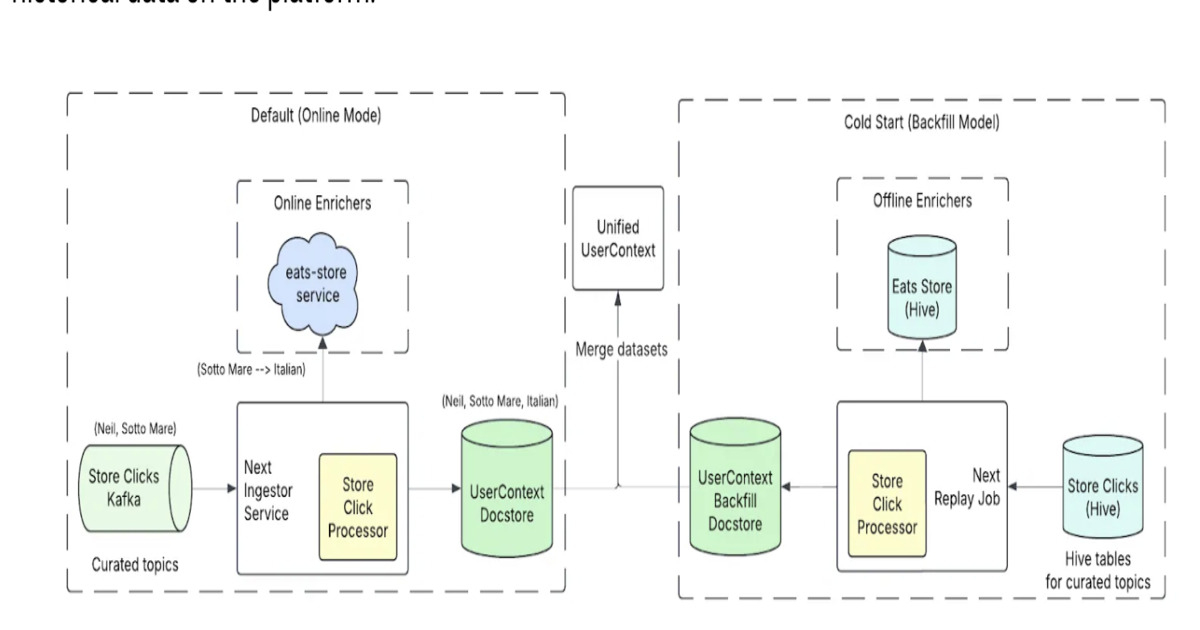
- The architecture unifies short-term session activity with long-term historical signals using a shared feature extraction layer.
- Alignment between offline training and online serving pipelines is a key design consideration to prevent feature drift.
- The system separates feature preprocessing and model inference for efficiency and scalability.
📖 Source: Uber Improves Restaurant Recommendations Using Real-Time Signals and Listwise Ranking
Related Articles
Comments (0)
No comments yet. Be the first to comment!