
Thousands of AI Agents: The Future of Observability

Alps Wang
Jun 22, 2026 · 1 views
Beyond the Single Agent Paradigm
The ClickHouse blog post compellingly argues against a monolithic, proprietary AI agent for observability, advocating instead for a distributed ecosystem of specialized agents built by individual teams. This shift is driven by the inherent context-dependency of debugging, which extends far beyond raw telemetry data to encompass organizational knowledge, team workflows, and historical operational experience. The article highlights that a 'one-size-fits-all' AI agent will inevitably be too narrow, failing to capture the unique nuances of how different teams—database, frontend, payments—investigate and resolve issues. The proposed future involves leveraging AI as a primary interface, transforming the human-dashboard-data paradigm to human-agent-data, thereby automating much of the mechanical work of investigation and allowing engineers to focus on higher-level decision-making. The emphasis on 'openness'—allowing teams to choose their own models, harnesses, and tools, and to build agents around existing systems rather than adapting to a vendor's view—is a crucial and forward-thinking point. This distributed, team-centric approach promises greater flexibility and deeper integration into specific operational contexts.
However, a significant concern lies in the 'collaboration problem' that arises from this distributed model. While agents can accelerate investigations, the article correctly identifies the need for durable, inspectable artifacts to share findings, hypotheses, and conclusions. The proposed 'persistent investigation surface' or 'notebook' as a shared workspace is a good starting point, but the practical implementation of inter-agent communication, context sharing, and collaborative debugging across potentially disparate agent architectures presents a substantial technical and operational challenge. Ensuring consistency, preventing redundant efforts, and maintaining a unified view of an incident across thousands of agents will require robust orchestration, standardized data formats for investigation artifacts, and sophisticated mechanisms for knowledge synthesis. Furthermore, while the article stresses that humans remain the control plane, the increasing sophistication of agents and their ability to 'brute force' investigations by running numerous queries simultaneously implies a significant increase in demand on underlying data storage and API layers, necessitating highly performant and scalable data platforms like ClickHouse, as implicitly suggested by the source.
Key Points
- The future of observability lies not in a single proprietary AI agent, but in a distributed ecosystem of thousands of specialized agents built by individual teams.
- Debugging is highly context-dependent, shaped by system ownership, failure modes, trusted data, runbooks, and accumulated operational knowledge, making a universal agent too narrow.
- AI agents will become the new interface for observability, shifting from human-dashboard-data to human-agent-data, automating mechanical investigation work.
- Agentic observability requires robust underlying data infrastructure capable of handling non-linear query patterns and high data fidelity, as agents cannot compensate for missing context with intuition.
- 'Openness' is key: teams need the freedom to choose models, harnesses, tools, and to build agents around existing systems and processes, controlling data location and agent behavior.
- A 'persistent investigation surface' or shared workspace is crucial for collaboration, allowing humans and agents to share, review, rerun, and build upon investigation artifacts to create a growing body of operational knowledge.
- Humans will remain in the control plane, providing judgment, understanding business priorities, and making final decisions, while agents accelerate investigations and gather context.
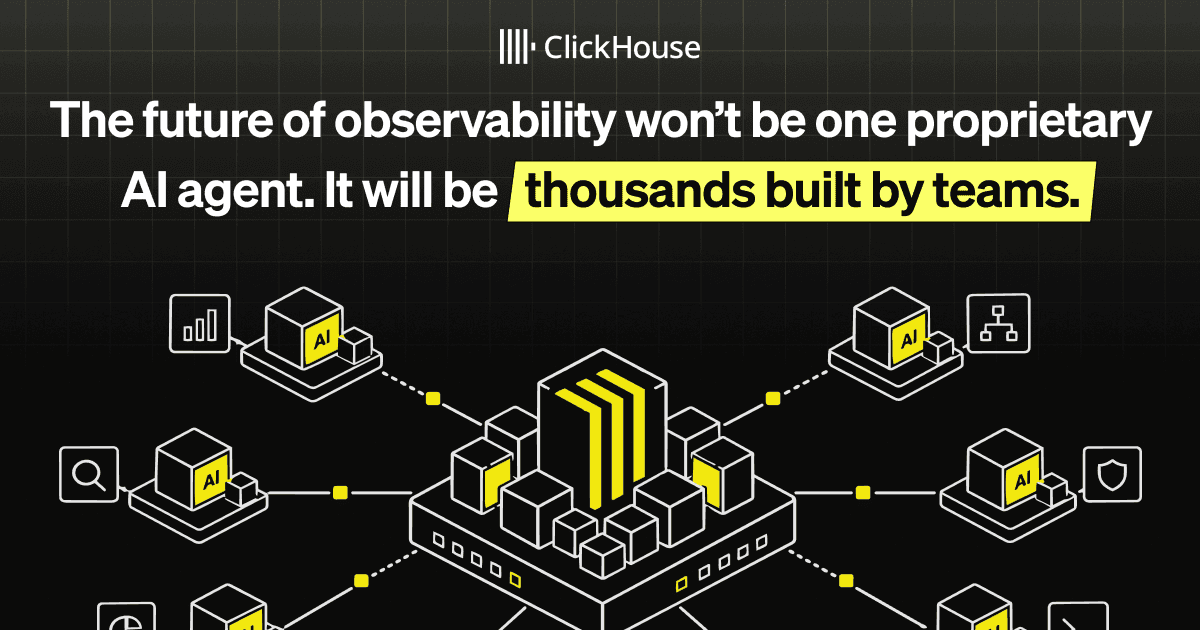
📖 Source: The future of observability won’t be one proprietary AI agent. It will be thousands built by teams.
Related Articles
Comments (0)
No comments yet. Be the first to comment!