
Synthesia's AI Video Speed-Up on AWS G7e

Alps Wang
May 20, 2026 · 1 views
Unlocking Generative Video Performance
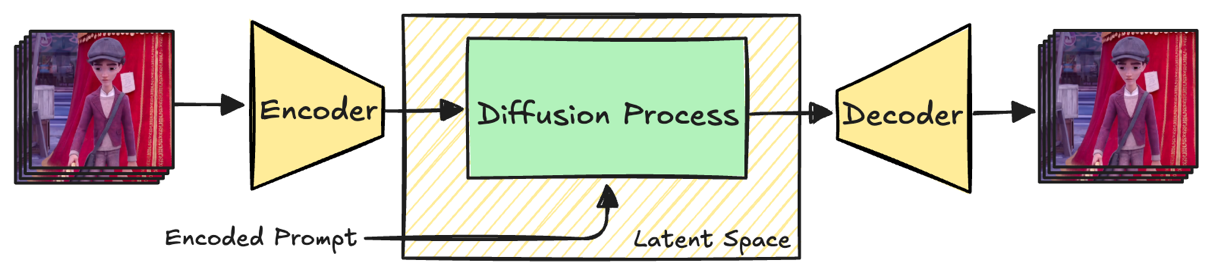
The article presents a compelling optimization technique, the Asynchronous Frame Generation Pipeline, which demonstrably improves GPU utilization and reduces latency for generative AI video inference. By decoupling GPU compute from host-side transfers and I/O using dual CUDA streams, pinned memory, and a dedicated worker thread, Synthesia and AWS have tackled a common bottleneck in VAE-based video generation. The benchmark results, showing an 8.2% latency reduction and significant cost savings per hour of processed video, are impressive and directly address a practical challenge faced by users of memory-intensive AI models. The explanation of the sequential decoding bottleneck and how the asynchronous approach overcomes it is clear and well-illustrated with diagrams, making the technical details accessible. The emphasis on no change to model weights or inference quality is a key selling point, highlighting that this is a purely architectural and implementation optimization.
However, while the article focuses on the Wan 2.2 14B model and EC2 G7e instances, its broader applicability to 'any customer with a chunked video generation pipeline that transfers frames to host memory' might benefit from more extensive validation across different model architectures and GPU types. The benchmark results, while significant, are based on a specific test scenario (a single 41-frame video) and 10 consecutive runs. While this provides a solid example, demonstrating scalability across much longer videos or varied chunk sizes would further strengthen the claims. The theoretical cost savings are also dependent on the assumption of 'full computational efficiency without bottlenecks,' which might not always hold true in real-world, complex production environments. Nevertheless, the provided sample implementation and encouragement to experiment are excellent steps towards enabling wider adoption of this optimization.
This optimization is particularly valuable for developers and researchers working with large-scale generative AI video models, especially those utilizing VAE decoders. Companies like Synthesia, who rely on efficient inference for their enterprise-focused AI video platform, stand to gain considerably. The cost savings highlighted, particularly for processing large volumes of video, make this a critical technique for optimizing cloud infrastructure spend. The approach is not tied to specific AI frameworks beyond PyTorch (though transferable) or specific AWS services beyond EC2 G7e, suggesting that similar optimizations could be implemented in other cloud environments or on-premises setups. The core principles of overlapping compute, data transfer, and host processing are fundamental to high-performance computing and AI inference, making this a noteworthy contribution to the field.
Key Points
- Synthesia and AWS collaborated to optimize generative AI video inference on EC2 G7e instances.
- The core innovation is the "Asynchronous Frame Generation Pipeline," which decouples GPU compute from device-to-host (D2H) data transfers and host-side post-processing.
- This is achieved using dual CUDA streams (compute and copy), pinned host memory buffers, and a dedicated worker CPU thread.
- The optimization eliminates GPU stalls caused by synchronous frame saving, leading to increased GPU kernel utilization (from 82% to 99.9% in benchmarks).
- Benchmarks show an 8.2% reduction in decoding latency and a theoretical cost saving of approximately $896 per 1,000 hours of decoded video on a g7e.2xlarge instance.
- The technique is applicable to any chunked video generation pipeline transferring frames to host memory, not just the specific model or instance type.
📖 Source: How Synthesia optimizes generative AI video inference on Amazon EC2 G7e instances
Related Articles
Comments (0)
No comments yet. Be the first to comment!