
Sync Engine: The Future of Fast, Local-First Apps

Alps Wang
Aug 21, 2026 · 1 views
Beyond Fetch: The Sync Revolution
James Arthur's presentation compellingly argues for 'sync' as the next frontier in frontend architecture, moving beyond traditional data fetching to a declarative, reactive model that extends to the server. The core innovation lies in abstracting the network's latency and complexity, enabling instantaneous local writes and real-time synchronization. This approach promises significant gains in application speed, responsiveness, and collaborative capabilities, particularly relevant for the emerging landscape of agentic systems where multiple users and AI agents interact with data concurrently. By treating data synchronization as a first-class concern, developers can achieve a more seamless user experience, akin to the declarative benefits React brought to UI development, but applied across the entire data plane. The emphasis on leveraging existing stacks and avoiding vendor lock-in, exemplified by ElectricSQL's approach, is a critical differentiator in a market often dominated by opinionated, greenfield solutions.
However, the inherent complexity of distributed systems, even with abstractions, remains a potential concern. While the presentation highlights the availability of robust sync engine solutions like ElectricSQL, Ditto, and others, the underlying technologies such as CRDTs and incremental view maintenance are indeed PhD-level deep. This implies that while the adoption of these tools might be easier, a deep understanding might still be required for advanced troubleshooting or custom optimizations. The 'red pill' analogy, where existing solutions often demand a complete rewrite or adoption of a new, opinionated stack, is a valid concern. ElectricSQL's promise to integrate with existing stacks is a strong selling point, but the operational overhead and potential debugging challenges of maintaining a reactive, stateful connection across clients and servers, especially at scale, will be a crucial test for widespread adoption. The comparison between HTTP and WebSockets, while illustrative, could benefit from a deeper dive into how the proposed sync engine effectively manages the scalability and observability aspects typically associated with stateless HTTP, rather than relying solely on the perceived real-time benefits of WebSockets.
The target audience for this paradigm shift includes engineering leaders, architects, and development teams aiming to build high-performance, collaborative, and agent-aware applications. The presentation is particularly timely given the rise of AI agents, which inherently create multi-user, multi-process data environments. For developers frustrated with the limitations of imperative data fetching and the complexities of real-time communication, this sync-based architecture offers a powerful alternative. The ability for LLM-generated code to scale by leveraging declarative data bindings rather than imperative fetches is also a significant implication for the future of AI-assisted development. Ultimately, this talk positions sync engines not just as a way to improve app performance but as a foundational element for the next generation of software, especially as AI becomes more integrated into application logic.
Key Points
- The next frontier in frontend development is 'sync' rather than 'fetch', enabling local-first applications.
- Extending reactivity to the server with a sync engine eliminates network latency and complexity.
- Declarative data bindings across the full stack provide a superior developer and user experience.
- Sync engines are crucial for building agentic systems which are inherently multi-user and multi-process.
- LLM-generated code can scale better with declarative data bindings, avoiding 'fetch spaghetti'.
- ElectricSQL offers an off-the-shelf sync solution that integrates with existing stacks, addressing a gap in the market.
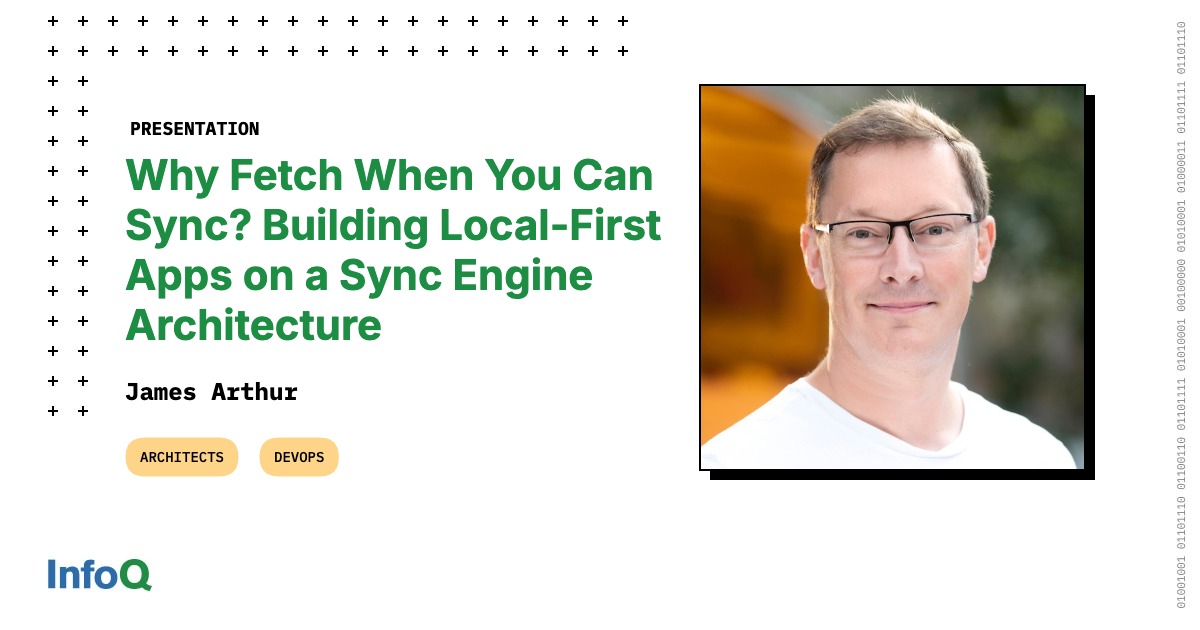
📖 Source: Presentation: Why Fetch When You Can Sync? Building Local-First Apps on a Sync Engine Architecture
Related Articles
Comments (0)
No comments yet. Be the first to comment!