
Swiggy's pLTV: 350+ Features & Multi-Task MLP Powering Ads

Alps Wang
Sep 3, 2026 · 1 views
Predicting Value in Sparse Data
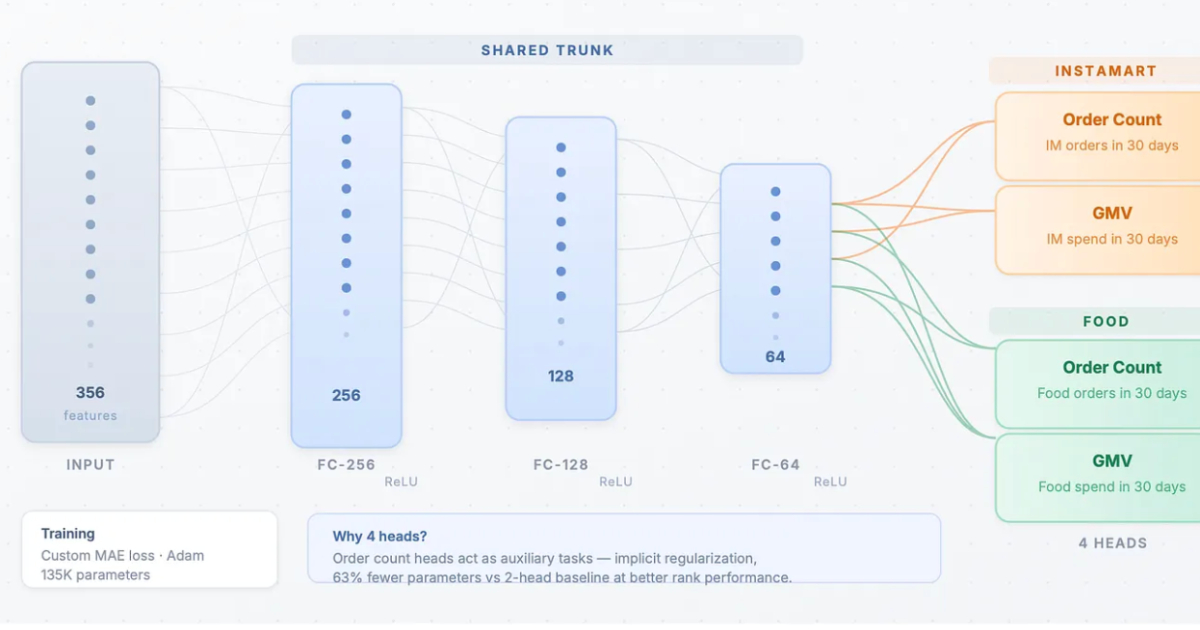
Swiggy's approach to predicting Customer Lifetime Value (pLTV) is a compelling case study in leveraging machine learning to tackle real-world business challenges, particularly in the 'cold start' problem inherent in new user acquisition. The use of over 350 features, meticulously gathered from pre-first-order data, demonstrates a deep understanding of the data landscape and a commitment to robust feature engineering. The innovative application of a multi-task learning MLP, where an auxiliary task (order count) not only improved accuracy but also significantly reduced model size, is a standout technical achievement. This efficiency gain is crucial for large-scale deployment and operational cost management. Furthermore, the shift in evaluation metrics from traditional regression scores to quantile-based ranking and diagonal coverage highlights a mature understanding of what truly drives business value in this context – distinguishing high-potential customers for targeted advertising.
However, a key limitation to consider is the inherent complexity introduced by such a large feature set. While effective, maintaining and interpreting hundreds of features can become a significant engineering and data governance challenge over time. The article mentions 'socioeconomic indicators,' which raises questions about data privacy and ethical considerations, especially in advertising contexts. The success of the model is also heavily reliant on the quality and availability of these diverse data sources. Future work moving towards probabilistic pLTV predictions is a logical and necessary next step to better capture uncertainty and improve bidding strategies, but this also adds another layer of complexity to the system. The comparison with a third-party platform, while favorable to Swiggy's in-house solution in terms of retention and GTV, didn't elaborate on the user acquisition cost differences beyond stating the external platform acquired more users per dollar spent, leaving a slight gap in a complete picture of advertising effectiveness.
This research is highly beneficial for e-commerce platforms, food delivery services, quick commerce businesses, and any organization grappling with new user acquisition and customer value prediction. It offers a practical blueprint for feature engineering, model selection (especially the multi-task learning aspect), and evaluation methodologies tailored for skewed data distributions. For data scientists and ML engineers, it showcases how a seemingly simple MLP architecture, when augmented with thoughtful multi-task learning and a comprehensive feature set, can outperform more complex models. The insights into evaluation metrics are particularly valuable for practitioners who might be struggling with similar data challenges. The implications for advertising technology are profound, suggesting a move towards more intelligent, value-driven bidding strategies that can optimize for long-term customer relationships rather than just immediate conversions. The adoption of this approach could lead to more efficient marketing spend and higher customer lifetime values across the industry.
Key Points
- Swiggy developed an in-house pLTV model to predict the long-term value of new customers across food delivery and Instamart.
- The model utilizes over 350 features, all available before a customer's first order, addressing the cold start problem.
- A multi-task learning MLP with shared hidden layers and task-specific heads for Food and Instamart was employed.
- Adding order count as an auxiliary task significantly reduced model parameters (63%) while improving accuracy.
- Evaluation shifted from traditional regression metrics to quantile-based ranking and diagonal coverage due to skewed data distributions.
- The model achieved a Spearman correlation above 0.75 and 70-80% diagonal coverage across value deciles.
- The pLTV signal is used with Google's tROAS bidding for advertising optimization.
- In-house model outperformed a third-party platform in retention and GTV per acquired user.
- Future work will focus on probabilistic pLTV predictions to incorporate uncertainty.
📖 Source: Swiggy Uses 350+ Features and Multi-Task MLP to Predict Customer Lifetime Value
Related Articles
Comments (0)
No comments yet. Be the first to comment!