
Swiggy's ML Search Powers Faster, Smarter Autocomplete

Alps Wang
May 19, 2026 · 1 views
Real-Time ML for Instant Search
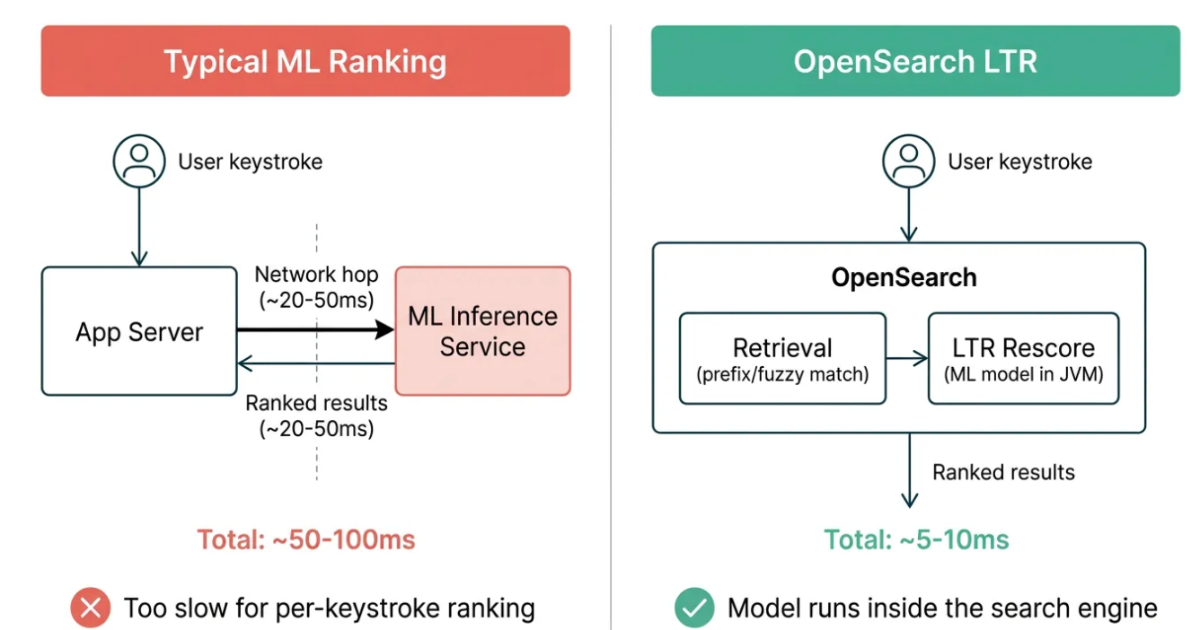
Swiggy's implementation of a real-time machine learning ranking system for search autocomplete is a compelling case study in optimizing user experience through advanced AI. The key innovation lies in integrating a learning-to-rank (LTR) model directly within OpenSearch, bypassing external services and minimizing latency. This architectural choice is crucial for autocomplete, where every keystroke demands an immediate, relevant response. The separation of candidate generation (recall-focused) and ranking (precision-focused), coupled with the strategic use of a feature store for both precomputed and streaming features, allows for a sophisticated yet performant system. The continuous feedback loop, utilizing click-through rates and conversion data to retrain models, ensures the autocomplete remains adaptive to evolving user preferences and trends, a significant upgrade from static, heuristic-based systems.
While the article highlights the benefits of low latency and improved relevance, a deeper dive into the trade-offs of model complexity versus serving efficiency would be valuable. The reliance on OpenSearch LTR, while efficient, might introduce constraints on the types or sophistication of models that can be deployed in real-time. Furthermore, the article touches upon the continuous feedback loop but doesn't extensively detail the operational challenges of managing these live retraining pipelines at scale, including data drift detection, model versioning, and rollback strategies. The success of such a system hinges on robust MLOps practices to ensure model quality and system stability. Nevertheless, for any platform dealing with high-volume, interactive search functionalities, Swiggy's approach offers a clear blueprint for enhancing user engagement through intelligent, low-latency AI.
Key Points
- Swiggy replaced a hand-tuned heuristic ranking with a real-time ML ranking model directly inside OpenSearch for search autocomplete.
- The system separates candidate generation (OpenSearch retrieval + embedding similarity) from ranking (ML models).
- A feature store serves both precomputed and streaming features, balancing real-time signals with efficiency.
- Learning-to-rank (LTR) models, integrated with OpenSearch (e.g., OpenSearch LTR, RankLib, XGBoost), are used for reordering suggestions.
- A continuous feedback loop retrains models using live user interaction data (CTR, conversions) to adapt to evolving behavior.
📖 Source: Swiggy Improves Search Autocomplete Using Real Time Machine Learning Ranking
Related Articles
Comments (0)
No comments yet. Be the first to comment!