
Spotify's AI-Powered Dev Tools: Days, Not Months

Alps Wang
Mar 17, 2026 · 1 views
AI Meets Platform: Spotify's Tooling Revolution
Spotify's presentation at QCon London 2026 highlights a compelling synergy between their internal developer platform, Portal Studio (built on Backstage), and Anthropic's Claude AI for accelerating internal tool development. The core innovation lies in leveraging AI to generate boilerplate code and scaffolding for portal plugins, drastically reducing the 'from prompt to production' timeline for small, often neglected internal tools. This directly addresses a common pain point in engineering organizations: the hidden cost and fragmentation caused by manual processes or ad-hoc scripts for essential but low-priority tooling. The platform's emphasis on governance through standardized templates, permissions, and auditability is crucial, ensuring that the speed gained through AI doesn't compromise operational safety and maintainability. This approach effectively democratizes internal tool creation, empowering teams to build solutions quickly within a controlled environment.
However, while the demonstration of reducing development time from months to days is impressive, the article doesn't deeply explore the potential limitations of AI-generated code. Reliance on AI for scaffolding might introduce subtle bugs or suboptimal architectures that require significant developer oversight and debugging, potentially shifting the effort rather than eliminating it entirely. Furthermore, the effectiveness of the AI component is heavily dependent on the quality of prompts and the AI model's understanding of Spotify's specific internal systems and coding standards. The article also touches on scalability, but the long-term implications of maintaining and evolving AI-generated code, especially as the codebase grows and LLM capabilities change, remain an area for further investigation. The success of this model hinges on continuous adaptation and robust human oversight to ensure code quality, security, and long-term maintainability.
Key Points
- Spotify leverages its internal developer platform, Portal Studio (built on Backstage), and Anthropic's Claude AI to dramatically accelerate internal tool development.
- The core problem addressed is the slow development and fragmentation of small, essential internal tools that are too small for dedicated resources.
- AI is used to generate scaffolding, templates, and initial code for portal plugins via natural language prompts, moving from idea to working tool in days.
- Portal Studio provides a local development and preview environment, ensuring tools integrate seamlessly into the developer portal.
- Platform engineering provides essential governance, including standardized templates, permissions, and auditability, to ensure safe production deployment of AI-generated tools.
- The combined approach enables a sustainable ecosystem for internal tooling by reducing duplicated work and promoting reuse of integrations and patterns.
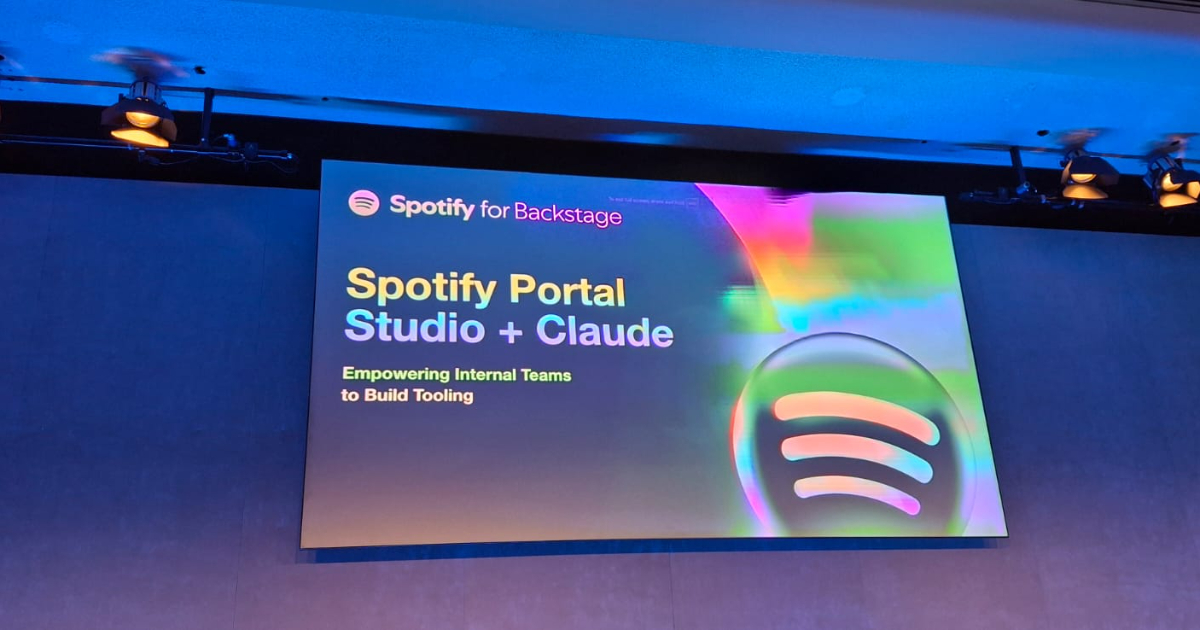
📖 Source: QCon London 2026: From Prompt to Production: How Spotify Builds Internal Tools in Days with AI
Related Articles
Comments (0)
No comments yet. Be the first to comment!