
Slack's AI Agents Revolutionize UI Test Resilience

Alps Wang
Jul 11, 2026 · 1 views
Agentic Testing: A Smarter Path to UI Automation
Slack's introduction of agentic testing for UI test automation is a significant step forward in addressing the persistent challenge of brittle end-to-end tests in dynamic software environments. The core innovation lies in shifting from rigid, script-based execution to an objective-driven approach where AI agents interpret intent and dynamically adapt to UI changes. This allows tests to maintain execution even when minor structural modifications occur, thereby reducing false positives and the associated maintenance overhead. The concept of an agent planning, executing, observing, and iterating based on higher-level goals is a powerful paradigm shift. Furthermore, the emphasis on observability and structured execution traces is crucial for debugging and understanding agent behavior. The acknowledgment of cost considerations, positioning agentic testing for targeted debugging and exploratory testing rather than full CI integration, demonstrates pragmatic engineering. This approach is particularly valuable for complex, rapidly evolving user interfaces where traditional selectors and flows are constantly in flux.
However, several limitations and concerns warrant consideration. The article highlights that agentic testing is currently not a replacement for deterministic tests, which remain essential for validating core logic and contract correctness. This implies a hybrid testing strategy is necessary, potentially increasing architectural complexity. The cost factor mentioned, while realistic, also suggests that widespread adoption might be constrained by computational resources and the sophistication of the AI models required. The "exploration boundaries" and "allowed actions" constraints are critical for managing agent behavior and preventing unintended consequences, but defining and tuning these effectively will likely be a complex and ongoing task. The success of agentic testing hinges on the agent's ability to accurately interpret intent and make intelligent decisions. The article doesn't delve deeply into the AI models or techniques used, leaving questions about their robustness, interpretability, and potential biases. While it promises improved resilience, the complexity of implementing and managing these AI agents could introduce new forms of fragility and debugging challenges if not meticulously designed and maintained. The article also doesn't explicitly address the learning curve for engineers adopting this new paradigm.
Key Points
- Slack has introduced "agentic testing" for UI test automation.
- This approach uses AI agents to interpret higher-level test intents rather than following rigid scripts.
- Agents dynamically adapt to UI changes, improving test resilience and reducing maintenance overhead.
- Agentic testing is positioned for targeted debugging and exploratory testing due to cost considerations, not as a replacement for CI's deterministic tests.
- The system emphasizes observability with detailed execution traces for debugging.
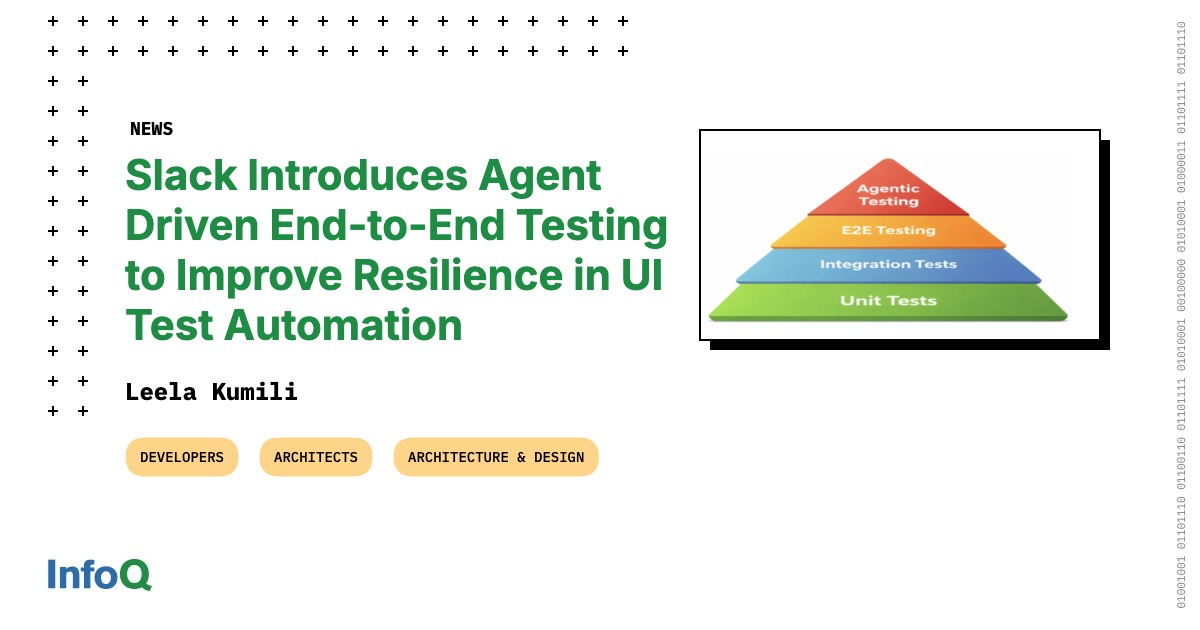
📖 Source: Slack Introduces Agent Driven End-to-End Testing to Improve Resilience in UI Test Automation
Related Articles
Comments (0)
No comments yet. Be the first to comment!