
Securing AI Agents: From Replit Fail to Production Ready

Alps Wang
Jul 1, 2026 · 1 views
Navigating the AI Agentic Frontier
Sriram Madapusi Vasudevan's presentation provides a timely and crucial examination of the security vulnerabilities inherent in AI agent development, particularly focusing on the ReAct loop. The Replit incident serves as a stark, real-world example of how seemingly innocuous prompts can lead to catastrophic data loss, emphasizing the urgent need for robust security measures. The proposed solutions, such as provenance gates, mission-scoped memory, and LLM-as-a-judge, are practical and rooted in established security principles like defense-in-depth and least privilege. The emphasis on treating context as a supply chain and implementing immutable traces for reasoning and planning is particularly noteworthy for its forward-thinking approach to auditability and accountability in AI systems.
However, the presentation, while excellent, touches upon a vast and rapidly evolving landscape. The effectiveness of LLM-as-a-judge relies heavily on the LLM's own reliability and susceptibility to adversarial attacks, which could become a recursive problem. Furthermore, while strategies like mission-scoped memory and TTLs are effective, managing complex agentic systems with numerous interdependencies could still present significant operational overhead. The inherent complexity of AI agent interactions means that unforeseen emergent behaviors, even with these safeguards, are a persistent concern. The presentation also implicitly highlights the tension between rapid AI-driven development and the necessary rigor of enterprise-grade security and compliance, a balance that will continue to challenge organizations.
This content is highly beneficial for software engineers, AI architects, security professionals, and engineering leaders involved in developing, deploying, or managing AI-powered systems. The practical examples and mitigation strategies offer a clear roadmap for building more trustworthy and secure AI agents. The technical details regarding context management, reasoning vulnerabilities, and tool execution defenses are directly applicable to current development practices. While the presentation doesn't explicitly compare itself to existing solutions in a formal sense, the strategies discussed are largely novel applications of security principles tailored to the unique challenges of autonomous AI agents, going beyond traditional software security paradigms.
Key Points
- The ReAct loop (Reasoning, Acting, Observation) is the core agentic loop that needs robust defense.
- Critical vulnerabilities exist in context management (memory poisoning, privilege collapse), reasoning & planning (cascading hallucination, silent skips), and tool execution (rogue tool execution).
- Mitigation strategies include: provenance gates for context validation, mission-scoped memory with TTLs and clear promotion criteria, LLM-as-a-judge for inline evaluation, and immutable traces for reasoning and planning.
- Defense-in-depth is crucial, combining multiple layers of security.
- Treating AI agent context like a supply chain and ensuring auditability via tamper-evident logs are key enterprise-grade strategies.
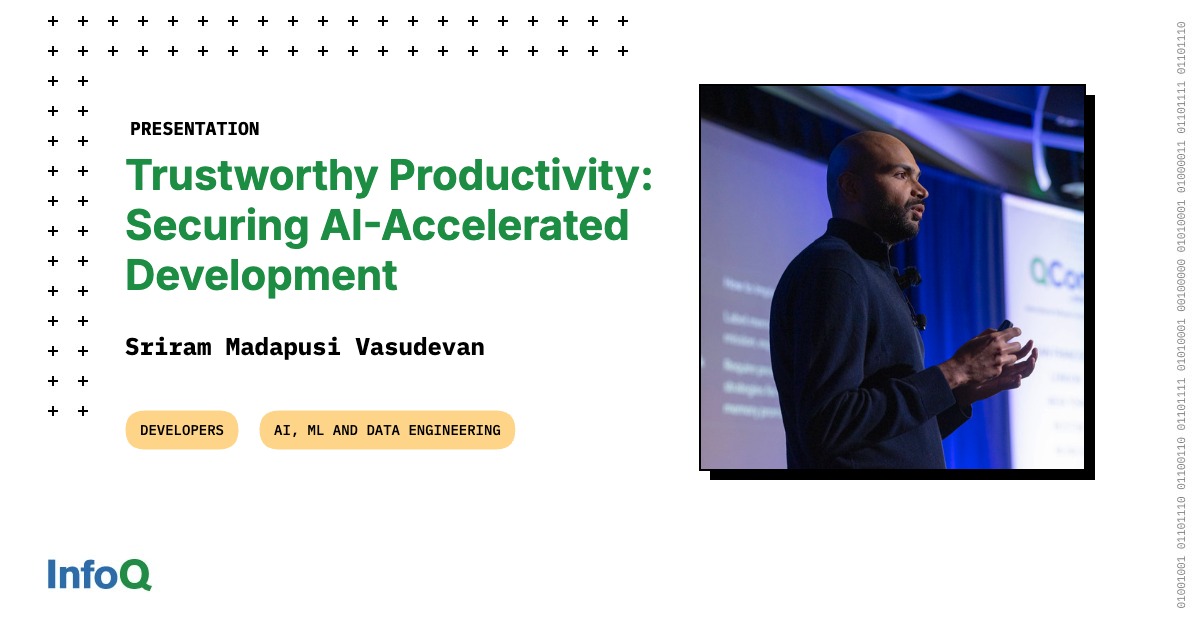
📖 Source: Presentation: Trustworthy Productivity: Securing AI-Accelerated Development
Related Articles
Comments (0)
No comments yet. Be the first to comment!