
Samsung's Real-Time Pricing: Lambda Streaming Success

Alps Wang
Jun 16, 2026 · 1 views
Streaming for Real-Time E-commerce
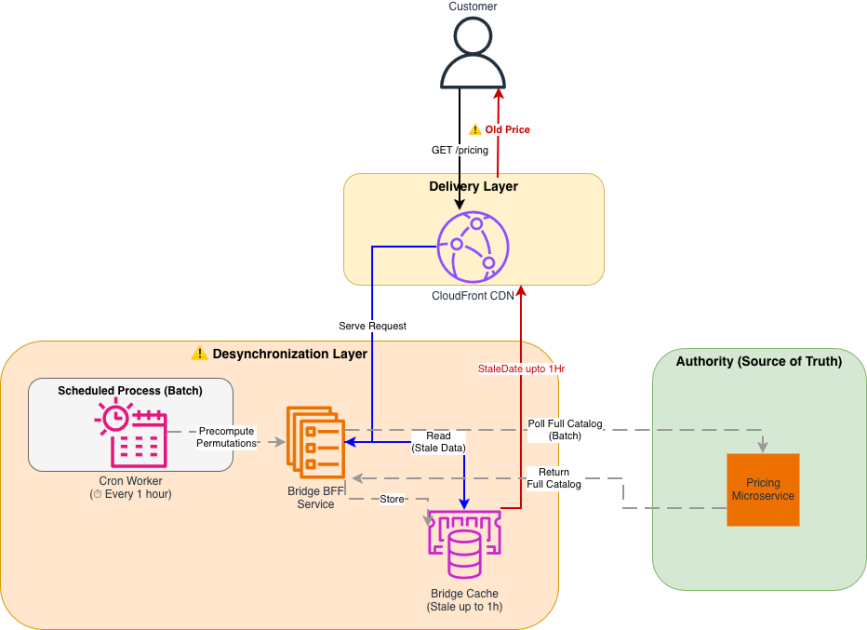
Samsung's implementation of AWS Lambda Response Streaming for real-time pricing is a compelling case study in overcoming architectural latency in high-traffic e-commerce. The shift from a stateful, cache-dependent Data Aggregation (DA) model to a stateless Bulk Arbitration Engine (BAE) using Lambda streaming directly addresses the core problem of desynchronization and the 'permutation explosion.' The innovation lies in effectively leveraging Lambda's streaming capabilities to fan out requests to the pricing engine and stream results back immediately, drastically reducing time-to-first-byte. The clever use of a compressed query string to enable caching of complex GET requests via CloudFront is also a noteworthy technical achievement, balancing flexibility with performance. This pattern is highly applicable to any scenario requiring real-time data aggregation from multiple backend sources for high-traffic APIs.
However, the approach isn't without potential limitations. The reliance on a custom compressed query string format, while effective, introduces a degree of coupling between the client and backend implementation. Any changes to this format would require coordinated updates. Furthermore, the article mentions a 5-minute default TTL for CloudFront caching. While this is a reasonable balance, for extremely dynamic pricing scenarios (e.g., sub-minute flash sales), this TTL might still introduce a slight lag, although significantly less than the previous hourly desynchronization. The complexity of managing the Lambda function, including potential cold starts (though mitigated by the streaming nature and CloudFront caching), and the need for careful error handling in a streaming pipeline, are also considerations for adoption. Organizations adopting this pattern must have robust monitoring and tracing in place to manage these aspects effectively.
Key Points
- Samsung addressed critical pricing inconsistency and cart shock in high-traffic e-commerce by implementing AWS Lambda Response Streaming.
- The legacy architecture suffered from a 1-hour desynchronization gap due to asynchronous middleware caching, leading to outdated prices.
- The new stateless Bulk Arbitration Engine (BAE) uses Lambda to fan out requests to the Pricing Engine in parallel and streams results immediately, eliminating intermediate caching.
- Lambda Response Streaming was chosen over buffered responses or EC2 with caching for its ability to stream results as they arrive and maintain statelessness.
- A custom compressed query string format was developed to fit complex data into GET requests, enabling CloudFront caching.
- CloudFront was configured with a precise cache policy including query strings and specific headers to cache these dynamic requests effectively.
- The solution uses NDJSON for parsing streaming data and GZIP compression with Z_BEST_SPEED for low latency.
📖 Source: How Samsung achieved real-time pricing with AWS Lambda Response Streaming
Related Articles
Comments (0)
No comments yet. Be the first to comment!