
Rust & Typst: Revolutionizing PDF Generation

Alps Wang
Jun 30, 2026 · 1 views
Beyond Legacy PDF Pains
Erik Steiger's presentation effectively highlights the pervasive operational pain associated with legacy PDF generation systems, particularly in regulated industries. The core innovation lies in leveraging Rust and Typst to create a highly performant, serverless document infrastructure. The dramatic reduction in latency (below 2ms) and memory consumption, coupled with cost savings (less than 50 cents per million PDFs), are truly impressive. The application of Git and Docker concepts to template registries is a smart move towards ensuring compliance and maintainability, directly addressing the chaotic workflows often encountered with older tools like Crystal Reports. The serverless Rust architecture with Typst as the rendering engine offers a compelling modern alternative, promising not just speed but also a better developer experience through tools like cargo-lambda.
However, while the focus on speed and efficiency is paramount, the presentation could benefit from a deeper dive into the practicalities of managing complex, dynamic templates and error handling in a production environment. The mention of 'no retry and error handling' in the initial implementation, though acknowledged as a point for improvement, leaves room for concern regarding robustness for high-stakes applications. The discussion on caching is promising for extreme performance, but the intricacies of cache invalidation for dynamic data and template changes in a distributed serverless environment warrant further exploration. Furthermore, while Typst is presented as a superior alternative to LaTeX and Puppeteer, a more direct comparison of its capabilities for highly complex layouts, scientific notation, or intricate graphical elements would be beneficial for developers evaluating its suitability for diverse use cases. The integration with existing enterprise systems and data sources, beyond simple JSON injection, could also be a crucial consideration for broader adoption.
Key Points
- Legacy PDF generation tools (Crystal Reports, LaTeX, Puppeteer) suffer from performance issues, high resource consumption, and poor developer experience.
- Typst, a modern typesetter, offers a lean, fast, and developer-friendly alternative to LaTeX, with simpler installation and better error messaging.
- A serverless Rust architecture on AWS Lambda, utilizing Typst, can achieve sub-100ms rendering times and drastically reduce costs (under $0.50 per million PDFs).
- Applying Git and Docker concepts to template registries enhances compliance, maintainability, and debugging for document generation workflows.
- Caching template compilation allows for sub-2ms rendering times by only re-rendering changed data sections.
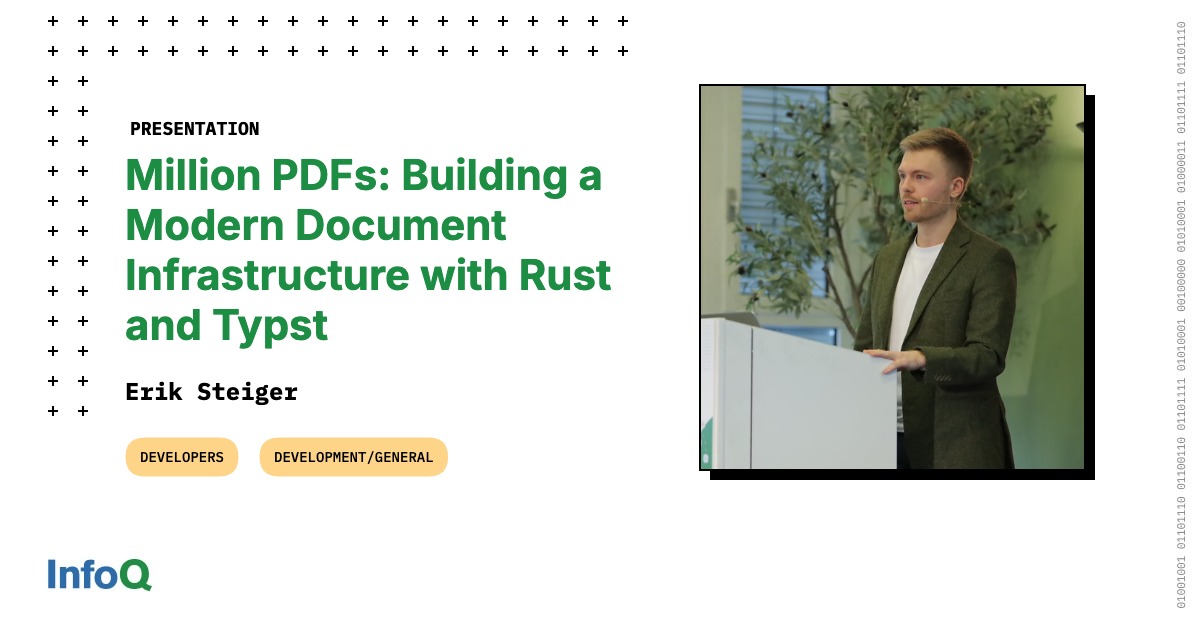
📖 Source: Presentation: Million PDFs: Building a Modern Document Infrastructure with Rust and Typst
Related Articles
Comments (0)
No comments yet. Be the first to comment!