
ReadyOn's 4-Layer EKS Isolation for Multi-Tenant Security

Alps Wang
Oct 26, 2026 · 1 views
Fortifying Multi-Tenancy in EKS
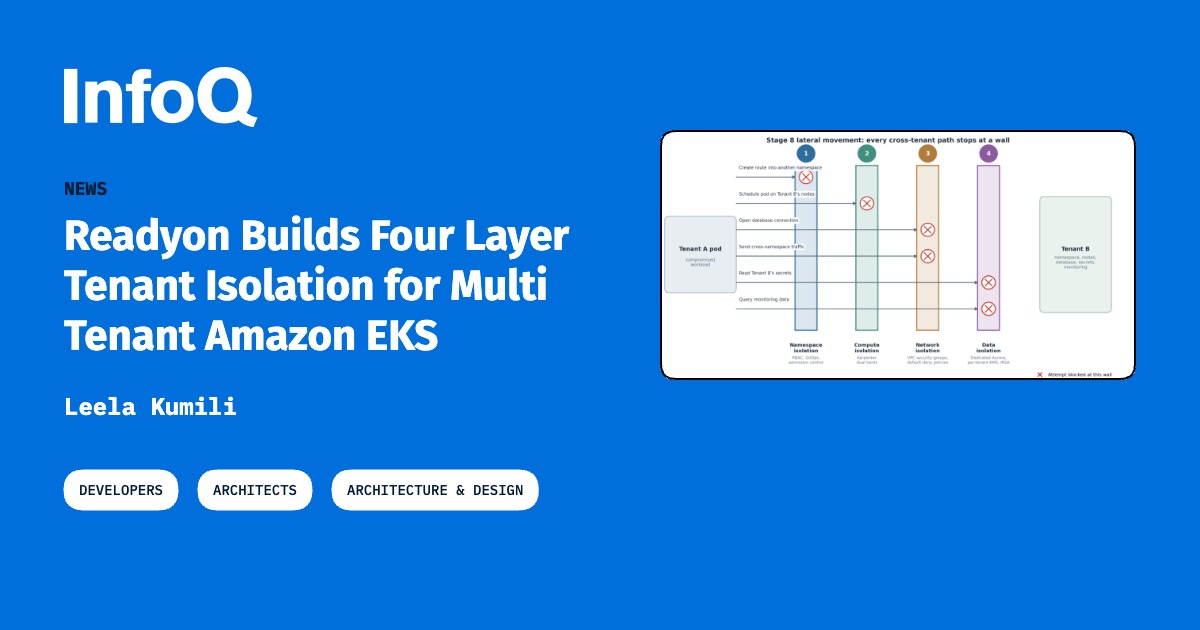
ReadyOn's four-layer tenant isolation strategy for Amazon EKS represents a sophisticated and pragmatic approach to a critical multi-tenancy challenge. The combination of Kubernetes namespaces with RBAC, dedicated Karpenter node pools, VPC security groups, and per-tenant Aurora databases creates a robust defense-in-depth. This layered model effectively addresses the inherent security complexities of shared infrastructure, particularly concerning lateral movement from compromised workloads. The mapping to a 10-stage threat model and the emphasis on adversarial exercises lend credibility to their security posture. The use of GitOps via Argo CD ApplicationSets for generating baseline controls is a commendable practice for ensuring consistency and automated reconciliation, a crucial aspect for managing complex multi-tenant environments at scale.
While the architecture is impressive, the discussion around observability is pertinent. As noted by Juan Pablo Gaviria, the effectiveness of isolation controls is directly tied to the ability to observe and verify them. Without deep observability that correlates workload identity with network and data enforcement, even the most robust isolation can foster a false sense of security. This highlights the ongoing challenge of balancing isolation strength with the operational overhead of monitoring and debugging such complex systems. The decision to retain a shared EKS environment while extending isolation to AWS networking and data layers is a pragmatic choice, acknowledging the operational benefits of a single EKS control plane, but it necessitates meticulous attention to the security boundaries between these layers.
This solution is particularly beneficial for SaaS providers and enterprise applications that host multiple distinct customers on shared cloud infrastructure. Companies running sensitive data or requiring strict compliance mandates will find the detailed approach to layered security highly valuable. Developers and architects working with Kubernetes on AWS, especially those facing multi-tenancy requirements, should consider this a strong reference architecture. The innovation lies not in a single novel component, but in the intelligent orchestration and integration of existing AWS and Kubernetes primitives to achieve a comprehensive security posture. The implications for building scalable, secure, and compliant multi-tenant applications on EKS are significant, pushing the envelope for what's considered standard practice.
Key Points
- ReadyOn implements a four-layer tenant isolation strategy on Amazon EKS for its Harmony platform.
- Layers include Kubernetes namespaces (with RBAC, quotas, admission controls), dedicated Karpenter node pools, VPC security groups, and per-tenant Amazon Aurora databases.
- The approach is mapped to a 10-stage multi-tenant threat model, focusing on preventing lateral movement.
- Argo CD ApplicationSets are used for GitOps-driven generation and reconciliation of baseline controls.
- Dedicated node pools utilize a dual taint strategy for compute isolation.
- VPC security groups restrict database connections below the Kubernetes layer.
- The architecture emphasizes layered, overlapping defenses rather than relying on any single layer for complete isolation.
- Observability is highlighted as a crucial, yet potentially challenging, aspect for verifying isolation effectiveness.
📖 Source: Readyon Builds Four Layer Tenant Isolation for Multi Tenant Amazon EKS
Related Articles
Comments (0)
No comments yet. Be the first to comment!