
Postgres: The Unsung Hero of AI Agents

Alps Wang
Jul 16, 2026 · 1 views
Relational Roots for Intelligent Agents
Gwen Shapira's presentation compellingly argues for PostgreSQL's suitability as a foundational database for enterprise AI agents. The core insight is that modern PostgreSQL, with its multi-modal capabilities like JSONB and HNSW vector indexing, is not just a relic of traditional data management but a powerful, flexible engine for the complex data demands of LLMs. The emphasis on leveraging existing relational data alongside vector embeddings for context retrieval, and the discussion around agentic workflows where the LLM utilizes database tools, are particularly strong. The presentation effectively bridges the gap between traditional database expertise and the burgeoning AI landscape, highlighting how familiar tools can be adapted for novel applications.
However, a potential limitation lies in the implicit assumption that all teams possess the necessary expertise to deeply integrate and optimize PostgreSQL for these advanced AI workloads. While the presentation showcases impressive capabilities, the nuances of tuning HNSW indexes, managing vector quantization for performance, and designing effective agentic tool interactions can still present a steep learning curve. Furthermore, the discussion on agentic memory and its management, while touched upon, could benefit from more concrete architectural patterns and best practices beyond just stating it's an infrastructure problem. The comparison with other potential solutions, especially specialized vector databases, is hinted at but not deeply explored, leaving room for questions about when pure relational approaches might fall short.
Despite these minor points, the presentation is highly beneficial for developers, data engineers, and architects working on or planning to implement AI features, particularly within enterprise environments where reliability and scalability are paramount. It provides a strong case for reconsidering PostgreSQL not just as a data store, but as an active participant in the AI inference pipeline. By demonstrating how complex data retrieval and manipulation for LLM context can be handled within a single, robust relational system, it offers a path to simplify architectures and reduce operational overhead compared to managing disparate specialized databases. The detailed examples of relational queries for context generation are particularly valuable for those looking to implement RAG or agentic patterns with a familiar toolset.
Key Points
- PostgreSQL's multi-modal capabilities (JSONB, HNSW vector indexing) are critical for providing deterministic and semantic context to LLMs.
- Modern SQL and relational databases offer significant flexibility for complex data retrieval and manipulation, often negating the need for specialized databases like graph databases.
- Vector quantization can dramatically speed up query performance (e.g., 4x) for AI workloads.
- Agentic workflows can leverage PostgreSQL as a tool, reversing the control loop by allowing LLMs to interact with the database via predefined tools.
- Managing agentic memory is an infrastructure problem that PostgreSQL can help address through its robust data management features.
- Traditional relational data structures are a valuable source of context for LLMs, complementing vector-based similarity searches.
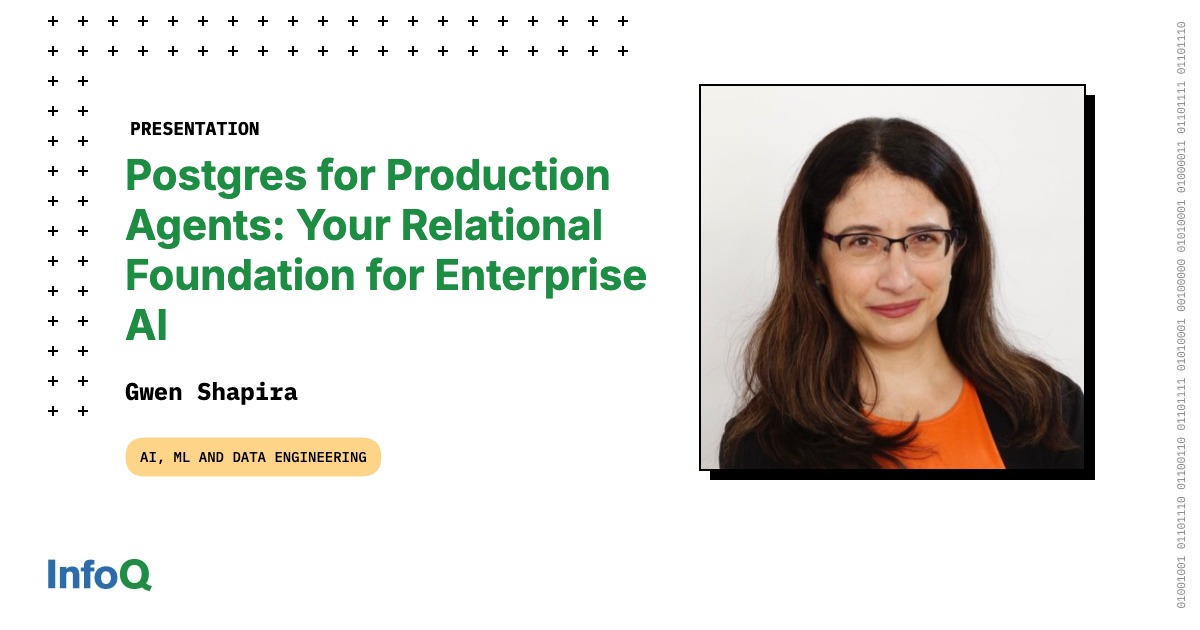
📖 Source: Presentation: Postgres for Production Agents: Your Relational Foundation for Enterprise AI
Related Articles
Comments (0)
No comments yet. Be the first to comment!