
Pinterest's AI-Powered URL Deduplication Unveiled

Alps Wang
Jun 9, 2026 · 1 views
Beyond Static Rules: Pinterest's Content Fingerprinting
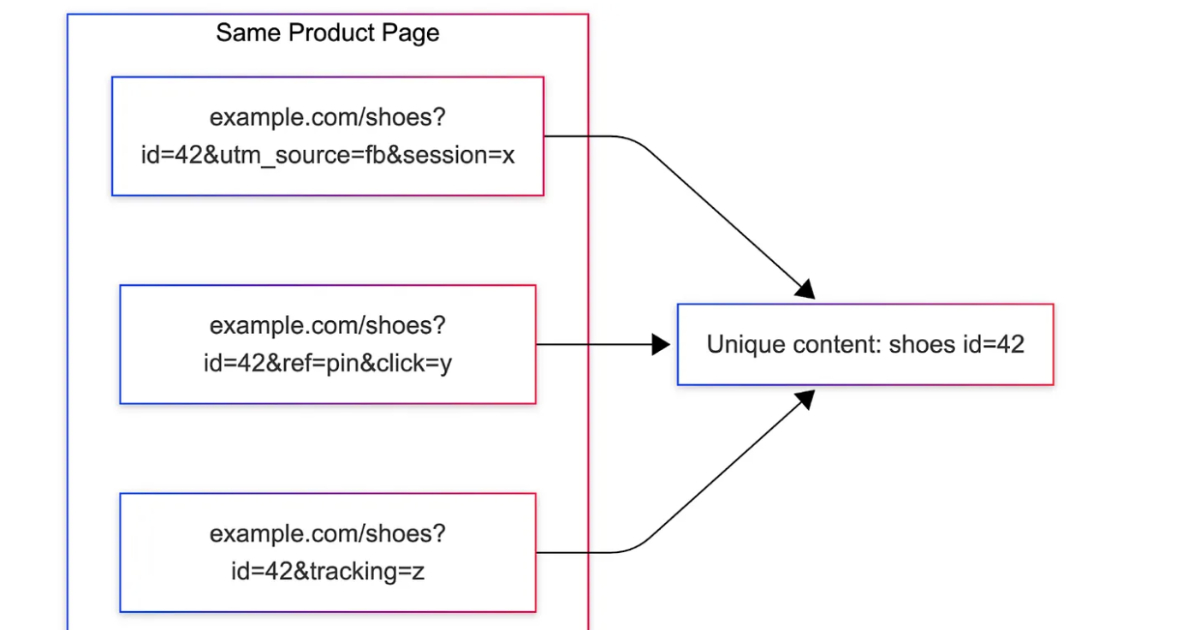
Pinterest's MIQPS system represents a sophisticated evolution in URL normalization, moving beyond brittle, manually maintained rule sets to a dynamic, content-aware approach. The core innovation lies in using content fingerprints derived from page rendering to infer the importance of query parameters. This data-driven methodology is particularly impactful for handling the 'long tail' of diverse merchant and publisher domains, where static rules falter. By evaluating the actual impact of parameter removal on content, MIQPS achieves a more accurate and scalable deduplication, directly addressing the significant infrastructure overhead associated with processing redundant URLs. The separation of offline analysis and runtime processing, coupled with anomaly detection for updates, demonstrates a robust engineering solution designed for massive scale and reliability.
The implications for other large-scale content ingestion platforms are substantial. Any service dealing with web crawling, indexing, or content aggregation – from search engines and social media platforms to e-commerce aggregators – can draw valuable lessons from MIQPS. The emphasis on observable content behavior rather than relying on potentially unreliable metadata like canonical tags is a critical insight. However, a potential limitation could be the computational cost of the offline analysis, especially for extremely dynamic or rapidly changing content. While Pinterest notes that URL structures evolve slowly, the frequency of re-evaluation and the resource requirements for large-scale rendering and fingerprinting would be a key consideration for adoption. Furthermore, the effectiveness of the 'defined threshold' for content change detection is crucial; a poorly calibrated threshold could lead to either over-deduplication (losing important variations) or under-deduplication (missing duplicates).
Developers and architects responsible for scaling content pipelines will find this article highly relevant. It offers a practical blueprint for tackling URL variations at scale, emphasizing intelligence over brute force. The MIQPS approach highlights the power of AI/ML in solving complex, real-world engineering challenges by analyzing actual outcomes. The system's ability to adapt to heterogeneous URL conventions without extensive manual configuration is a testament to its intelligent design. This is not just a feature update; it's a foundational architectural pattern for efficient, large-scale web data processing.
Key Points
- Pinterest developed MIQPS (Minimal Important Query Param Set) to deduplicate URLs across millions of domains.
- MIQPS uses a data-driven approach, evaluating content changes when query parameters are removed, unlike traditional rule-based methods.
- It infers parameter importance by observing content behavior through page rendering and fingerprinting, making it robust against unreliable canonical tags.
- The system separates expensive offline analysis from efficient runtime processing.
- Anomaly detection protects against incorrect parameter importance downgrades.
- This approach significantly reduces infrastructure overhead by avoiding redundant fetching, rendering, and indexing of duplicate content.
📖 Source: Pinterest Uses Content Fingerprints for URL Deduplication Across Millions of Domains
Related Articles
Comments (0)
No comments yet. Be the first to comment!