
OpenAI's WebRTC Rethink for AI Voice Scale

Alps Wang
May 21, 2026 · 1 views
Deconstructing OpenAI's WebRTC Edge
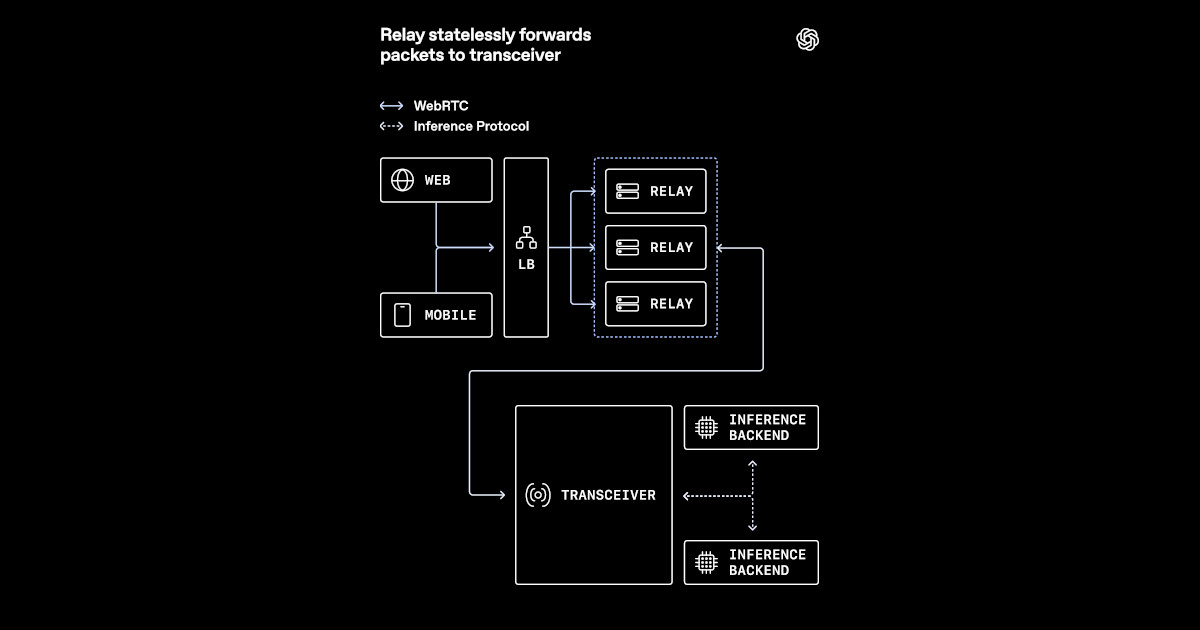
OpenAI's architectural evolution for WebRTC at scale is a compelling case study in balancing performance, scalability, and operational complexity. The core innovation lies in the separation of concerns: a stateless relay layer for efficient packet forwarding and a stateful transceiver layer for managing the intricate WebRTC session state. This decomposition is particularly insightful for cloud-native environments like Kubernetes, where traditional, monolithic approaches to media termination can become unwieldy. By concentrating the complexity of ICE negotiation, DTLS, SRTP, and session lifecycle management within the transceiver, OpenAI enables the relay to remain lean and highly scalable. This design choice effectively decouples the real-time media path from the stateful control plane, a crucial pattern for building robust and resilient distributed systems.
While the article highlights the benefits of this approach for 1:1 sessions, a potential area for further exploration would be its extensibility to multi-party conferencing scenarios, which are common in many voice AI applications. The stated preference for a transceiver design over an SFU (Selective Forwarding Unit) is justified by their current workload, but understanding how this architecture might adapt to more complex media topologies would be valuable. Furthermore, the choice to keep the transceiver layer at the edge, terminating WebRTC and converting to a backend protocol, implies a specific set of backend integration requirements. The performance and scalability of this conversion process itself, and the potential for introducing latency or bottlenecks there, warrant closer examination. Nevertheless, the overall strategy of abstracting away WebRTC complexity into a dedicated, stateful edge component while leveraging lightweight, scalable relays is a significant contribution to the field of real-time AI infrastructure.
Key Points
- OpenAI has redesigned its WebRTC architecture for low-latency voice AI at global scale.
- The new approach replaces a conventional media termination model with a relay-transceiver design.
- This architecture separates stateless relays for packet forwarding from stateful transceivers for WebRTC session management (ICE, DTLS, SRTP).
- The design is optimized for Kubernetes and cloud load balancers, reducing public UDP exposure and keeping media routing close to users.
- Key constraints driving the change were global reach, fast connection setup, and low, stable media round-trip times.
- This pattern concentrates complexity in a thin routing layer rather than duplicating it across backend services or custom client behavior.
📖 Source: OpenAI Outlines WebRTC Architecture for Low-Latency Voice AI at Scale
Related Articles
Comments (0)
No comments yet. Be the first to comment!