
OpenAI's GPT-Live: Real-Time Voice AI Breakthrough

Alps Wang
Aug 4, 2026 · 1 views
The Architecture of Conversational Flow
OpenAI's GPT-Live represents a monumental leap in achieving natural, real-time voice AI interaction, fundamentally rethinking the turn-based architecture that has historically limited conversational fluidity. The core innovation lies in the full-duplex, streaming model that eliminates the lag introduced by turn detectors, allowing the AI to listen and speak concurrently. This not only enhances the user experience by making conversations feel more immediate and less robotic but also opens up new possibilities for complex agent coordination and computer control, as demonstrated in the ChatGPT desktop app. The meticulous engineering effort, spanning six months, focused on optimizing every layer—from model inference and context management to media transport—to sustain an uninterrupted media loop. The separation of the media path from application logic is a particularly elegant design choice, ensuring responsiveness is prioritized while allowing for flexible customization of backend services and tools without impacting the core voice experience.
However, the success of GPT-Live hinges on its ability to manage stateful inference at scale. While OpenAI details sophisticated mechanisms for model instance handoffs and dynamic context compaction, the operational overhead and potential for subtle latency creep during these transitions remain critical considerations. The effectiveness of the WebRTC Abridged Roundtrip Protocol (WARP) and Instant Connect in reducing startup latency is impressive, but the reliance on these specific protocol optimizations might create integration challenges for developers not already deeply embedded in the WebRTC ecosystem. Furthermore, while the article emphasizes decoupling 'talking' from 'thinking' by delegating to frontier models, the latency budget for this delegation path is still a significant factor. Any slowdown in reasoning, tool use, or prompt processing on the frontier model side, even if off the main media loop, will eventually impact the perceived responsiveness of the entire system. The success of GPT-Live in production will ultimately depend on the continuous refinement of these off-path processes and the robust handling of edge cases in continuous speech segmentation, especially during speaker overlap or substantive interjections.
Key Points
- GPT-Live eliminates turn detectors for truly full-duplex, real-time voice AI.
- Achieves conversational immediacy by streaming audio directly to the voice model.
- Separates the low-latency media path from asynchronous application logic (tool use, deeper reasoning).
- Employs stateful inference with seamless model instance handoffs and dynamic context compaction.
- Optimizes startup latency with WARP (WebRTC Abridged Roundtrip Protocol) and Instant Connect.
- Enables complex agent coordination and computer control within ChatGPT Voice.
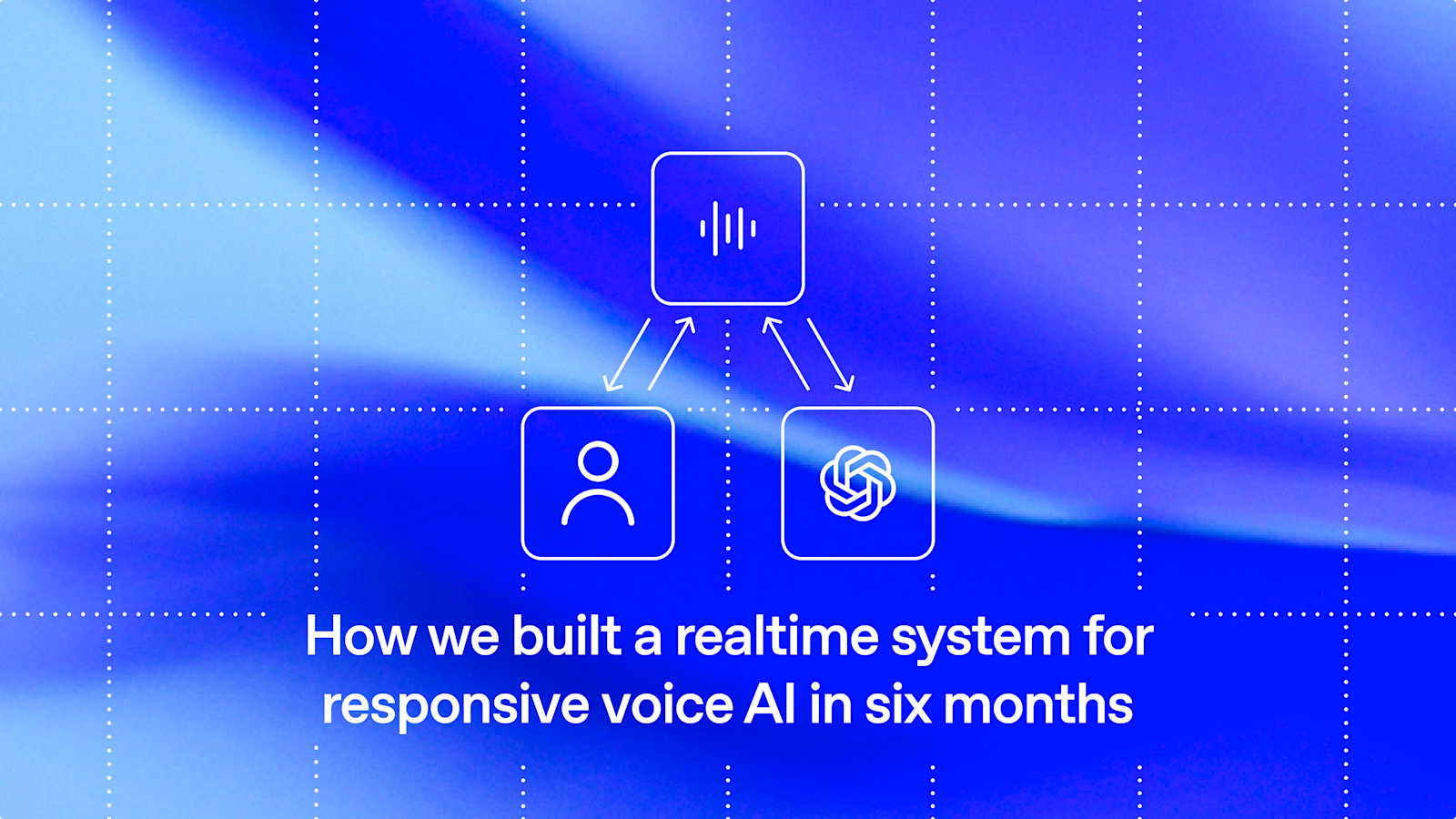
📖 Source: How we built a realtime system for responsive voice AI in six months
Related Articles
Comments (0)
No comments yet. Be the first to comment!