
Netflix's LLM Serving: Inside the Tech Stack

Alps Wang
Jul 18, 2026 · 1 views
Beyond the API: Netflix's LLM Engineering Prowess
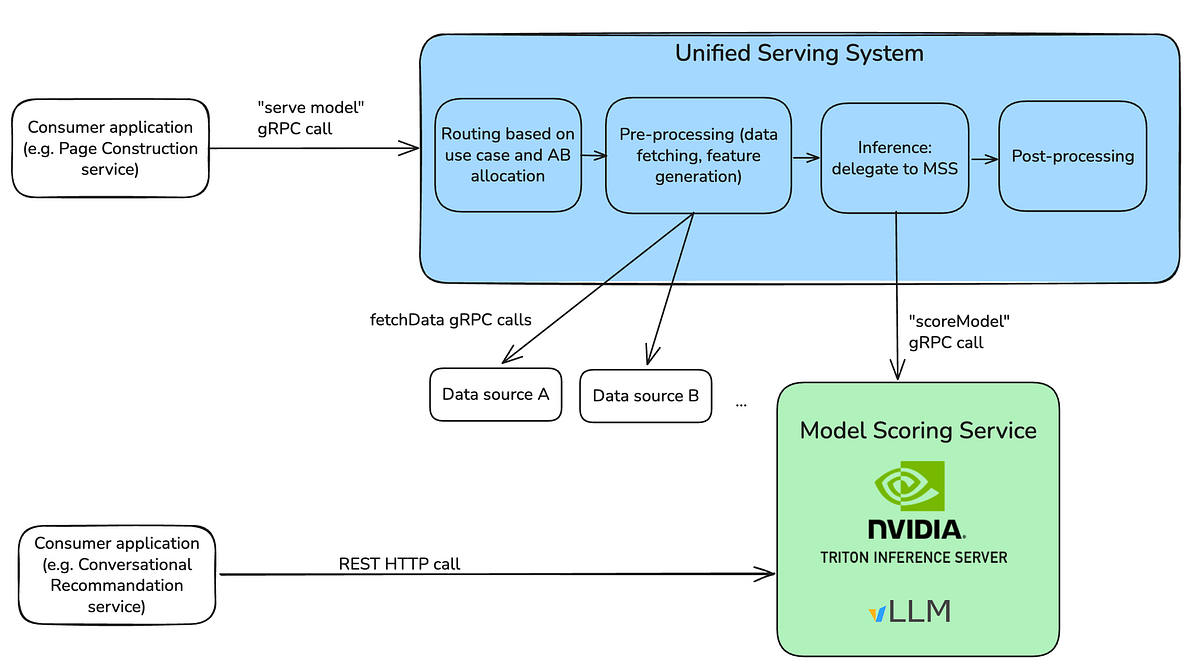
Netflix's detailed account of their in-house LLM serving infrastructure provides a masterclass in tackling complex ML deployment challenges. The decision to integrate LLMs into their existing JVM-based serving system, rather than creating a separate ML silo, is a significant architectural choice that emphasizes operational efficiency and unified tooling. The deep dive into engine selection (vLLM over TensorRT-LLM), model packaging (vLLM backend for independent evolution), API surface (OpenAI-compatible alongside gRPC), and deployment strategies (Red-Black vs. Versioned) reveals a mature, pragmatic approach to production ML. The insights into production-revealed issues, such as Triton/vLLM version mismatches and the need for custom logic via the Python backend, are particularly valuable for organizations embarking on similar journeys. The detailed explanation of constrained decoding at scale, showcasing the evolution from vLLM V0 to V1 and the performance gains from batch-level processing, highlights the intricate optimizations required for real-world LLM applications.
However, the article, while comprehensive, could benefit from a more explicit discussion on the long-term cost implications of managing such a complex in-house infrastructure compared to leveraging managed cloud services, especially as LLM models and hardware evolve. The emphasis on internal tooling and engineering effort suggests a substantial investment. Furthermore, while the OpenAI-compatible API offers seamless integration, it also implies a dependency on that ecosystem's standards. Future challenges and strategic directions, such as prompt compression and vectorized logits processors, are exciting but could be elaborated upon with more concrete examples of their expected impact on performance and cost. The article effectively demonstrates how Netflix is pushing the boundaries of what's possible with self-managed LLM serving, but a broader perspective on the trade-offs versus external solutions would enhance its completeness.
Key Points
- Netflix developed a comprehensive in-house LLM serving platform, integrating it into their existing JVM-based serving system.
- Key decisions included selecting vLLM as the primary inference engine for its flexibility and extensibility, and using its backend for model packaging to ensure independent evolution of models and frontends.
- The platform exposes an OpenAI-compatible API alongside their internal gRPC interface for seamless integration with the LLM ecosystem.
- Deployment strategies like Red-Black and Versioned are employed to manage model rollouts, with Versioned used for breaking interface changes.
- Production challenges included Triton/vLLM version mismatches, the need for custom logic via the Python backend, and the complexities of constrained decoding at scale.
- Significant engineering effort was invested in optimizing constrained decoding, moving from per-request CPU-bound processing in vLLM V0 to efficient batch-level C++ implementation in vLLM V1.
- Observability was enhanced by creating a unified /metrics endpoint merging Triton and vLLM metrics.
- Future investments focus on prompt compression, asynchronous scheduling, vectorized logits processors, and lower-precision models.
📖 Source: In-House LLM Serving at Netflix
Related Articles
Comments (0)
No comments yet. Be the first to comment!