
Netflix's GenRec: LLMs Revolutionize Recommendations

Alps Wang
Jul 31, 2026 · 1 views
LLMs Powering Next-Gen Recommendations
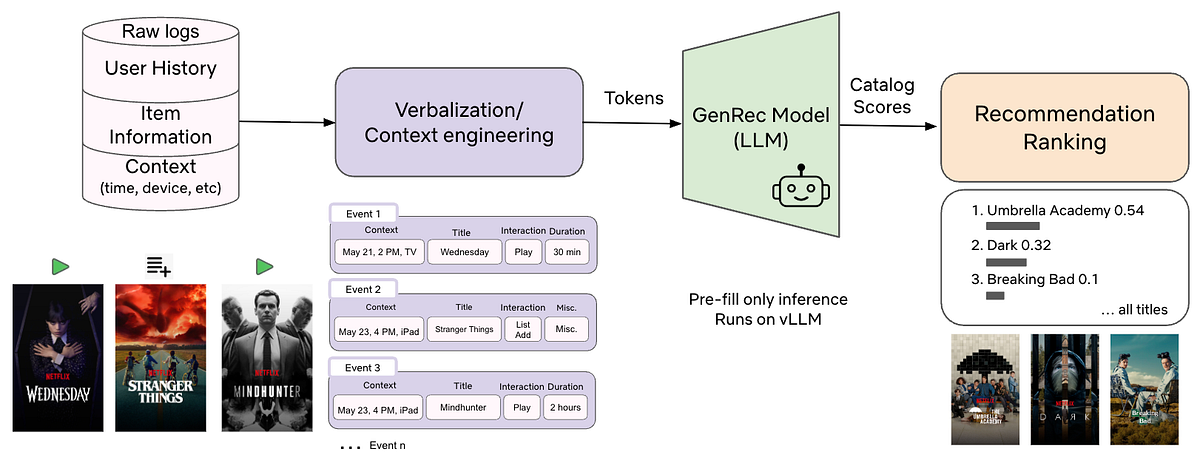
Netflix's GenRec represents a compelling leap towards LLM-native recommendation systems, demonstrating that a post-trained foundation LLM can rival or surpass mature, feature-engineered systems. The innovation lies in its 'context engineering' approach, transforming raw interaction logs into natural language prompts, thereby allowing the LLM to infer complex user preferences and item relationships without explicit feature creation. This shift from feature engineering to context engineering is a significant paradigm change, promising greater agility in onboarding new content types and product surfaces. The use of reward-weighted loss for aligning with long-term member value and business goals, rather than solely relying on immediate engagement metrics, is also a crucial advancement for responsible AI deployment in a user-centric platform.
However, the reliance on a 'prefill-only' inference mode for cost efficiency, while effective, highlights the ongoing challenges of serving LLMs at scale. The effectiveness of context engineering is directly tied to the LLM's ability to interpret and prioritize information within a fixed token budget, a process that is likely still an area of active research and potential refinement. Furthermore, while GenRec shows impressive data efficiency compared to traditional methods, the initial 'Phase 1' training of the foundation LLM on proprietary Netflix data still represents a substantial upfront investment. The article also touches upon the potential for text-generation use cases like recommendation explanations, which, if fully realized, could further enhance user transparency and engagement, though this remains a future development.
Despite these considerations, GenRec's success in a large-scale A/B test, achieving significant improvements in both short-term and long-term metrics with fewer resources, is a strong testament to its efficacy. This work is highly relevant to any organization aiming to leverage LLMs for complex personalization tasks, offering a practical blueprint for integrating LLMs into production recommendation pipelines. Developers and researchers in the AI and recommendation space will find this a valuable case study, showcasing how to overcome the limitations of off-the-shelf LLMs and build robust, production-ready systems.
Key Points
- GenRec is an LLM-backed recommendation ranker that post-trains an internal foundation LLM on Netflix-specific data and objectives.
- It shifts focus from manual feature engineering to 'context engineering' by verbalizing user histories and item metadata as natural language.
- The system uses a two-phase training framework: Phase 1 for Netflix-adapted foundation LLM, and Phase 2 for ranking-specific post-training.
- Training data is converted into 'conversations' to leverage both language modeling and ranking objectives.
- GenRec employs a multi-objective loss combining catalog-aware ranking, language modeling, and reward-weighted loss for alignment with long-term member value and business goals.
- Serving is optimized using smaller/distilled models, aggressive context compaction, and prefill-only inference mode on vLLM.
- GenRec achieved statistically significant improvements in both short-term and long-term online metrics in a large-scale A/B test against a mature production ranker, using fewer labeled examples and input signals.
- Phase 1 adaptation provides a 10-20% improvement, while Phase 2 post-training adds a 35-50% gain, growing to 80% as Phase 1 data ages.
📖 Source: GenRec: Towards LLM-Native Recommendation at Netflix
Related Articles
Comments (0)
No comments yet. Be the first to comment!