
Netflix's AI Observability: Knowledge Graphs at Scale

Alps Wang
Oct 9, 2026 · 1 views
Unifying Data for Proactive Ops
The presentation by Netflix engineers outlines an ambitious and technically sophisticated solution to the perennial problem of observability at extreme scale. The core innovation lies in shifting from reactive monitoring to a proactive, AI-driven operational ontology, leveraging knowledge graphs and agentic workflows. By unifying MELT (Metrics, Events, Logs, Traces) telemetry into a queryable knowledge graph, Netflix aims to achieve automated triaging, root-cause analysis, and even self-healing systems. This approach directly addresses the inherent complexity and data silos that plague traditional observability, promising a unified view from user experience to the deepest backend dependencies. The use of graph databases and AI agents (like Claude) to reason over this unified data is particularly noteworthy, moving beyond simple correlation to understanding nuanced relationships and dependencies.
However, the sheer scale and complexity of implementing such a system at Netflix are daunting. The presentation highlights the 'data engineering challenge' as paramount, and the effort required to build and maintain a comprehensive ontology that accurately reflects the dynamic Netflix ecosystem is immense. While the vision is compelling, the practicalities of achieving near real-time accuracy and completeness across millions of events per second and billions of requests are significant. Concerns might arise regarding the computational overhead of maintaining such a knowledge graph, the complexity of the ontology itself, and the potential for emergent issues within the AI agents or the graph database that could, paradoxically, become new observability challenges. Furthermore, the reliance on specific AI models like Claude, while powerful, introduces potential vendor lock-in and the need for continuous model updates and fine-tuning. The effective democratization of this powerful observability layer to all engineers across Netflix, enabling them to easily query and understand complex system behaviors, will also be a critical factor in its success.
Key Points
- Netflix is tackling observability at an extreme scale, handling 38 million events/sec and 2 billion requests/day.
- The core problem is data silos and lack of connectedness between MELT telemetry.
- The vision is to shift from reactive monitoring to a proactive, AI-driven operational ontology.
- This involves unifying MELT data into a queryable knowledge graph.
- Key technologies include graph databases and AI agents (e.g., Claude) for automated triaging, root-cause analysis, and self-healing.
- The approach emphasizes understanding relationships and dependencies, not just connections, through an ontology.
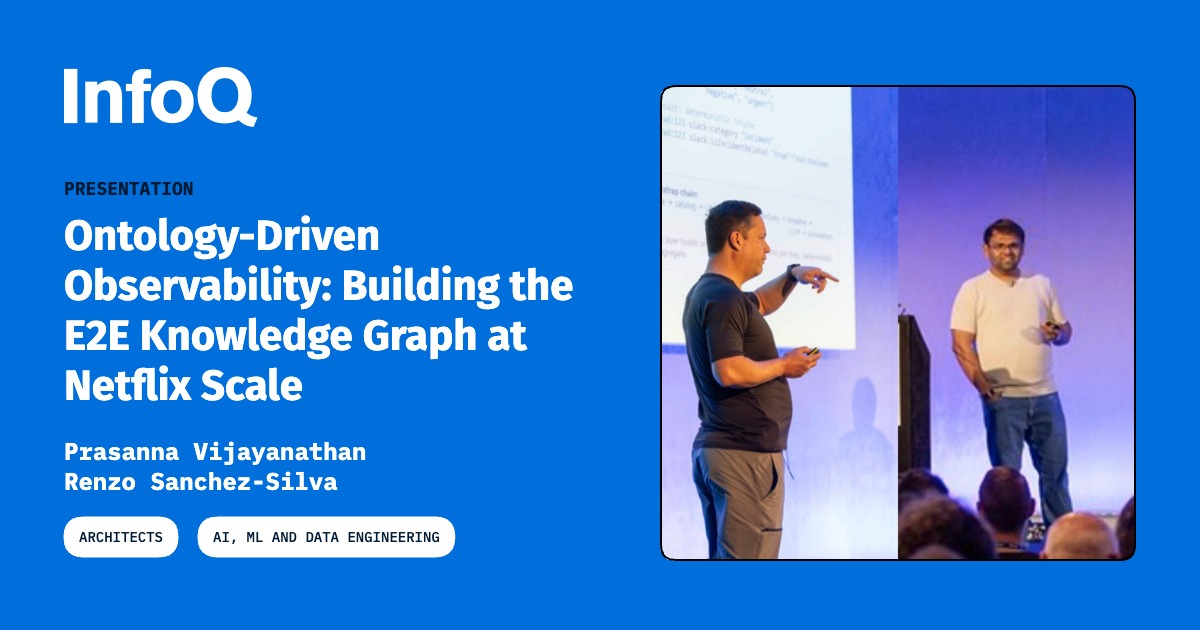
📖 Source: Presentation: Ontology‐Driven Observability: Building the E2E Knowledge Graph at Netflix Scale
Related Articles
Comments (0)
No comments yet. Be the first to comment!