
Netflix Unlocks Live Streaming Efficiency with VBR

Alps Wang
Apr 3, 2026 · 1 views
The VBR Shift: Efficiency Meets Stability
Netflix's adoption of Variable Bitrate (VBR) for all live events, as detailed in their tech blog, represents a sophisticated engineering feat with significant implications for real-time media delivery. The core innovation lies in moving from the predictable but inefficient Constant Bitrate (CBR) to VBR, which dynamically adjusts encoding quality based on scene complexity. This allows for substantial bandwidth savings by using fewer bits for simple scenes and more for complex ones, directly translating to reduced CDN load and potentially fewer rebuffers for viewers. The article effectively highlights the initial challenge: VBR's inherent bitrate variability can mislead capacity planning systems, leading to potential server overload when bitrate spikes unexpectedly after prolonged dips. Their solution – reserving capacity based on nominal bitrates rather than current usage – is a pragmatic approach to maintain system stability while still reaping VBR's efficiency benefits. This demonstrates a deep understanding of the interplay between encoding technology and distributed systems architecture.
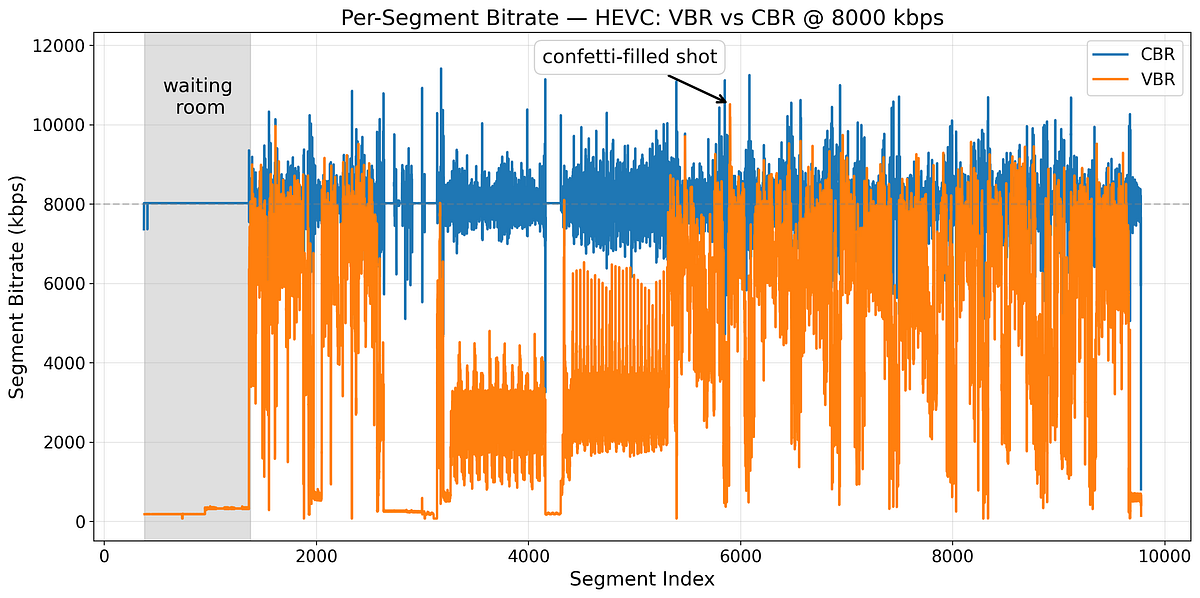
The technical depth is commendable, explaining the QVBR implementation via AWS Elemental MediaLive and the crucial adaptation of their traffic steering logic. The comparison with CBR using the WWE RAW example visually underscores the benefits of VBR. However, a key limitation or area for further exploration could be the long-term impact on encoder processing complexity and the potential for increased latency introduced by more complex VBR decision-making processes, especially for very low-latency live streams. While they mention A/B tests showing improved quality of experience, a more granular breakdown of VMAF improvements across different content types or devices would be valuable. The focus on tuning nominal bitrates to match CBR quality at the lower end of the bitrate ladder is a crucial detail that ensures a smooth transition without sacrificing perceived quality for users with less bandwidth. The future work on using actual segment sizes in adaptive bitrate algorithms on devices and more aggressive capacity reservation shows a forward-looking approach to further optimize the system.
Key Points
- Netflix has transitioned all live events to Variable Bitrate (VBR) encoding, moving away from Constant Bitrate (CBR).
- VBR dynamically adjusts bitrate based on scene complexity, leading to increased efficiency by using fewer bits for simple scenes and more for complex ones.
- This shift results in reduced average bandwidth consumption, lower CDN load, and improved quality of experience (e.g., ~5% fewer rebuffers).
- A major challenge was VBR's unpredictable bitrate swings, which could trick traffic steering systems into overloading servers; this was addressed by reserving capacity based on nominal bitrates.
- Netflix meticulously tuned their VBR bitrate ladder, slightly increasing nominal bitrates on some low-end streams to match CBR quality, while still achieving overall traffic reduction.
- Future work includes integrating actual upcoming segment sizes into adaptive bitrate algorithms on client devices and exploring more aggressive, yet safe, capacity reservations.
📖 Source: Smarter Live Streaming at Scale: Rolling Out VBR for All Netflix Live Events
Related Articles
Comments (0)
No comments yet. Be the first to comment!