
Netflix Boosts Flink Efficiency with Open-Source Autoscaler

Alps Wang
Sep 8, 2026 · 1 views
Operator-Aware Flink Scaling Unveiled
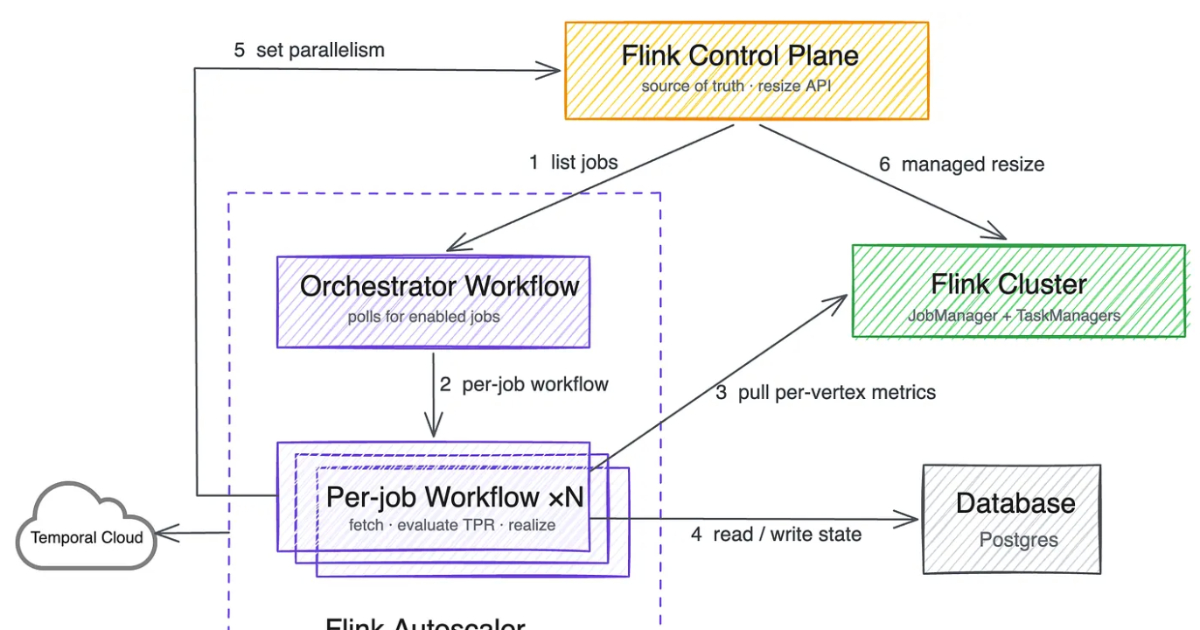
Netflix's move to an open-source, operator-aware Flink autoscaler is a crucial evolution for managing complex, stateful streaming workloads at scale. The shift from a cluster-level to an operator-specific scaling strategy directly addresses the limitations of monolithic scaling decisions, which often lead to over-provisioning or under-utilization in heterogeneous dataflows. The reported 58% reduction in compute expenditure for one team, translating to $1.1 million annually, underscores the substantial economic benefits of this granular approach. By leveraging metrics like True Processing Rate and incorporating insights from FLIP-271 and the DS2 project, Netflix is not just optimizing its internal infrastructure but also contributing valuable patterns to the broader Apache Flink community. The architectural integration with Temporal workflows for isolating autoscaling decisions and modifications to JobManager metric collection demonstrate a deep understanding of distributed system challenges.
However, the integration details also highlight potential complexities. While the approach of preserving forward connected subgraphs is a clever workaround for redistribution issues, it might introduce its own set of trade-offs or require careful monitoring in edge cases. The comparison to generic autoscalers like KEDA is apt; Flink's strength lies in its deep integration with the dataflow graph, a crucial differentiator for stateful stream processing. The lower utilization target (0.45 vs. 0.7) is a pragmatic choice for large, stateful jobs, balancing cost savings with stability, but it implies that the optimal target may vary significantly based on workload characteristics. Future investigations into Flink 2's disaggregated state architecture suggest an ongoing commitment to tackling state recovery costs, a persistent challenge in distributed stream processing. This article serves as a compelling case study for organizations heavily invested in Flink, demonstrating a path toward more efficient and cost-effective operation.
Key Points
- Netflix is adopting an open-source Apache Flink Autoscaler for over 30,000 streaming jobs.
- The new autoscaler focuses on individual operator parallelism rather than cluster-level scaling.
- This operator-aware approach is more effective for complex, stateful pipelines with diverse processing needs.
- One team achieved a 58% reduction in Flink compute expenditure, saving approximately $1.1 million annually.
- The autoscaler uses metrics like True Processing Rate and is described in FLIP-271.
- Netflix integrated the autoscaler with its internal control plane using Temporal workflows.
- Modifications were made to support larger jobs, filter metrics, preserve forward connections, and handle sink backpressure.
- The Flink autoscaler reasons about the internal dataflow graph, unlike generic event-driven autoscalers.
📖 Source: Netflix Moves Toward Open Source Flink Autoscaler for 30,000+ Streaming Jobs
Related Articles
Comments (0)
No comments yet. Be the first to comment!