
MySQL 9.6: Foreign Keys Go SQL, Boosting CDC & Replication

Alps Wang
Mar 1, 2026 · 1 views
SQL Layer Foreign Keys: A New Era
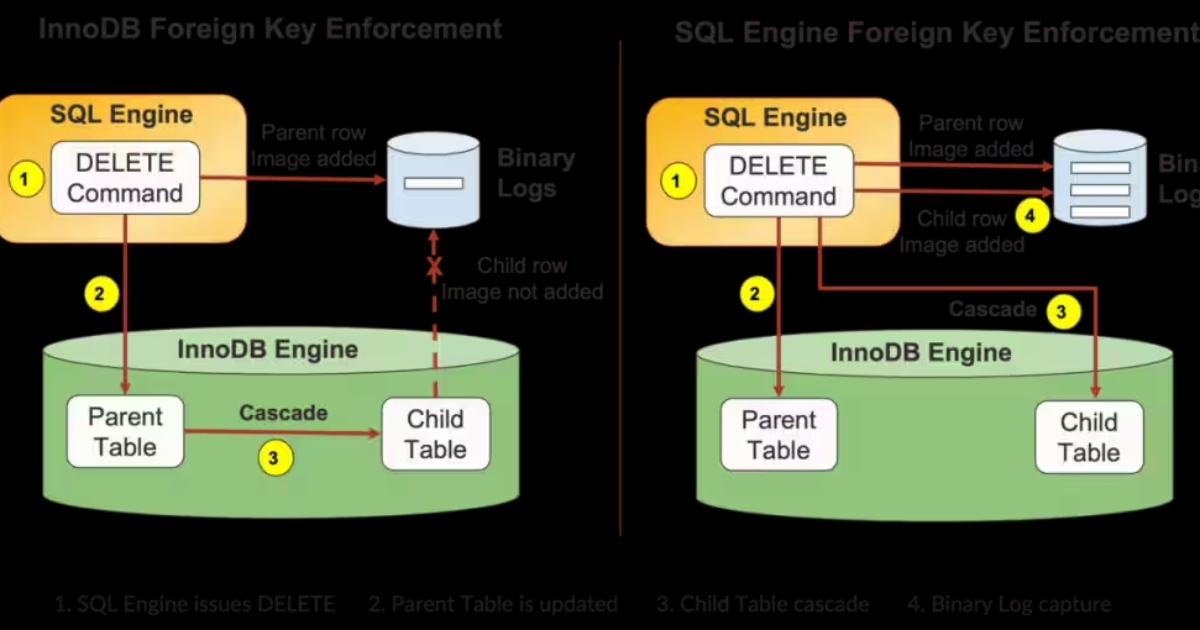
The shift of foreign key constraint and cascade handling from the InnoDB storage engine to the SQL layer in MySQL 9.6 is a fundamental architectural change that addresses a critical pain point for many developers and data engineers. Historically, the inability of the binary log to capture cascade operations performed internally by InnoDB led to significant challenges in maintaining data consistency across replication streams, Change Data Capture (CDC) pipelines, and analytical systems. This limitation often resulted in downstream systems having an incomplete view of data modifications, necessitating complex workarounds or leading to outright data discrepancies. By bringing these operations into the SQL layer, MySQL 9.6 ensures that all data modifications, including those triggered by cascades, are properly logged in the binary log. This dramatically improves the reliability and accuracy of replication and CDC, making MySQL a more robust choice for environments where data integrity and auditability are paramount. The performance benchmarks suggesting 'nearly identical' performance to the InnoDB approach are reassuring, mitigating initial concerns about potential regressions. This change is particularly valuable for organizations leveraging mixed-database architectures or those heavily reliant on real-time data integration and analytics.
However, the article highlights a concerning disconnect in documentation and community engagement. The lack of prominent mention in release notes and the apparent absence of detailed documentation updates, as noted by Evan Elias, are significant drawbacks. For a change of this magnitude, which impacts core database behavior and has direct implications for third-party tools and developer workflows, comprehensive and accessible documentation is crucial. This oversight could lead to confusion, implementation errors, and a slower adoption rate, especially among independent software vendors (ISVs) and developers who rely on clear technical specifications. The community's perception of Oracle's commitment to MySQL's community edition is also a backdrop to this announcement. While the technical advancement is commendable, ensuring transparency and proactive communication with the developer community is equally important for fostering trust and sustained innovation. The promise of future support for triggers on cascaded changes and enforcement for additional storage engines indicates a roadmap for further development, which is positive, but the immediate need for clarity around the current release is apparent.
Key Points
- MySQL 9.6 shifts foreign key constraint and cascade handling from the InnoDB storage engine to the SQL layer.
- This change ensures that cascade operations are logged in the binary log, improving replication accuracy and CDC pipeline reliability.
- Previously, cascade operations were internal to InnoDB and not visible to the binary log, leading to data inconsistencies in downstream systems.
- Benchmarking indicates that the performance of SQL-layer enforcement is comparable to the InnoDB approach, with no observable regression.
- Concerns exist regarding the lack of prominent documentation updates for this significant change, potentially impacting developer adoption and understanding.
- This enhancement addresses a long-standing limitation for MySQL users, making it more suitable for complex data integration and analytical workloads.
📖 Source: MySQL 9.6 Changes Foreign Key Constraints and Cascade Handling
Related Articles
Comments (0)
No comments yet. Be the first to comment!