
Multi-Tenant Config: DynamoDB & Parameter Store Synergy

Alps Wang
Apr 9, 2026 · 1 views
Optimizing Multi-Tenant Configuration at Scale
The AWS Architecture Blog post provides a robust and well-articulated solution for managing multi-tenant configurations, tackling critical challenges like cache staleness and scaling metadata services. The tagged storage pattern, leveraging DynamoDB for high-frequency tenant-specific data and Parameter Store for static shared parameters, is a clever approach. The integration of the Strategy pattern for flexible backend selection and the event-driven refresh mechanism with EventBridge and Lambda are particularly noteworthy for their ability to deliver real-time updates with zero downtime. The emphasis on extracting tenant context solely from validated JWT tokens is a strong security practice, mitigating risks of data leakage. This is a significant contribution for architects and engineers building complex, distributed SaaS applications.
However, while the article highlights the benefits, a deeper dive into the operational overhead of managing this multi-service architecture could be beneficial. The introduction of gRPC, NestJS, ECS, Fargate, API Gateway, WAF, Cognito, EventBridge, and Lambda, while powerful, introduces a considerable set of services to deploy, monitor, and maintain. For smaller teams or less complex multi-tenant scenarios, this might represent over-engineering. Furthermore, the 'multi-dimensional tenant context' section, while offering advanced capabilities, could benefit from more concrete examples of its implementation and the associated query performance implications. The trade-offs between this sophisticated setup and simpler, potentially less performant, alternatives for less demanding use cases would be valuable to explore.
Ultimately, this article offers a compelling blueprint for building a highly scalable and resilient multi-tenant configuration system. It's a testament to modern cloud-native architectural patterns, demonstrating how to combine various AWS services effectively to solve complex problems. Developers working on large-scale SaaS platforms, especially those dealing with rapidly changing tenant-specific configurations and stringent uptime requirements, will find immense value in this detailed walkthrough. The architecture promotes flexibility, allowing for future expansion with new storage backends, and prioritizes performance and security, making it a highly relevant piece of technical content.
Key Points
- The article presents a multi-tenant configuration system architecture on AWS that addresses challenges of rapidly changing tenant metadata and scaling metadata services.
- It utilizes a 'tagged storage pattern' to route configuration requests to appropriate AWS storage services like Amazon DynamoDB (for tenant-specific, high-frequency access) and AWS Systems Manager Parameter Store (for shared, hierarchical parameters).
- The solution employs the Strategy pattern for flexible storage backend switching, allowing easy addition of new backends.
- Tenant isolation is enforced by extracting tenant context from validated JWT tokens, never from request parameters.
- An event-driven auto-refresh mechanism using Amazon EventBridge and AWS Lambda enables real-time, zero-downtime configuration updates, solving the cache TTL problem.
- The architecture leverages gRPC for high-performance, type-safe service-to-service communication.
- DynamoDB schema uses composite keys (TENANT#{tenantId}, CONFIG#{configType}) for efficient tenant-scoped queries and isolation.
- Parameter Store uses a hierarchical path structure for bulk retrieval and versioning.
- Advanced multi-dimensional tenant context is discussed for finer-grained access control beyond tenant-level isolation.
- A multi-layer caching strategy is implemented, with application-level caching for high-frequency data and in-memory caching with event-driven invalidation for shared parameters.
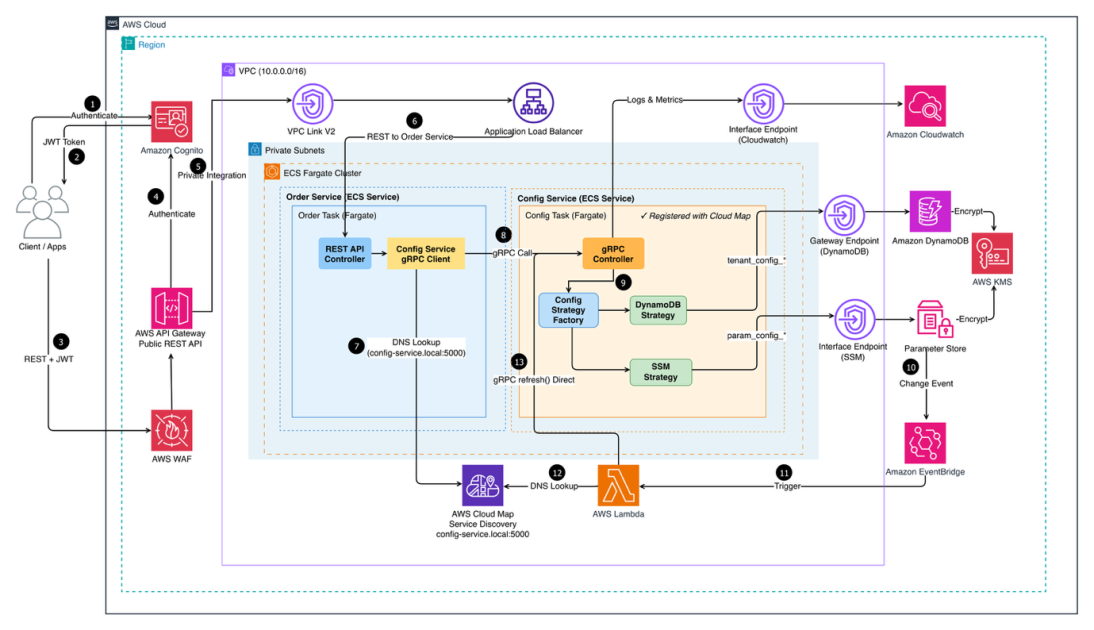
📖 Source: Build a multi-tenant configuration system with tagged storage patterns
Related Articles
Comments (0)
No comments yet. Be the first to comment!