
Microservices & AI: Modernizing Legacy Software

Alps Wang
Feb 24, 2026 · 1 views
Evolving Legacy with Microservices & AI
The podcast episode with Chris Richardson offers a highly practical perspective on the monumental task of modernizing monolithic legacy systems through microservices. A key insight is the emphasis on 'fast flow' and its direct correlation with business agility in today's volatile environment. Richardson correctly identifies that the root of many modernization challenges lies not just in code, but critically in the data model. The difficulty in splitting monolithic data schemas is a significant hurdle, often necessitating a phased approach with eventual consistency, which gradually diminishes as the architecture matures. This pragmatic advice, backed by years of experience, is invaluable for organizations struggling with outdated, unmaintainable systems.
While the discussion touches upon the potential of Generative AI (LLMs) to aid in understanding existing codebases, it rightly tempers expectations regarding their role as full-fledged architects. The limitations of LLMs in reasoning and handling the inherent ambiguity of requirements make them tools for assistance rather than autonomous decision-makers in system architecture. This nuanced view is crucial. The article also highlights a valid concern about greenfield development: the prolonged time to market and validation can lead to building the wrong product, underscoring the strategic advantage of evolving existing systems. The podcast effectively bridges the gap between architectural theory and real-world implementation challenges, making it highly relevant for practitioners.
One area that could be further elaborated upon is the specific tooling and methodologies for data model decomposition. While Richardson mentions the complexity, detailing common patterns or anti-patterns for tackling this would enhance the practical applicability. Additionally, a deeper dive into how AI can assist in identifying service boundaries beyond code comprehension – perhaps in analyzing data access patterns or business domain logic – could offer more concrete use cases. Despite these minor points, the conversation provides a robust framework for approaching legacy modernization, emphasizing that it's a journey of continuous evolution rather than a one-time migration, heavily reliant on organizational structure (Team Topologies) and development methodology (DevOps).
Key Points
- Monolithic architectures are difficult to evolve, often built on outdated technology and difficult to maintain due to dependencies and retiring expertise.
- Microservices enable modernization by facilitating 'fast flow' and rapid software delivery, crucial for business agility in volatile environments.
- Modernization efforts often start with analyzing and splitting complex monolithic data models, frequently requiring eventual consistency scenarios initially.
- Greenfield development isn't always superior; delaying product validation for years increases the risk of building the wrong product.
- Generative AI (LLMs) can assist in understanding existing codebases but are not yet feasible as autonomous architects due to limitations in reasoning and ambiguity handling.
- Evolving architecture to support DevOps and Team Topologies is essential for achieving rapid software delivery.
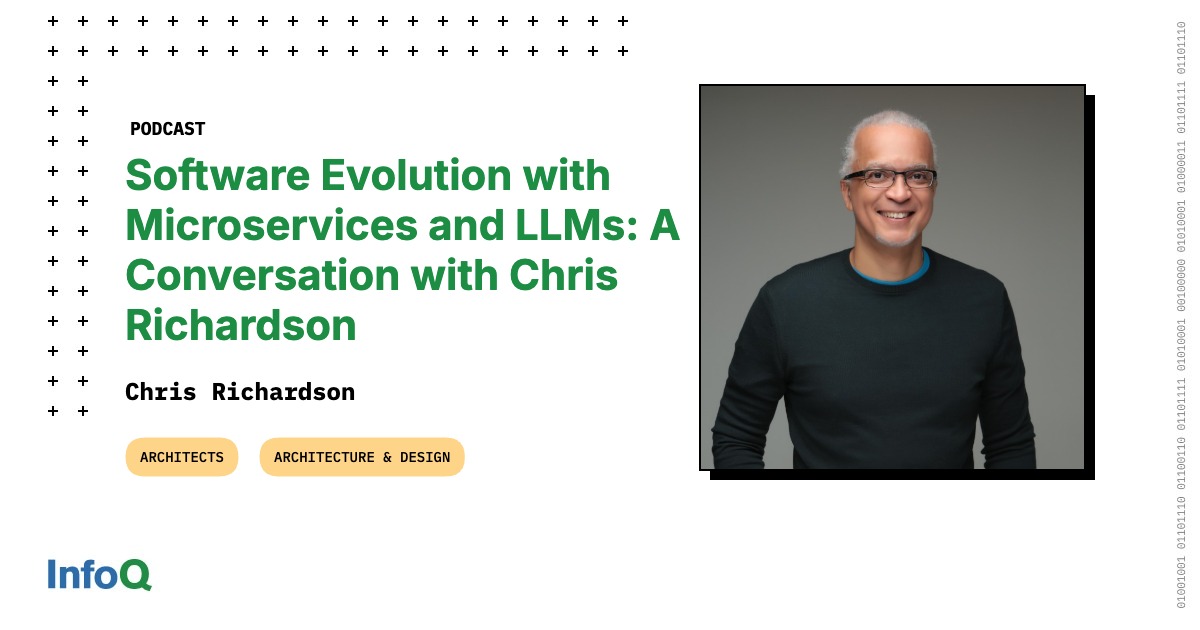
📖 Source: Podcast: Software Evolution with Microservices and LLMs: A Conversation with Chris Richardson
Related Articles
Comments (0)
No comments yet. Be the first to comment!